
01 June 2025
Help the environment and boost farm profits
Over 17,000 farmers are working with Teagasc’s Signpost Advisory Programme to reduce greenhouse gas emissions, Tom O’Dwyer, Head of Teagasc Signpost Programme, and George Ramsbottom, Teagasc Signpost Advisory Programme Manager, tells us more.
The Teagasc Signpost Programme has three parts. Firstly, a network of 125 ‘Signpost Farms’, which adopt research-based climate mitigation strategies and share their knowledge through farmer-to-farmer learning. The second component is the Signpost Advisory Programme. Advisors visit farms on request and work with farmers to calculate the farm’s greenhouse gas (GHG) emissions. They do this using the AgNav computer programme, which combines data from Teagasc, the Irish Cattle Breeding Federation, and Bord Bia. They then help the farmer to create a plan of actions to reduce those emissions. The twenty advisors are targeting a total of 50,000 farmer participants.
The third component is the National Agricultural Soil Carbon Observatory (NASCO), an on-farm research initiative focused on understanding soil carbon sequestration (capture and storage). The Signpost Farms play a vital role in NASCO, contributing to the research that will shape future climate action strategies.
AgNav
Teagasc’s Signpost Climate Advisors use AgNav to estimate the impact of actions taken on GHG emissions reduction. Examples are listed in Table 1.
Table 1: The impact of actions taken on example dairy and drystock farms
| Farm type | Action | Change in farm GHG emissions |
|---|---|---|
| Intensive dairy farm | Switching fertiliser N type1 | 8.4% reduction |
| Reducing fertiliser N by approx. 1/32 | 4.4% reduction | |
| Intensive suckler to finishing farm | Switching fertiliser N type | 2.6% reduction |
| Reduce slaughter age by one month | 1.6% reduction | |
| Reduce cow age at first calving3 | 5.5% reduction |
The reduction in GHG emissions is higher on a dairy farm because of the greater reliance on fertiliser N to support forage production. Reducing age at first calving was the single most impactful action on the suckler farm. All actions examined will reduce production costs potentially increasing profit. Sadly, there is no magic solution, and multiple actions are necessary on individual farms to significantly reduce GHG emissions.
Greenhouse gas emissions trends
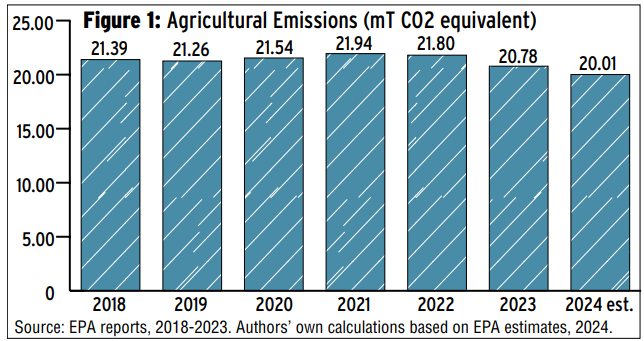
Compared to the base year 2018, national greenhouse gas emissions from agriculture rose between 2020 and 2022 but declined in 2023 and are estimated to have declined further in 2024 as illustrated in Figure 1.
A reduction in fertiliser N use was responsible for much of the recent decline in GHG emissions. The challenging goal for the agriculture sector is to reduce 2018 Greenhouse Gas emission levels 25% by 2030.
Three of the most widely selected actions by farmers in Signpost are:
- Greater use of NBPT protected Urea
- Between 2018 and 2024, protected urea application increased from 1% to 18% of fertiliser N used nationally. The goal is to increase protected urea use to 90%.
- Lime application
- Lime application increased from 1m tonnes in 2018 to 1.6m tonnes in 2022 but declined to 1m tonnes used in 2023 and 2024 possibly because of adverse weather in both years. Teagasc aims to increase the quantity of lime spread to 2.5m tonnes nationally.
- Clover
- Over 20% of farmer participants in the Signpost Advisory Programme plan to incorporate more clover into their swards. This will allow them to reduce fertiliser N. Of the three most frequently selected actions, this is potentially the most challenging. It requires excellent grassland management and optimal soil fertility.
Figure 1: Agricultural Emissions (mT CO2 equivalent)
Industry partnership
Over 1,000 one-to-one consultations have been held as part of the Dairygold-Teagasc Environmental Partnership through the Grassroots Sustainability Programme. The programme helps Dairygold suppliers improve their environmental footprint by updating farmers on nutrient balance and greenhouse gas emissions using the AgNav system.
Advisors also discuss water quality risks present on farms and create action plans to reduce nutrient loss, emissions and improve biodiversity. Nearly 95% of Dairygold’s dairy suppliers are participating in the programme. Similar collaborations are being finalised with other milk processors.
The GHG emissions coming from Irish agriculture are heading in the right direction. We encourage all farmers to attend the events that will take place throughout 2025 on Signpost Farms and to join the Signpost Advisory Programme to establish a plan for their farm to cut costs and reduce emissions. If you are interested contact your local Teagasc office which will put you in contact with a Signpost advisor.
More information
The Teagasc Signpost Programme was launched in 2021 and has over 60 partners including milk and meat processors, farm organisations, the Department of Agriculture, Food and the Marine, and Bord Bia. For more information on the programme, visit Teagasc’s Signpost Programme.
The above article first appeared in the May/June edition of Today’s Farm. For further insights, access the full edition of Today’s Farm here.