
How can we make Irish beef even more valuable?
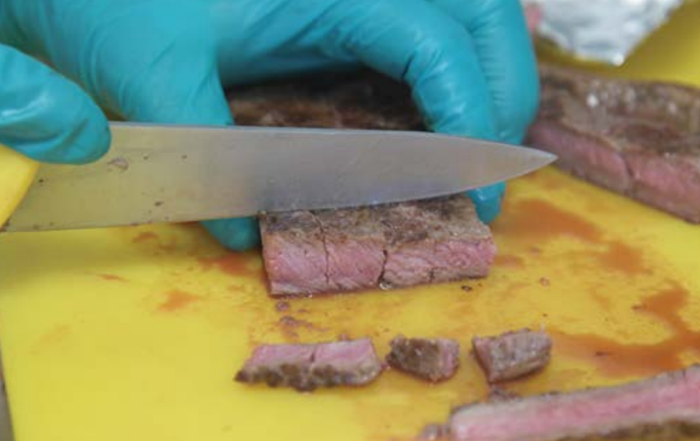
Teagasc scientists are developing techniques to ensure consumers have the optimum eating experience and farmers get paid for the high quality of their product. Through a recent Today’s Farm article, Mary Ann Kent, Meat Science Technologies, explains how provable, predictable, tenderness and flavour in beef will benefit both farmers and consumers.
Irish beef is known around the world for its quality. This is thanks to our grass-based farming system where cattle can spend most of the year outdoors, producing beef sustainably, while also being flavoursome and nutritious. The big question is how can we make Irish beef even more valuable and secure the best possible price for our beef. Proving that our beef is worth the very highest prices is a challenge.
“The measures of quality are tenderness and flavour,” said JingJing Liu, a researcher at Teagasc Ashtown Food Research Centre. “A key issue for customers is consistency; if we want to achieve the top prices on world markets, we need to be able to guarantee that a piece of meat will be both flavoursome and tender.”
The aim of beef researchers at Teagasc Ashtown and across Europe is to develop an eating quality prediction system. This is still some way off. Meat Standards Australia can currently reliably predict the eating quality of beef produced there. This is primarily due to the extensive consumer-based research underpinning the system, combined with large datasets that link animal, carcass, processing, and sensory information to eating quality outcomes.
Intramuscular fat (marbling) is one of the key factors associated with improved eating quality, particularly juiciness, flavour and overall palatability. As a result, heifers often produce meat that is perceived as more tender, juicy, and flavoursome than that from steers or bulls, partly due to their greater propensity to deposit fat.
Breed also influences fat deposition, with breeds such as Angus and Wagyu generally exhibiting higher marbling levels than many continental breeds.
“Consumer preferences and production systems in Europe differ from those in Australia,” said JingJing. “So we need our own system. Greater predictability of beef quality should lead to consumers in Europe choosing beef more often or paying a higher price for higher eating quality.”
In the meantime, Teagasc researchers are monitoring the impact of changes in production methods, such as earlier age at slaughter, on eating quality. At Teagasc Ashtown experienced ‘tasters’ evaluate meat from various breeds and production systems. They also evaluate techniques such as dry aging which are used to enhance quality.
What is dry ageing?
Dry aging involves storing beef without packaging under controlled conditions (typically 0 – 4 °C and 75 – 85% relative humidity) for between 14 to 35 days. During this time, two key things occur: meat losses moisture, concentrating flavour, and tenderisation through the breakdown of protein.
Dry-aged beef is sold at a premium price as it produces a premium flavoured product, and flavour is increasingly recognised as a key driver of consumer perception of meat quality. However, it reduces saleable yield and promotes crust formation.
Research carried out at Ashtown has found that the rate of moisture loss is influenced by the shape and size of muscle being aged, whereby smaller, thinner cuts lose moisture faster than larger cuts. This means processors can use the shape of the meat being dry aged to better predict and control the dry ageing process, helping to balance meat quality and yield reductions.
Can we improve or accelerate the dry-aging process?
While we can control the shape and size of the beef being dry-aged, innovative technologies such as high pressure processing have also been investigated as a potential method to accelerate dry aging.
High pressure processing has been found to have the potential to accelerate the dry aging process by scientists in the Food Research Centre in Ashtown, however, this must be carefully controlled. If pressure levels or treatment durations are too high, this can negatively affect key quality traits of beef such as tenderness, colour and lipid oxidation.
What actually happens in the meat throughout dry aging?
Moisture loss is a key driver of characteristic flavour development in dry-aged beef, as it concentrates proteins, fats, and flavour precursors within the muscle.
In parallel, lipid oxidation and other biochemical reactions contribute to the formation of key aroma compounds, while naturally occurring enzymes present in meat break down muscle proteins over time and therefore, tenderise the beef. The combination of these two processes produces a premium, tender beef product with a more intense, complex flavour.
The role of innovative technologies
The use of post-mortem interventions such as Ultra Violet (UV) light and high pressure processing have been studied to see how they affect dry aging. UV treatment has been found to influence changes at the initial stages of dry aging, however, these effects diminish over time.
Dry aging has potential to increase the value of Irish grass-fed beef by enhancing its flavour and tenderness. While a balance between a higher quality, premium product must be balanced between weight loss and processing costs, the research carried out in Teagasc so far has provided a deeper understanding of the underlying mechanisms behind dry aging, helping to identify how the process can be better controlled and quality optimised.
While an emphasis has been placed on dry aging in recent years, other areas of research in the areas of meat are also ongoing in the Teagasc Food Research Centre, in areas such as digitalisation, meat quality prediction and beef product optimisation.
Senior Teagasc Researcher, Ruth Hamill said: “Digital technologies such as Artificial Intelligence, computer vision and robotics are revolutionising many industrial sectors, but applications in the food sector have been challenging. For example, in meat, the great natural variability among beef animals across the industry means ‘one size does not fit all’ in terms of automation.
“Now we are evaluating the potential of contemporary AI, with sensors and computer vision for their relevance to support the sector to make best use of our precious natural resources, enhance consistency in the final product, and reduce waste and improve sustainability of meat processing”.
The ultimate goal is to reduce waste and drive the optimum outcome for farmers, the agri-food chain and consumers.
The above article first appeared in the July-September edition of Today’s Farm. For more on Today’s Farm, visit here.