
14 March 2025
How do I prevent negative energy balance?
Dr. Joe Patton and Dr. Aisling Claffey have prepared a Q&A document to aid farmers in ensuring their spring-calving cows’ nutritional needs are met in the early lactation period. Below, they focus on negative energy balance and the factors that influence it.
Negative energy balance (NEB) in early lactation measures the difference between energy intake and energy required for maintenance, activity and milk. Some degree of NEB is inevitable in early lactation because the intake capacity of the rumen is not sufficient to meet the rapidly increasing energy demands of the cow to produce milk.
If NEB is too severe then excess body condition score (BCS) loss will occur which has detrimental effects on fertility, lameness and general herd performance. A typical target is to keep BCS loss to less than 0.5 units in the first 10-12 weeks of lactation (ideal BCS profile is calving at 3.25 and minimum 2.75 at breeding); therefore, the energy balance deficit should be no more than 1.0 UFL per day on average in early lactation.
We can minimise the duration and the severity of this period of NEB, and therefore the rate of BCS loss, by ensuring that the cow is optimally fed during this period. This means getting grass in to the diet as much as possible, monitoring residuals and ensuring grass deficits are met with high-energy ingredients.
Across a number of early grazing studies, a 13-14kg DM grass allowance plus 3-4 kg high energy concentrate offered daily during the early lactation period has been sufficient to ensure a good energy balance profile. When grazing conditions are good, high levels of utilisation can be achieved at grass, which helps maintain grass quality in subsequent rotations, however, it should not come at the expense of total DMI, therefore a post-grazing residual of 3.5 to 4 cm is considered optimal during the first rotation. If grass availability is below target, high quality forage should be included early in the season and if grass availability is ahead of target concentrate feed levels should be reduced in order to increase grass intake.
Cows are losing a lot of body condition even though meal feeding rates are high. What can be done?
Rate of body condition loss in early lactation is a function of BCS at calving, quality of diet in the early lactation period, and herd genetics. The dry period diet and duration should ensure that cows calve down at a BCS of 3.0 to 3.25, often described as ‘fit but not fat’. Cows that have excess body condition at calving (3.5+) have inevitably a greater risk of BCS loss, and metabolic issues such as milk fever and ketosis. It is therefore critical to monitor BCS from late lactation, through the dry period and to limit the daily energy intake of later-calving cows in particular.
Increased concentrate feeding in early lactation will typically result in increased milk yield output, substitution of the lower cost forage as well as reduced efficiency of digestion in the rumen as the proportion of concentrate increases. Therefore, there is limited scope to arrest a drop in BCS by feeding extra concentrate alone, if forage quality or allowance is inadequate.
Ensure cows are getting an appropriate and increasing allocation of forage, by monitoring post-grazing residuals, as dry matter intakes increase throughout early lactation. Where BCS of individual animals is very low (BCS 2.5 or less), these animals should be considered for once a day milking to reduce energy demand for milk, whilst maintaining a high plane of nutrition to the animal.
Impact of genetics
It is important also to consider the effect of herd genetics on BCS profiles. While much focus is given to feeding rates, it is also the case that some herds have a genetic makeup that makes retention of BCS in early lactation BCS more difficult. Such cow types have a predisposition to mobilise body reserves after calving and to partition a higher proportion of their daily energy intake to milk at the expense of BCS, meaning they are genetically thinner all through lactation and are more prone to a whole range of metabolic and other issues.
Figure 1: Effect of herd genetics on BCS profile in a pasture based system
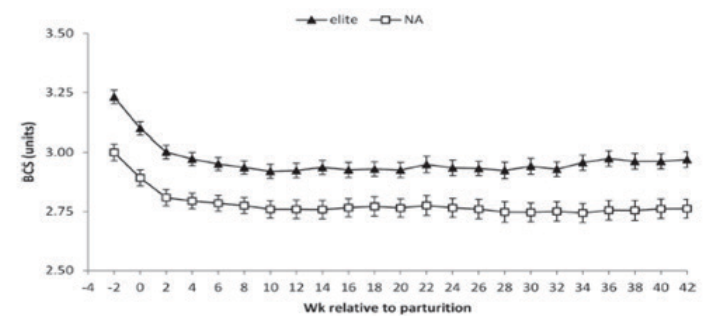
This is illustrated in Figure 1, where the BCS of elite EBI versus national average EBI animals are compared on an identical diet; higher EBI cows produced more milk solids but also held BCS better through lactation. This has proven knock-on effects on fertility. Importantly, feeding extra concentrate pre-breeding has shown little to no beneficial effect on fertility in low EBI herds, because it has relatively little effect on key metabolic profiles and BCS. If your herd is routinely struggling to meet BCS and fertility targets, make sure to review EBI profiles and set targets for fertility sub-index of >€120 for sires used.