
How summer drought impacts our native ash trees
Research conducted by the E-PATH project and Teagasc’s Forestry Development Department is shedding new light on how native ash trees respond to the combination of stress from summer drought and ash dieback disease, Bailey Parkhouse, Teagasc Walsh Scholar and PhD Researcher, tells us more.
The E-PATH project is the first of its kind, integrating ecological forecasting tools and cutting-edge field data to predict the resilience of ash trees impacted by ash dieback disease in Ireland.

2026 as the hottest summer on record
Recently published data from the European Union’s Copernicus Climate Change Service Data show that the summer of 2026 was the warmest on record for western Europe, surpassing the long-standing record set in 2003.
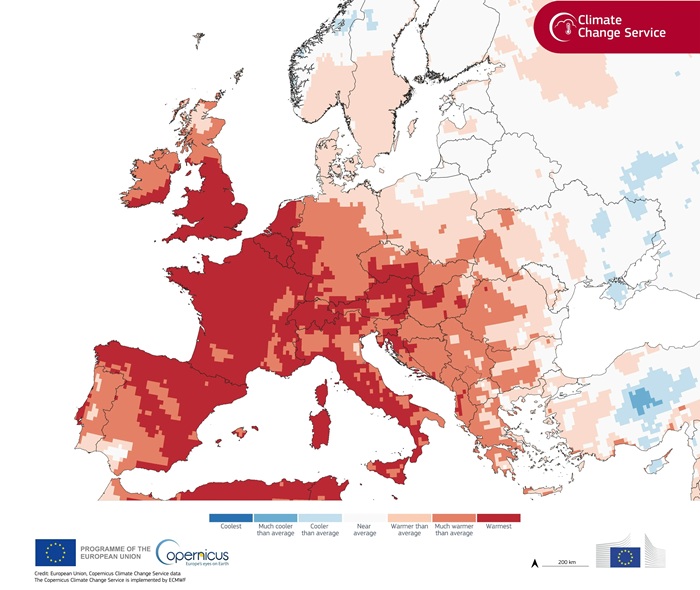
Figure 1: The European Union’s Copernicus Climate Change Service Data western Europe heat map
A succession of exceptionally early, persistent and intense heatwaves across the region characterised the season. Ireland was no exception. Summer 2026 was the hottest on record since records began 127 years ago, with temperatures reaching over 25°C. These unprecedented climatic conditions could have a significant impact on trees in Ireland, however, these impacts remain largely unknown.
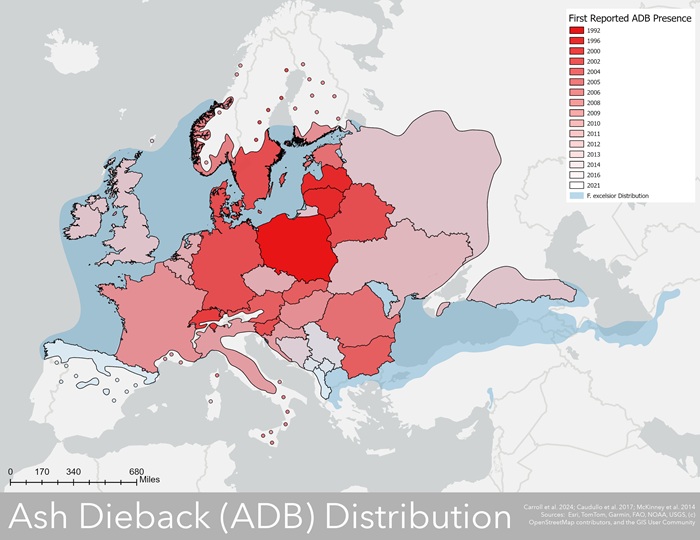
Native common ash (Fraxinus excelsior) populations across Europe are experiencing severe declines due to ash dieback disease, caused by the invasive fungal pathogen Hymenoscyphus fraxineus. The disease can kill up to 80% of ash trees where present, subsequently affecting many species of plant, fungi, lichens and animals that rely diretly or indirectly on ash. The E-PATH project combines field observations with molecular approaches to understand how disease and drought stress impact these native trees.
How summer drought impacts our native ash trees
Teagasc PhD student Bailey Parkhouse and Senior Research Officer Dr. Dheeraj Singh Rathore, in collaboration with Trinity College’s Dr. Carmen Watkins and Dr. SIlvia Caldararu, used the drought conditions this past summer as an opportunity to monitor local ash populations’ health and short term recovery from drought.
Using the Teagasc Oak Park ash gene bank, they recorded the health status of 30 Irish ash trees for two weeks during, and one week after, the summer drought. Tree health status is reflected through their photosynthesis, which represents sugar production and water use. The subsequent data is the first of its kind collected on Irish ash trees.
Excitingly, many Irish ash populations proved resilient to drought despite active disease presence, with the healthiest of infected trees recovering sugar production after drought. Unfortunately, approximately 40% of the most diseased trees were negatively impacted by the drought conditions. The research team further found that the inability to recover from drought is defined by specific genotypes, indicating certain trees are more likely to suffer following severe drought.
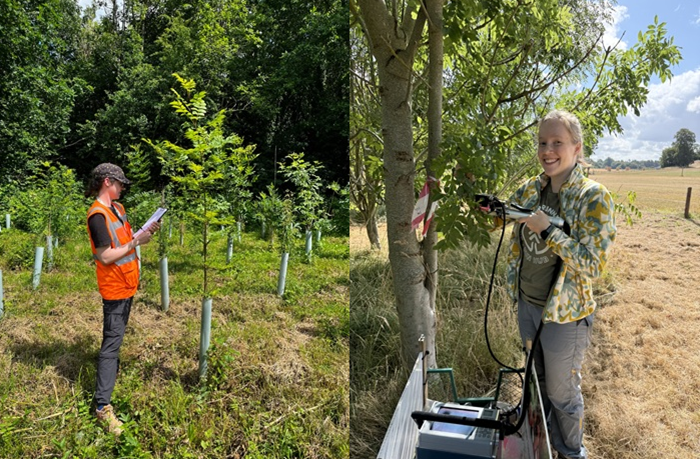
Bailey Parkhouse disease scoring ash dieback on a young ash tree (left). Dr. Carmen Watkins collecting photosynthetic drought data July 31st, 2026 in Oak Park’s ash gene bank (right).
Understanding the changing climate and ash dieback
The collaborative E-PATH project aims to integrate ecological forecasting tools and cutting-edge field data methods to predict tree health in response to ash dieback at a local scale in Ireland. The project will therefore incorporate these summer drought results with climatic data to further develop a computer model to predict tree health based on key tree processes, including energy, sugar production, water uptake and growth. This model will be used as a predictive tool for ash breeding and future restoration efforts.
This research will improve our understanding of how native ash trees respond to the combined pressures of ash dieback and drought, helping to inform current and future management efforts. Ultimately, the E-PATH project represents an important step towards protecting Ireland’s native ash trees and ensuring the long-term survival of the species in a dramatically shifting climate.
To learn more about the Teagasc’s forestry research, or to report a healthy ash tree as part of the AshforFuture citizen science initiative, visit: Forestry Research – Report a Healthy Ash Tree.
Resources:
- European Union (2026) Western Europe affected by warmest summer on record. EU Space Policy. Available at: EU Space Policy (Published: 12 September 2026).
- Met Éireann (2026) Climate Statement for Summer 2026. The Irish Meteorological Service. Available at: Met Éireann .
- Carroll, J. (2024) Ash dieback: From Asia to Europe. Plant Pathology. Wiley Online Library. https://bsppjournals.onlinelibrary.wiley.com/doi/10.1111/ppa.13859