
01 June 2024
How using lime can reduce Greenhouse Gas emissions
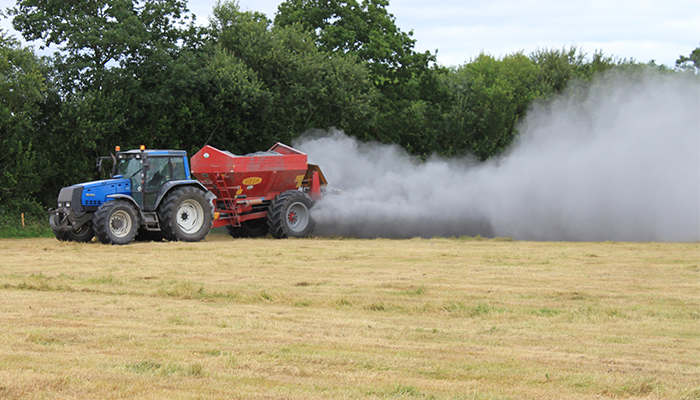
Mark Plunkett, Teagasc Signpost Programme Training & Development Specialist, and Aisling Molloy, Teagasc Future Beef Programme Advisor, explain how using lime can reduce Greenhouse Gas emissions.
Considerable progress was made improving soil pH through liming from 2012 to 2018. However since then, across both dairy and beef enterprises we have seen a significant increase in the proportion of soils that have low pH, requiring lime. Any soil below pH 6.2 needs lime. Just under two-thirds (65%) of soils on cattle farms having a soil pH less than 6.2. The equivalent figure on dairy farms is almost half (50%) below 6.2.
What are our targets for lime use to help achieve our emissions targets? The Teagasc Marginal Abatement Cost Curve (MACC) aims to assist farmers and the Agriculture industry to reduce Greenhouse Gas (GHG) emissions. It sets out targets for levels of lime usage which will assist in GHG reduction on farms.
In 2022 Irish farmers applied 1.4 m tonnes of time. This fell to ~ 0.7 m tonnes in 2023 (Industry estimate) due to limited opportunities to apply lime as a result of adverse weather conditions. The MACC target is to use 1.75 m tonnes of lime per annum up to 2025 and 2.5 m tonnes per annum to 2030.
We are significantly behind these targets and increased emphasis on liming is needed to redress the situation.
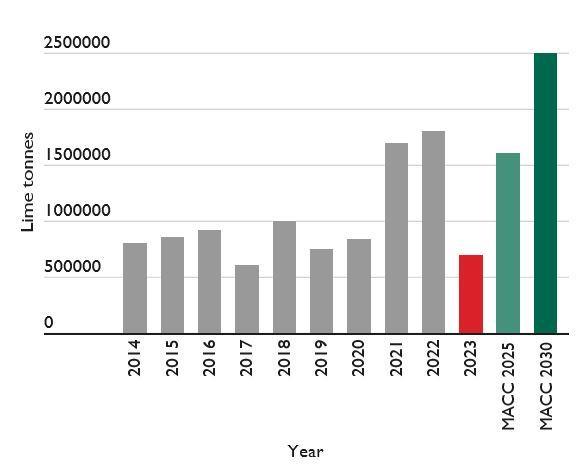
Figure 1: Lime usage since 2018 and MACC lime targets up to 2030
How does lime reduce Greenhouse Gas emissions?
Lime helps reduce Greenhouse Gas emissions in two ways;
Research at Teagasc Johnstown Castle has shown that increasing soil pH by liming results in a significant reduction of nitrous oxide (N2O) emissions and increased grassland productivity compared to the un-limed plots under the same management and fertiliser regime. The degree of reduction in N2O emissions mainly depended on the amount of lime applied. When soil pH was increased to 6.9, N2O emissions were reduced by 39% compared to a control soil at pH of 5.0. The long-term results showed that the highest grass yields were achieved when liming was combined with regular Phosphate application. Plots limed to above pH 6.0 had 0.5 t/ha higher dry-matter yields. The yields in limed plots with optimal P content (P Index 3) had an even better outcome . On average they delivered 1.5 t/ha higher yields compared to un-limed soils with P Index 1.
Applying chemical nitrogen releases N2O, which is a big contributor to emissions from farming. By getting soil pH right, up to 70kg of nitrogen per hectare can be made available in the soil… at no cost. If nitrogen availability in the soil is increased by liming, you will need to apply less chemical nitrogen and as a result farm emissions will decline.
So, does lime contribute to Greenhouse Gas emissions?
Yes in the year that lime is applied short term emissions can rise. For every one tonne of lime applied, 0.4 t CO² equivalent is emitted but the benefits of this lime in terms of releasing N in the soil far outweigh this loss over time.
What contribution does reducing chemical N use make to achieving our emissions target?
We know from the Teagasc MACC that by reducing chemical N by 25% we can reduce total emissions by 0.5 Mt or 11% of the total reduction needed. This can be achieved, without yield reduction, as a result of correcting soil pH through lime application, making better use of slurry, incorporating clover and optimising soil P & K.
What is the return on investment for liming?
- Research shows an average grass production response of ~1.5 t DM/ha from lime alone.
- This is worth ca. €181/t DM on a dairy farm and €105/t DM on a drys- tock
- An investment of €30/ha to maintain soil pH in the optimum range returns €150/ha
- This represents a return of €5 – 10 for every €1 invested in lime.
Case study: The impact of spreading lime
Eamon and Donnchadh Carigeen, Glendine, Co Waterford took soil samples on their farm in winter 2021. The results showed that only 32% of the farm had a soil pH of over 6.2. Their nutrient management plan showed that Eamon and Donnchadh needed to spread 133t of lime.
“We decided to spread all of this in autumn 2022 so that it would start working in the soil,” says Eamon. “Spreading at that time of the year avoided any potential nitrate losses through spreading slurry or preservation issues when cutting silage. We spread a total of 134t at a cost of
€29/t. We spread all of it because it was needed and we could afford to do it that year. I was expecting to get an increase in the soil PH and phosphorus indexes but did not expect it to happen so quickly and did not expect the level of the growth response either.”
Soil samples
Soil samples have since been taken in spring 2024 and these show the impact that the lime has had. The percentage of the farm with a soil pH over 6.2 has increased to 95%. The lime has also released background phosphorus that was locked up in the soil, and the percentage of the farm in Index 3 or 4 for P has jumped from 38% to 79%.
Eamon and Donnchadh measure grass on their farm and growth has increased by 2.6t DM/ha from 2022 to 2023 as a result. Eamon says: “I have spread lime in the past and sometimes saw that the grass was greener but at other times wasn’t sure if it worked. Now that we are measuring grass I have figures from PastureBase and the soil sample results prove that it worked.
“In previous years I have had to feed silage during the summer to cows and calves at grass but in 2023 I didn’t need to. Growing the extra grass has also helped to increase our silage stocks and has really taken pressure off this year with the late spring. The benefits to my farming system have definitely shown it was a necessary and valuable thing to do.”
When should lime be applied?
Prepare a farm liming plan to identify where lime is It will indicate when, and at what rate, lime should be applied. Lime can be spread all year round.
How often should lime be applied?
- Apply lime often as per the soil test
- On very acidic soils apply 50% now and the remainder in two years’
- Apply lime to 20% of the farm annually
How do I handle lime on high molybdenum (Mo) soils?
- Soils with high molybdenum (Mo) status may give rise to copper deficiency in grazing animals.
- Increasing soil pH above 2 increases Mo availability.
- To reduce elevated Mo levels maintain a somewhat lower soil pH of 0 to 6.2. Avoid applying lime to species rich grasslands in order to maintain swards species biodiversity.
This article first appear in the May/June edition of Today’s Farm. Access the full publication here.