
How windthrow is the biggest threat to Irish forests
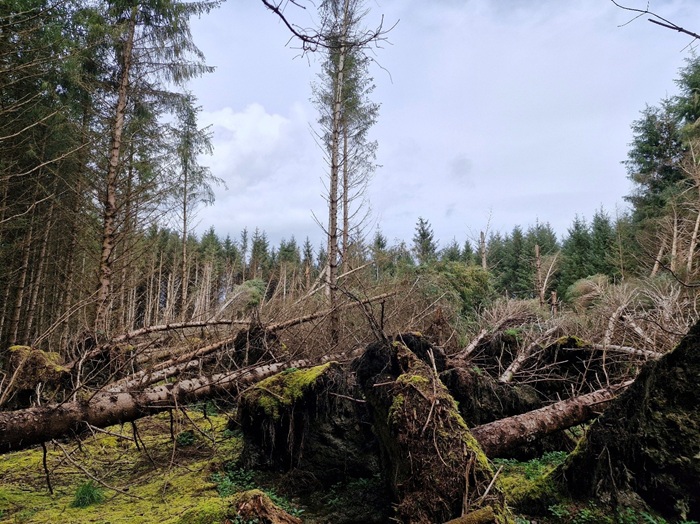
Windthrow can reduce the climate benefit of forestry by removing trees that would have kept growing and disturbing the carbon-rich soils beneath them, through the medium of RTÉ Brainstorm, Emmanuel Ekeoma, and Owen Fenton, Teagasc, and Nicole Metje, University of Birmingham, tell us more.
Even if there is no one around to hear it, the effects of a tree falling in the forest can be felt across the forestry supply chain. Windthrow, the uprooting of trees by wind, represents the most significant natural threat to the stability and economic viability of the Irish forestry sector.
While the industry has long managed the risks of extreme weather, the escalating scale of storm damage suggests that a business-as-usual approach is no longer tenable. Compare the impact of Storm Darwin in 2014 with Storm Éowyn in January 2025; the former destroyed approximately 8,000 hectares whilst the latter devastated 23,652 hectares, representing 227% of the typical annual harvest volume.
Salvage harvests after storms push down timber prices
To help forest managers better understand and mitigate potential risks, a research project at Teagasc Johnstown Castle is developing a framework to create site-specific forestry vulnerability maps. The impact of windthrow events ripples through the entire supply chain. These events increase harvesting risks and make strategic planning challenging. Salvage volumes can dwarf standard capacity, causing economic devaluation and disruption of timber supply; the premature harvesting of crops floods the market and reduces prices.
Climate-smart forestry
Add to these the difficult, sometimes dangerous, working conditions after storms such as unstable trees, restricted access and time pressure and it becomes clear why windthrow disrupts both short-term operations and long-term planning. There is also a climate dimension that is easy to miss when we focus only on clearing up the mess.
Windthrow can reduce the climate benefit of forestry in two ways: removing trees that would have kept growing and disturbing the carbon-rich soils beneath them. Forests deliver climate value by storing carbon in wood and soils. When trees fall before the planned harvest age, that future carbon capture is cut short. Where tree overturning disturbs the soil, especially in wetter or more organic soils, carbon that has been locked in the soil for decades can be released.
Branching disciplines: meteorology, mechanics and soil science
Whilst risk is inherently site-dependent, the sector’s historical ability to mitigate these impacts has been limited, largely due to the interdisciplinary nature of the challenge. Storms are meteorology, wind flow through forests is fluid dynamics, tree stability is biomechanics, and root anchorage is geotechnical engineering. The pattern of damage is spatial and often contagious, with one failure increasing the risk of the next.
This framework allows us to visualise not just if a tree will fall, but how an entire stand might succumb.
These elements are usually studied separately, which makes it hard to see the full risk picture for a forest. This research has undertaken the first step towards addressing this by developing a dynamic, overarching framework. It shifts the focus from an empirical approach to considering failure due to mechanical impacts. At its heart, the framework aims to provide what forest managers ask for: decision-ready outputs that show where risk is high, why it is high, and how confident we are in that assessment.
Getting to the root of the problem
The framework integrates three data layers to create vulnerability maps. Remote sensing is used to identify individual trees within a stand and extract key structural attributes, including tree height and crown dimensions. Geotechnical information uses soil maps to characterise spatial variation in soil strength across the forest and integrates these data with tree root models to estimate the anchorage of individual trees. Meteorological information uses wind speed data to quantify the forces acting on trees, and precipitation data to assess how soil conditions may vary over time. This is important because the same wind speed can have very different consequences depending on whether soils are firm or waterlogged.
Using the above inputs, researchers then model the dynamic behaviour of a tree and ascertain its likelihood to fail. When a tree fails, it exposes the trees next to it to more wind loading, transforming a single point of failure into a potential wider failure chain reaction. This framework allows us to visualise not just if a tree will fall, but how an entire stand might succumb. The framework’s accuracy was confirmed by contrasting drone imagery of actual damage against the model’s predicted spatial distribution, matching the physical reality on the ground.
Bark up the right tree: prioritise vulnerable stands
Ultimately, this framework is designed to serve as a digital twin, allowing managers to simulate interventions before deployment. It can support decisions about thinning, harvesting, replanting layouts and risk prioritisation, not by replacing professional judgement, but strengthening it with site-specific evidence.
In practice, the model would sit behind a simple mapping tool that forest managers can access via a web portal. Stands will be coloured by windthrow risk and confidence, with options to overlay soil and harvest plans. This means vulnerable areas can be identified in advance and prioritised for earlier harvesting, alternative species, or extra protection along exposed edges.
With a new storm season only months away, the stands most exposed this winter are already in the ground. Identifying them now, rather than counting them afterwards, leaves time to act. As additional field and post-storm data are integrated, the framework can be scaled to support climate-smart forestry, strengthening adaptation and protecting long-term carbon capture by reducing avoidable storm losses.
Emmanuel Ekeoma is a Teagasc Walsh Scholar who recently completed his PhD in the School of Engineering at the University of Birmingham. Owen Fenton is a Principal Research Officer at Teagasc Johnstown Castle. Nicole Metje is Professor of Infrastructure Monitoring in the School of Engineering at the University of Birmingham. Mark Sterling also contributed to this piece.
The above first appeared in RTÉ Brainstorm and was subsequently republished on Teagasc Daily.