
13 November 2023
‘I was leaving money behind compared to other herds’
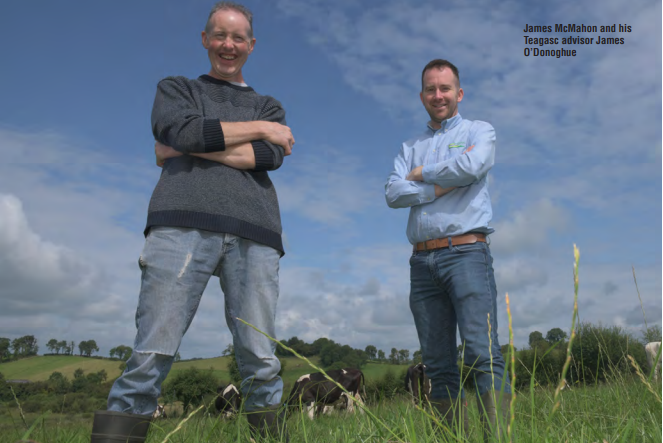
James McMahon has seen his herd’s milk performance increase since joining the Teagasc Heavy Soils Programme. Farming near Swans Cross, Co. Monaghan, James joined the Teagasc Heavy Soils Programme in 2015. He currently milks 115 cows on a 28ha milking platform, while farming 79ha in total.
“The farm is not only heavy in nature, but is also fragmented which has its own challenges,” explained James.
The farm performance wasn’t where he wanted it to be from an animal and grassland performance perspective. After he joined the Heavy Soils Programme, a plan was devised to correct soil fertility, improve grazing infrastructure, identify paddocks for land drainage works, and also improve herd genetics and fertility performance.
“Along with the Heavy Soils Programme team, we put in place a long-term plan for the farm which I have been working on over the last number of years,” James said.
On grazing, he placed a strong emphasis on improving the soil fertility status. This has improved dramatically, but continued work is required to ensure the percentage of paddocks optimised for pH, phosphorous (P) and potassium (K) continues to increase. For grazing infrastructure, additional main roadways and spur roadways have been added; fences have been amended to allow multiple access points into individual paddocks.
“If you can’t get to the paddock easily you just won’t get cows to grass on those wet days.”
Soil analysis and classification from the Heavy Soils Programme team identified that a shallow drainage system was required in the form of collector drains and gravel mole drainage.
“Unfortunately for me, this is the most expensive form of drainage but it is working very well in the parts of the farm where I have completed it. “We try to complete 2.5/3ha a year and then also incorporate this into our reseeding programme. We grew 12.8t DM/ha in 2022, which we are very happy with and it’s reflected in the animal performance improvements,” James said.
Breeding decisions
“Prior to joining the programme, herd breeding decisions were often outsourced with my only real concern being that we had cows with plenty of milk,” James commented.
Until 2015, the herd produced 408kg of milk solids per cow at 4.18% butterfat and 3.32% protein, with a calving interval of 430 days.
“I was leaving money behind when I looked at what other herds were achieving so something needed to be done to improve fertility and milk performance. It was slow in terms of progress up until we made the decision to buy in high EBI in-calf heifers over the last three seasons,” James said.
With the help of the local Teagasc advisor, James O’Donoghue, clear criteria were identified for the type of stock to be purchased. The emphasis was on fertility and solids, AI-bred, calving in February and high health status.
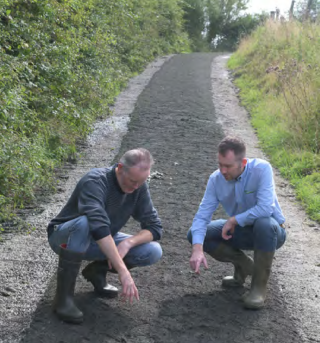
James McMahon and James O’Donoghue on the farm near Swans Cross in Monaghan inspect new roadways that have been added as part of the Teagasc Heavy Soils Progranmme plan for the farm.
“We identified a number of groups of stock in the south to look at that fitted the criteria with regards genetic potential. I won’t tell a lie – I wasn’t so sure when I looked at the first group of stock.
“They were a lot different from what I was used to looking at, but after seeing the herd of cows and the performance figures they were achieving it did put my mind at rest. We purchased 57 in-calf heifers over the last three years and sold poor performing cows,” he noted.
These changes have seen the herd’s EBI jump from €84 in 2018 to €166 in 2023. The herd calving interval is now down 378 days and there’s a six-week calving percentage of 65%.
“I would like the six-week calving percentage higher and we are continuing to work on that,” James noted.
There was also a dramatic increase in the herd’s milk performance in 2022, when the cows produced 498kg of milk solids at 4.20% butterfat and 3.54% protein on 1,200kg of meal. That is an increase of 90kg of milk solids per cow on 2015 levels or an additional €450 per cow in additional milk sales based on 2021 milk prices.
“It’s an additional €51,750 in milk sales when you multiply it up across the herd. It’s very much about focusing on the simple things and doing them well,” concluded James.
This article by James Dunne, Teagasc Dairy Specialist, was adapted from an article first published in the September/October edition of Today’s Farm. To learn more about the work being completed under the Teagasc Heavy Soils Programme, click here.
Also read: Investing in new genetics to improve herd performance
Also read: Unlocking the potential of heavy soils dairy farms