Identifying practical actions to improve water quality across Ireland
With the Teagasc Water Quality Conference fast approaching, Sinéad Devaney, ASSAP Advisor, tells us about her role and outlines the conference’s focus on farm compliance, reducing nutrient losses to water and the role of good farming practices in protecting water quality.
As an Agricultural Support and Sustainability Advisory Programme (ASSAP) Advisor, my job is to work with farmers all over County Galway to help improve water quality on their farms.
I do this through one-to-one meetings with farmers on-farms, identifying any issues likely to contribute to a-less-than-good water quality in their local river and collaborating with the farmers to put measures in place to fix these issues.
As part of my role, I apply for the Farming for Water European Innovation Partnership (EIP) grant-aid on behalf of the farmers, which near-enough covers all the costs of the measures required. This funding is targeted towards priority areas, where water quality is not good, so that real improvement in water quality can be brought about and is measurable, thus potentially securing additional funding into the future for Results-Based Schemes. Right now, this pilot scheme is closed for applications but is expected to re-open early in the New Year.
Educational work is part of my role also and I engage in Teagasc on-farm events, farm walks and Knowledge Transfer (KT) discussion group meetings with Teagasc and private consultants. There are ASSAP advisors across Ireland, within Teagasc and in our Dairy Co-ops, working together with farmers across all enterprises with the common goal of improving water quality.
Did you know?
While drinking water standards are designed strictly to protect human health, environmental thresholds (set by the EU Water Framework Directive) protect delicate aquatic ecosystems, fish and biodiversity. Because nature is often far more sensitive to chemical shifts than humans, environmental water limits are typically much stricter than drinking water standards.
EPA assessments indicate that nitrate levels should be less than 8 mg/l NO3 (or 1.8 mg/l as N) to support good water quality in our rivers. A separate drinking water standard is used to protect public health. This standard sets a maximum allowable nitrate concentration of 50 mg/l NO₃ in drinking water supplies (Source www.epa.ie ). For more detailed information on catchment assessments and water quality, visit Catchments.ie
The Teagasc Water Quality Conference
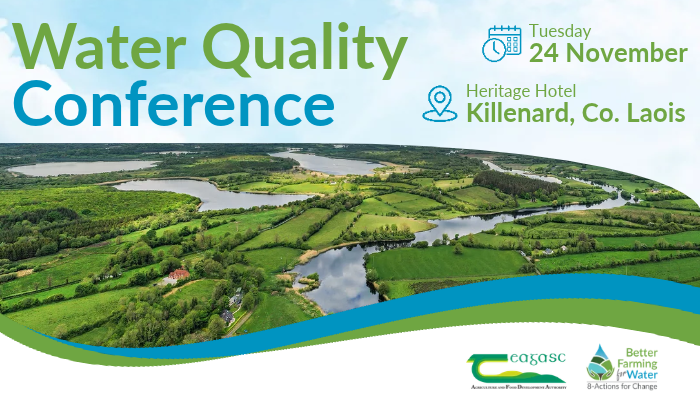
The Teagasc Water Quality Conference is taking place on Tuesday, 24 November in the Heritage Hotel, Killenard, County Laois, R32 PW10.
This year’s conference focuses on farm compliance, reducing nutrient losses to water and the role of good farming practices in protecting water quality. The event provides an opportunity to share experiences, discuss challenges and identify practical actions to improve water quality across Ireland.
It is open to farmers, advisors, private consultants, those working in water quality, community groups, students or anyone with an interest in improving their knowledge of the topic to attend. It presents a chance to network with others in similar work or farming areas.
Conference agenda
On arrival, there is sign in, tea, coffee and refreshments and a chance to mingle.
Liam Herlihy Teagasc Chairman gives the welcome address at 9.15am, followed by the opening address by Professor Frank O’Mara, Director of Teagasc. Three sessions will follow:
Session 1: Increasing Compliance with National Agricultural Inspections Programme (NAIP)
This session includes NAIP inspections and the issues being identified on farms, and upgrading farm infrastructure to minimise nutrient loss to water. The session will also include insights from a dairy farmer who has invested in upgraded farm infrastructure, demonstrating how effective infrastructure and good farming practices can support compliance and help protect water quality.
Session 2: Reducing Nitrogen loss to water
The focus here is on strategies to reduce Nitrogen losses from both grassland and tillage systems. The session includes presentations on:
- Improving Nitrogen Balance on Pasture-based Systems,
- The Role of Cover Crops in Mitigating Nitrate Loss from Tillage Systems
- And a Tillage Farmer with Cover Crops and a Dairy Farmer with Good Nitrogen Balance.
Analysis of National Farm Survey data from 2020–2024 highlights the potential to reduce Nitrogen balances and associated losses to water across all stocking rate bands. This demonstrates that all grassland dairy farmers, regardless of stocking rate, have an equally important role in protecting water quality.
Session 3: Environmental Policy & Compliance
Session 3 focuses on the Habitats Directive and Water Framework Directive; compliance when granting individual nitrates derogations; the closed period for slurry spreading and its crucial role in prevention of nutrient loss; followed by a case study of the Moynalty Catchment where water sampling was undertaken to identify diffuse losses from slurry spreading.
After each session, panel discussion and questions and answers will take place.
Visit here to register for the Teagasc Water Quality Conference and to view the full conference agenda. Please note that conference bookings close no later than 5pm on Friday, 13 November.