
Identifying problem cows early: David Hally’s approach
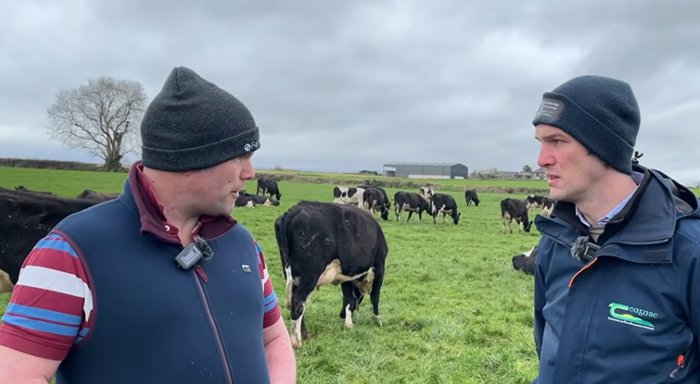
Preparing early for the upcoming breeding season is key for Tipperary dairy farmer, David Hally who places a focus on cow fertility and grassland management to drive fertility results on his farm.
Milking approximately 80 cows on a 32-33ha milking platform. David Hally joined Teagasc Dairy Specialist, Stuart Childs to share details of his pre-breeding plan in the video below.
Six-week calving rate on the farm is excellent, approaching the 90% mark, while the herd produced 530kg of milk solids last year from a concentrate input of 1.2t/cow.
Despite challenging conditions this spring, approximately 45% of the farm had been grazed by late March, with David prioritising turnout despite difficult conditions. Calving commenced on January 16, while cows have been at grass since around January 25, whenever weather allowed.
Viewing the two weeks prior to breeding as crucial for tightening the calving spread, David notes that technology now plays a key role on his farm. The use of monitoring collars and the supporting software package allows 24/7 monitoring, allowing him to quickly identify cows that are not cycling or showing irregular heats.
Where such cows have been identified, they are examined by a vet 10-14 days before breeding start date. Another key aim is to have later-calving cows fully active five to six weeks into the breeding season.
Having previously considered himself diligent when it comes to pre-breeding checks, David explained that technology helps to pick up issues earlier, particularly when time is the limiting factor before breeding starts.
Elsewhere in the video, Stuart caught up with Dennis Howard, Technical Manager, Munster Bovine to provide some advice on dealing with problem cows in the lead up to the breading season.
For full insights, watch the video below: