
Impact of reduced chilling on Sitka spruce seedlings dormancy
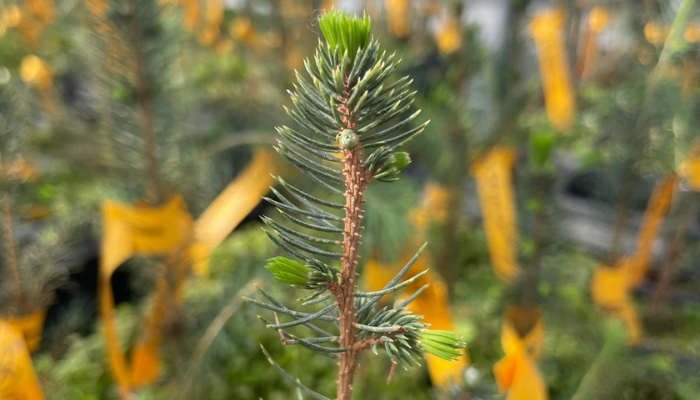
Romane Guernalec, PhD student, and Tomás Byrne, Tree Improvement Technologist, tell us about how research into the Sitka spruce growth cycle could help secure the future of Irish forestry.
Sitka spruce is an important tree species in the Irish forestry sector: its fast growth and valuable timber make it an efficient producer of vital raw material for our home construction and key for achieving the ambition of enhanced timber usage in the built environment. It also efficient at capturing and storing large amounts of atmospheric carbon. But what might be less known, is that this is also a highly resilient species, with a strong adaptive capacity.
Ireland’s wet and mild maritime climate is well suited for Sitka, as it is similar to its native range: the western coast of North America, from Alaska to California. It was initially imported to Ireland in the 1850’s and started to be grown intensively in the 1950’s after provenance trials in the UK and Ireland showed superior growth from trees originating from Haida Gwaii (formerly known as Queen Charlotte Island) and Washington. Sitka spruce quickly became the number one choice of tree and currently covers about 50% of planted forests.
In the current Forestry Programme, Sitka spruce can form a 55% component in Forest Type 10, which creates a mixed species production forest structured to be managed as a continuous cover forest from establishment. It is also the commercial conifer tree species in Forest Type 12, mixed with 20% broadleaves along with 15% of the overall area retained for biodiversity enhancement.
Understanding its growth cycle
Because of Irelands temperate climate, Sitka cannot continue growing during the winter as the sub-zero temperatures may harm the fresh tissue. Instead, the tree forms buds and goes into dormancy: which is only broken after the tissues experience a period of cold followed by the accumulation of warmer temperatures. Coupled with daylength, these are the two cues driving the seasonality of the tree. Dormancy is a strong adaptive trait, because it has evolved alongside the local climate. It can range from shallow (easy to break) to strong (harder to break), intra or inter species; and is ecologically linked with the species status. For example, pioneer species such as birch will have a shallower dormancy to take advantage of the growing season earlier. Sitka spruce is a climax species, but because the native range is so extended and solely coastal, the northern provenances enter dormancy much earlier than the southern ones.
What are the challenges?
With the climate rapidly changing, there is already a pattern of earlier leaf onset being observed in continental Europe due to warmer spring temperatures. Spring frosts events can happen up until May, and Sitka is known to flush around April. If the yearly cycle does not match the local climate anymore and the trees flush earlier in the year, there is a higher risk of frost damage. In forests, this is a key trait for establishment, whether it is a planted forest or naturally generated. Seedling stage is very critical, because it is much more responsive to environmental changes but also because it is difficult to transition provenance selection for an established industry.
This is why is it important to understand the spring phenology in Sitka, especially the differences between provenances – there might even be a future need to use a more southern provenance such as Oregon, better suited for the future climate.
Research
To understand this, we administered different length of cold temperatures to three Sitka spruce seedling provenances (QCI, Washington and Oregon) before testing their dormancy in controlled conditions. We wanted to assess the minimum chilling required for the trees to break their dormancy. In short, if the tree does not flush even with the best growth conditions (warm temperatures and longer day length) it means the dormancy is not broken – it did not get enough chilling (temperatures between 0 and 5 degrees).
We observed a very clear pattern: more chilling given to the trees, the faster their dormancy was broken, which is in accordance with the research findings on other species, in particular conifers. However, we also found that even without any chilling given, the trees were still flushing across the provenance range: this might indicate that Sitka spruce requires minimal chilling, if at all, and might be compensated by warmth accumulation. Chilling requirement in Sitka is therefore very low, giving the seedlings a competitive advantage compared to other species’ seedlings that have higher requirements.
Relevance to Irish Forestry
As Ireland is moving towards more diverse Forest Types and new forestry practices, forestry material adaptability becomes a key focus in the context of warming climate. Because the frost risk is more important at the ground level, there is a need to have seedlings growth cycle synchronised with frost-free season. As flushing timing does not differ across provenances for Sitka spruce seedlings, it might be important to look at the autumn phenology before provenance selection. A most southern provenance like Oregon will keep growing much later in the year which would suit a frost-free site better.
These findings suggest that Sitka spruce appears to be a stable candidate facing future rising temperatures, however more research is needed to assess the species resilience to other challenges climate change will bring.