
Improving suckler returns through better 200-day calf weights
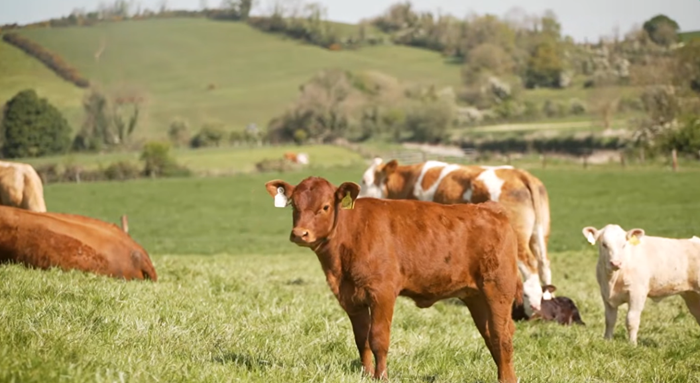
As the grazing season advances suckler farmers should evaluate herd performance to secure future profitability. James Mullane, Future Beef Programme Advisor, tells us more.
One of the key factors driving suckler cow profitability is her weaning efficiency. While reproductive and fertility traits remain foundational, a cow’s true maternal capability is best reflected in her weaning efficiency and the 200-day weight of her calf. Because a calf’s growth up to 200 days is heavily driven by its dam’s milk yield rather than grass intake alone, tracking these metrics provides an accurate, standardised benchmark for maternal performance across the herd and can guide culling or replacement decisions.
Why the 200-Day Weight Matters
The best time to weigh calves to calculate their 200-day weight is when the average age of the calf group is between 150 and 250days (approx. 5 to 8 months of age). Crucially, both dams and calves must be weighed on the same day prior to weaning to record performance before diet and environmental changes alter growth trajectories. Once recorded on the Irish Cattle Breeding Federation (ICBF) portal, farmers can generate a comprehensive Weaning Performance Report. The calves must be weighed before weaning to capture the dams true milking ability before the calf’s diet changes completely. Along with her calving and fertility traits, the 200-day weight is the gold standard for evaluating a suckler cow’s maternal ability. Up to 200 days, a calf’s weight is heavily driven by its dam’s milk yield rather than just grass intake. Analysing 200-day weights allows farmers to fairly compare early born spring calves with late-born. Identifying underperforming calves at this stage allows for early creep feeding or targeted dosing if required before weaning stress hits. For suckler enterprises, the industry target weights and required performance include:
- Male (Bull) Calves: 300 kg.
- Female (Heifer) Calves: 250 kg.
- Target Average Daily Gain (ADG): 1.2 kg to 1.3 kg per day from birth to weaning.
Analysis of a standard ICBF Weaning Performance Report demonstrates how a herd can be evaluated across key weight benchmarks. From the report below it can be seen that the heifers are on target and although the bulls had excellent daily liveweights gains, they fell short of the 300kg target 200-day weight. Even at this stage by looking at this report the heifers in this herd to be retained as replacements should reach hit their target bulling weight assuming the animals are managed correctly post weaning. As well as calf performance to make progressive culling and replacement decisions, the report highlights the top performing individual calves in the herd. These elite animals point directly back to the most efficient dams.
Example Weaning performance report
All Calves Avg. 200 Day Weight (kg)
| Born In Period | No. Weighed | ADG (kg) | Your Herd | Target | |
| All | 1.24 | 271 | N/A | ||
| Males | 1.29 | 282 | 300 | ||
| Females | 1.14 | 251 | 250 |
Top 5 Males on 200 Day Weight
| Calf Tag | Dam Parity | 200 Day Weight (kg) | ADG (kg) | Dam Jumbo | Dam Rep. Index |
| 4 | 365 | 1.63 | €174 ★★★★★ | ||
| 3 | 323 | 1.42 | €179 ★★★★★ | ||
| 4 | 311 | 1.36 | €129 ★★★★ | ||
| 10 | 308 | 1.34 | €124 ★★★★ | ||
| 9 | 302 | 1.31 | €131 ★★★★★ |
Top Females on 200 Day Weight
| Calf Tag | Dam Parity | 200 Day Weight (kg) | ADG (kg) | Dam Jumbo | Dam Rep. Index |
| 7 | 291 | 1.27 | €107 ★★★ | ||
| 2 | 283 | 1.23 | €120 ★★★★ | ||
| 4 | 250 | 1.16 | €159 ★★★★★ | ||
| 6 | 249 | 1.21 | €83 ★★ |
Calculating Weaning Efficiency
Weaning efficiency measures how much output a cow produces relative to her own body weight. A suckler cow should wean a calf that weighs at least 42% of her own body weight at 200 days. Although the herd target is 42% from the weaning performance report for a herd hitting the targets the top 5 cows will achieve a weaning efficiency of 50-52% versus 35-37% for the bottom 5cows.
Example Weaning performance report
Cow and sire performance
All Cows
| Calved in Period |
No. Weighed* |
Avg. Weight (kg) |
Weaning Efficiency (Calf 200 Day Weight as % of Cow Weight) |
||
| Your Herd | Target | ||||
| All | 664 | 41% | 42% | ||
| 1st Calvers | 587 | 43% | 42% | ||
| 2nd Calvers | 603 | 41% | 42% | ||
| 3rd + Calvers | 714 | 41% | 42% | ||
Top 5 Cows on Weaning Efficiency
| Cow Jumbo | No. Calvings | Rep Index | Cow Weight (kg) | Calf Tag | Calf Sex | Calf 200 Day Weight (kg) | Weaning Efficiency |
| 2 | €201 | 604 | ME | 422 | 70% (Twins) | ||
| Cow A | 1 | €187 | 497 | M | 295 | 59% | |
| 4 | €174 | 694 | M | 365 | 53% | ||
| 3 | €179 | 605 | M | 323 | 53% | ||
| 2 | €120 | 579 | F | 283 | 49% |
Bottom 5 Cows on Weaning Efficiency
| Cow Jumbo | No. Calvings | Rep Index | Cow Weight (kg) | Calf Tag | Calf Sex | Calf 200 Day Weight (kg) | Weaning Efficiency |
| 6 | €83 | 859 | F | 249 | 29% | ||
| 1 | €131 | 658 | F | 228 | 35% | ||
| 4 | €159 | 700 | F | 250 | 36% | ||
| 0 | €90 | 731 | M | 271 | 37% | ||
| Cow B | 1 | €178 | 606 | M | 226 | 37% |
| Dam Parity | Cow Weight | Calf Sex | Calf 200-Day Weight | Weaning Efficiency | |
| Cow A (Efficient) | 1 | 497 kg | Male | 295 kg | 59% |
| Cow B (Inefficient) | 1 | 606 kg | Male | 226 kg | 37% |
As a first-calf heifer, Cow A weaned a heavy 295 kg bull calf to hit a 59% weaning efficiency rating. Conversely, Cow B operated at just 37% efficiency. The heavier, less efficient Cow B reared a lighter calf while demanding significantly more grass and winter forage just for her own body maintenance reducing net margins.
Key Drivers to Improve Your Performance
Focus on Cow Genetics (The Milk Sub-Index)
A cow cannot wean a heavy calf without milk. Review your herd’s genetic indexes. Breed or buy replacement heifers with high maternal traits and strong milk figures.
Manage Cow Liveweight
Large, heavy cows require more feed just to maintain themselves. Aim for a hard-working, medium-sized cow (approx. 600–650kg) that can balance low maintenance costs with high milk output.
Protect Herd Health
Parasites poorly managed can affect calf performance. Check faecal egg counts in July and August to ensure lungworm and stomach worm burdens are not stalling daily liveweight gain. Ensure calves are vaccinated against respiratory diseases well in advance of weaning.
Introduce Forward Creep Grazing
Allow calves access to the best quality grass ahead of the cows via a creep gate or raised wire. This breaks the maternal bond gently and ensures calves maintain a high daily liveweight gain (target >1.3kg/day for bulls, >1.15kg/day for heifers) leading up to weaning.
Action Plan for Farmers This Month
Farmers should secure reliable weighing equipment this month to eliminate the inaccuracies of visual guessing. Use the resulting ICBF data to identify “passenger” cows that fail to meet the 42% weaning efficiency threshold and mark them for culling. Moving forward, ensure replacement heifers are selected exclusively from the most efficient, high-milk-yielding dams in the herd. You cannot manage what you do not measure, and leveraging these metrics is the most direct route to turning grass into beef with maximum economic efficiency.