
Attendees at the Teagasc Water Quality Conference, today, October 29, heard New Zealand and Irish experiences of improving water quality through a catchment science approach.
Speaking at session two ‘Catchment science approach to improving water quality in an agricultural setting’ at the event in Co. Laois, Professor Richard McDowell, Principal Scientist New Zealand Institute for Bioeconomy Science Limited, shared insights on the New Zealand approach to improve water quality in an agricultural catchment landscape.
Speaking at the conference, Professor McDowell said: “Empirical evidence demonstrates that on-farm mitigation actions can improve surface- and groundwater quality when properly targeted, implemented, and maintained. The level of confidence in attributing observed improvements depends on data quality and analytical rigour.”
For improvements to be realised, Professor McDowell detailed the five-step framework. This comprises of target setting, action selection, implementation, monitoring and attribution. This, he explained, provides a scientifically defensible process for linking farm actions to measurable freshwater improvements.
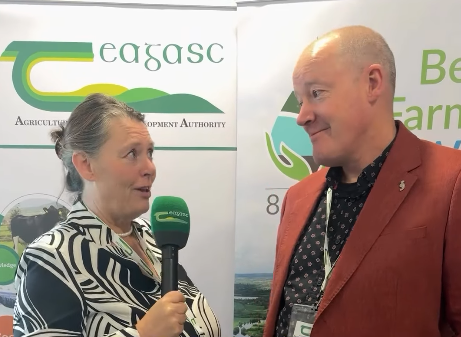
Fiona Doolan caught up with Professor McDowell at the Water Quality Conference, watch the below video for key insights:
View this post on Instagram
Professor Richard McDowell’s summary points:
- Farm plans are an excellent way of linking actions to water quality improvements,
- Estimating where and when water quality will improve can be done and gives those involved a timeline to work towards,
- Emphasis should be put on implementation to ensure that we have the best chance of achieving improvements,
- Additional actions may arise, but the effect of these can be included.
Dr. Per-Erik Mellander from the Teagasc Agricultural Catchments Programme followed Professor McDowell, where he shared experiences from Ireland.
“The Agricultural Catchments Programme (ACP) plays an important role for the national strategy to improve water quality,” he explained.
Chief amount its deliverables is a comprehensive understanding of the processes involved and the controlling factors that determine nutrient loss to water under the influence of changing drivers.
“There are critical source areas, critical mobilisation areas, critical delivery pathways, and critical delivery times for nutrients, Per-Erik Mellander explained, before adding: “Detailed insights need to be scaled up to larger areas and tested across scenarios to generate practical, evidence-based guidance for mitigation strategies.”
Dr. Per-Erik Mellander’s presentation summary points:
- The ACP plays an important role in the national strategies for improving water quality
- The ACP delivers a comprehensive understanding of the processes that determine when, where, and how nutrients are lost to water under the influence of changing drivers
- These insights are complex and need to be simplified, scaled up to larger areas, and tested across scenarios to generate practical, evidence-based guidance for mitigation strategies
- Efforts to improve water quality also need to address governmental and social challenges
- We should aim for a whole system-based approach with long-term planning horizons.
For more from the Teagasc Water Quality Conference, visit here.
More from Teagasc Daily: Supporting farmers to improve water quality
More from Teagasc Daily: Measures to improve water quality must gather pace