
In-crop applications turns back the clock
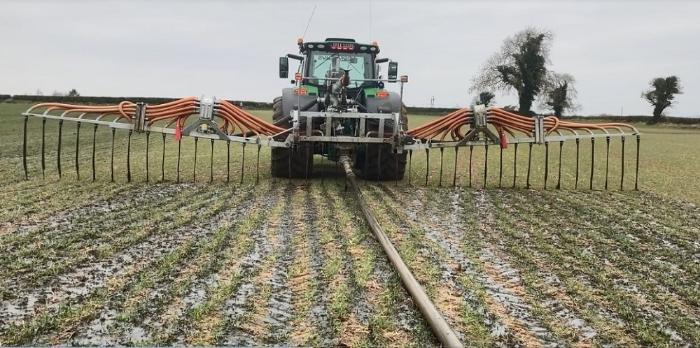
An EU project aims to promote the use of animal manures in established tillage crops, Ciaran Collins, Teagasc Tillage Specialist, tells us more.
When mixed farming systems were the norm, organic manures and crop rotations with grassland were central to soil fertility. Tillage crops received a top-up of chemical fertiliser, but much of the nutrient supply came from slurry and farmyard manure produced on the farm itself.
This was evident in the high organic matter values in fields growing crops and in the overall health of those soils. Today this is what’s called the circular economy: farm-produced organic manure recycled back to the land to grow the next crop, with clear benefits for soil structure, biology and resilience.
As systems have become more specialised, the rotation with grassland has reduced and livestock numbers on many tillage farms have declined. Consequently, there are fewer opportunities to utilise organic manures within arable systems. Nonetheless, Irish tillage soils generally have a good soil health status.
Mandatory organic matter testing carried out as part of cross compliance in 2010 and 2011 showed that the vast majority of tillage soils were well above the 3.4% organic matter threshold value. This is reassuring. However, the value of organic manures cannot be understated, not just from a soil health perspective, but also economically. Their value has become more obvious since fertiliser prices surged in 2022 and look unlikely to return to previous levels anytime soon.
The spring opportunity and the autumn challenge
A large cohort of tillage farmers apply organic manures in the spring. These farmers are using dribble bar umbilical systems to apply slurry directly into the growing crop. Successful implementation requires coordination between slurry supply, contractor availability and conditions.
This practice is relatively straight forward as land dries out, allowing slurry to be applied before cultivation and drilling of spring crops. Autumn-sown crops, however, do not offer the same opportunity. Applying organic manure in the autumn is of limited value. The mismatch between supply and crop demand reduces nutrient use efficiency and increases the risk of losses. Approximately half of Ireland’s cereal area is planted in the autumn. This effectively eliminates half of the tillage area from receiving organic manures in a conventional system.
An innovative solution – applying slurry in-crop
Some very innovative tillage farmers have begun applying organic manures in-crop to growing winter cereals, mainly winter wheat, barley and rye.
This approach aligns crop nutrient demand with the nutrients supplied by the organic manure. Applying slurry to actively growing crops improves nutrient use efficiency and reduces environmental losses. These farmers are using dribble bar umbilical systems to apply slurry directly into the growing crop. Successful implementation requires coordination between slurry supply, contractor availability and field conditions. GPS guidance is essential to avoid overlaps and underlaps.
Soil conditions are critical
Soil conditions are the crucial factor in this system. Very few umbilical systems match the full tramline width so contractors need to travel between tramlines to complete the field. Minimising soil damage is paramount.
Applications generally take place from early March up to stem extension, depending on the crop. In winter wheat, this can often extend well into April.
Weather plays a vital role in success. Experience from these innovative farmers suggests that mid tillering to growth stage 30 is often the ideal timing, but flexibility is essential, taking opportunities when ground and weather conditions allow.
The economics stack up but costs must be considered
At current fertiliser prices, an application of 2,000 gallons per acre of pig slurry (4% dry matter) is worth approximately €70/ac in nutrient value. However, we must consider transport costs, application costs, nutrient use efficiency and soil trafficability risks. Substituting a large proportion of chemical fertiliser with organic manure can significantly improve crop margins, but the full cost structure must be evaluated on each farm.
Investing in soil health
Aside from the economic benefits, organic manures bring considerable long-term benefits to soil. Not all of these are immediately visible, but they represent a strategic investment in soil function and resilience. There are many benefits to be gained from the application of organic manures to tillage crops. They provide a valuable source of N, P, K, Mg, S, Ca & minor nutrients such as Cu, Mn & Zn. These nutrients are supplied in a form that is plant available but also in organic forms that will mineralise over time and provide a reserve of nutrients within the soil. Organic manures also help to build the soil organic matter which improves the soil health and resilience while improving soil structure and water management and enhancing soil biology.
In many respects, these innovative tillage farmers are replicating what mixed farmers did decades ago but with modern precision technology and understanding of nutrient management.
SoilCycle
SoilCycle is an EIP funded project designed to empower Irish tillage farmers to improve nutrient management through the in-crop application of organic manures. Running until December 2029, SoilCycle builds directly on the experience of innovative tillage farmers who are already successfully applying slurry to growing winter cereals.
SoilCycle is centred around farmers. These farmers have shown that in-crop application can work by aligning slurry supply with spring crop demand, improving nutrient use efficiency and reducing reliance on chemical fertiliser. Through a national network of “Project Hubs”, each involving focus farmers and specialist contractors, the project is validating this practice using large scale tramline trials in commercial fields.
Pig slurry, cattle slurry, separated slurry fractions and digestate are being assessed, while a comprehensive database of Irish organic manure nutrient values is being developed. The project also integrates precision technologies such as GPS-guided spreading and Near-Infrared (NIR) sensing to improve accuracy and nutrient targeting.
Machinery compaction and wheeling effects are evaluated annually to ensure soil structure and crop performance are protected. Ultimately, SoilCycle aims to give the wider tillage sector confidence. By generating robust field-scale data, economic calculators, cooperation templates and best practice guidelines, the project aims to provide practical tools so that more farmers can adopt in-crop organic manure application on their own farms.