
29 December 2023
Insights from the Finnish pig industry
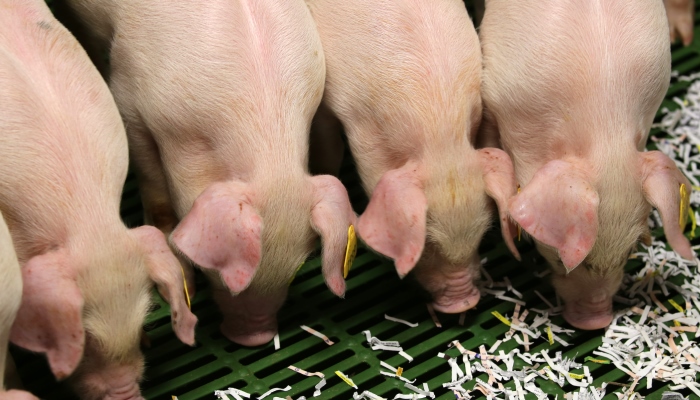
Johannes Vugts, Senior Advisor with HKScan Finland Oy, tells us how Finnish producers already have more than 20 years of experience with keeping undocked pigs, as tail docking has been totally forbidden in Finnish pork production since 2003.
Finnish production is mainly for the local market. The health status of herds is good since all farms are free of PRRS and Mycoplasma Hyopneumoniae.
The nursery piglets are housed in two-climate nurseries, where most of the piglets are fed liquid feed in a long trough. The finishers are typically kept in pens with 10-14 finishers. Almost all the finishers get liquid from a long trough. The nursery piglets often get fed six times per day and the finishers four times per day. It is important that all pigs can eat enough so they all will be satisfied. There should be a little bit of feed left after feeding.
Welfare
Welfare in the Finnish pork production sector is stimulated and regulated by the Finnish Government. To stimulate pig producers to invest in animal welfare, subsidies are given. Welfare improving investments are generally subsidised at 30%.
Subsidies are also given to support production. Two important ones are the free-farrowing subsidy of €250/sow/year and the intact tail subsidy of €21/finisher place/year. This last subsidy is given when less than 5% of the finishers have tail wounds at slaughter.
The subsidy for free farrowing has stimulated the HKScan producers to invest in free farrowing. During the last six years, the number of sows farrowing in a free-farrowing pen has increased to nearly 40% of the sows. The Finnish rules allow fixation from two days before until three days after farrowing. Fixation in the first days after farrowing is often practiced because it reduces mortality.
Tail damage
To get a better understanding of the tail damage at slaughter, HKScan did a trial together with the Helsinki University. From all the pigs slaughtered in one week, the tails were measured and the tip was scored. The results showed a very clear link between the tail damage and the number of abscesses found. It also showed that there is a huge variation in the number of damaged tails between the farms.
In 2020, we received more and more feedback from producers that the pigs were nervous and that tail biting became an increasing problem. This made my colleagues and me wonder what was going on.
While the tail biting increased, the amount of too fat pigs also increased. This made us wonder if there was a connection between the feeding and the behaviour. After discussions with the genetic suppliers, we decided to do a trial with higher amino acid levels and different fibre sources.
By using two concentrates, the feed could be made optimal for each stage of the finisher period. The sid lysine level in the starter diet was increased to 1.06g/MJ NE and the amount of wet distillery grain was decreased. The fibre level of the finisher diet was increased by the inclusion oats, wheat bran and beet pulp. The results of the trial were above expectation; the meat percentage improved and the animals were much calmer. This resulted in less tail damage at slaughter.
The trial from 2019 showed that most of the damaged tails were healed when the pigs were slaughtered. This indicates that the biting happened in the first half of the finisher period or during the nursery period. Based on 20 years of experience, we came to the conclusion that most of the tail biting occurs in the nursery. One of the main triggers for tail biting is weaning diarrhoea. In farms where there are issues with weaning diarrhoea, you often see that the piglets start to bite tails. The biting typically starts 1-2 weeks after the feed has changed from weaner to piglet diet.
Increased litter sizes
During the last years, we have seen a big increase in the number of born alive piglets / litter. On farms with a high born alive, we see that up to 50% of the sows have 18 or more born alive / litter.
These so called XL litters have often a negative impact on the quality of the weaned piglets. The birth weights are lower, colostrum intake is problematic and a lot of fostering occurs. This results in more variation in weaning weight and weaning age. Young weaned piglets and piglets who did not get enough colostrum are extra sensitive after weaning. A trial done in the past showed that piglets who are weaned at three weeks of age grow 111g/day slower in the nursery than piglets weaned at four weeks.
Genetic impacts
Experience has shown that certain genetics are less sensitive for tail biting than others. Since Duroc seems to be more sensitive for weaning diarrhoea and thus tail biting, we decided to test the Tempo.
To get a good impression of how the Tempo performs under Finnish conditions, seven producers agreed to change to Tempo (5,000 sows). The first finishers were slaughtered in the beginning of September. The feedback we have received from the producers is that the Tempo’s are less sensitive for diarrhoea and that tail biting has reduced a lot. The first slaughtered batches confirmed that the Tempo finishers had less tail damage at slaughter.
Keeping undocked pigs
If you want to start to keep undocked pigs, you need to first make sure that your docked pigs are doing well. If you see cannibalism in docked pigs, you can be sure that there will be serious issues with tail biting if you stop docking. Giving the pigs sufficient space is also a must. Finnish nursery piglets have 0.4m2 and the finishers 1.0m2 with 2/3 solid (max 10% open) floor. The solid floor makes it possible to give roughage on the floor which is the best way to give it.
If you want to succeed in keeping the tails of your pigs intact, you need to change your management from low cost to low risk focussed. This brings us to the point that raising pigs with long tails will increase the cost price of your pigs. This is why producers need to be rewarded for delivering pigs with intact (enough) tails to the slaughterhouse. Hopefully some of the Finnish experiences will be useful for Irish pig producers.
This article first appeared in the Teagasc Pig Farmers’ Conference 2023 event proceedings. To access the entire publication, click here.