
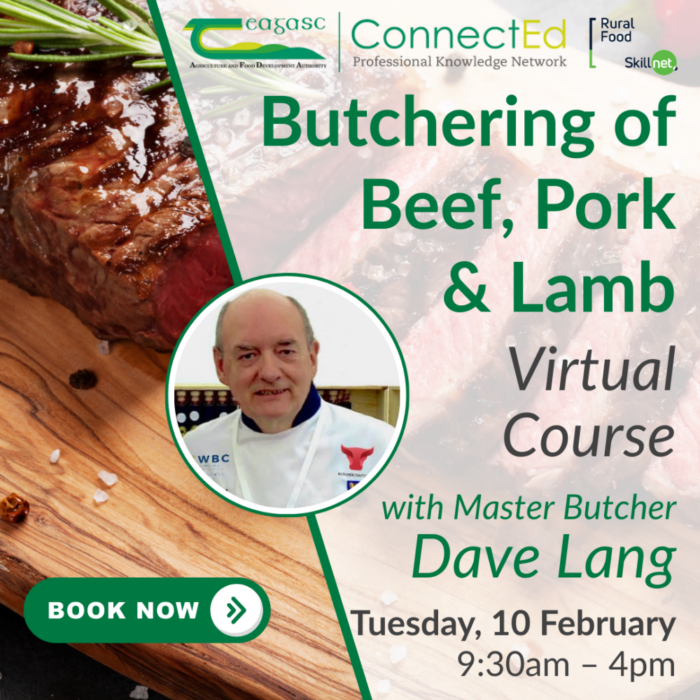
Are you seeking to expand your knowledge of butchery or considering butchering your own beef, pork or lamb? Then an upcoming training course, organised by Teagasc Ashtown and featuring Master Butcher, Dave Lang, may be of interest to you.
Butchery is a core skill in the modern agri‑food chain that supports product quality, improves carcass utilisation, controls costs and reduces food waste. Understanding which retail cuts can be produced from a carcass, how they meet customer expectations and how to optimise yield is valuable for everyone, from those employed in large and small meat enterprises to chefs and farmers supplying their own animals for processing. To ensure that this expertise is accessible to a wide audience, Teagasc Ashtown is offering a one‑day online course, Butchering of Beef, Pork & Lamb: An Overview.
Teagasc Ashtown has been sharing practical butchery knowledge and meat research for decades. This course brings together long‑standing practical butchery experience with food safety and new product development (NPD) insights. The course is delivered by Dave Lang, a master butcher with over 40 years’ experience, whose practical demonstrations are complemented by Teagasc sensory and NPD expertise. Together they provide a rounded view that links the craft of cutting with the science of quality and consumer preferences.
Raising awareness of the course, Carol Griffin, Course co-ordinator and Technologist with Food Industry Development, Teagasc, said: “This course was first introduced in 2010. Over the years we have continued to update the content and delivery methods. I am delighted that it remains relevant to an even broader audience today.”
Why participate?
Teagasc’s meat research activities, long-standing links with the meat sector and training programmes at Ashtown have built a technical and practical foundation that serves small producers and large processors alike. Participants benefit from access to specialist expertise in carcass assessment, retail cutting, sensory evaluation and product development. Along with cutting techniques, the course covers retail cuts of interest to customers, margin‑aware costings, strategies to reduce waste and ways to enhance carcass value through informed decision‑making.
Past participants have found the course engaging and practical, noting:
- “Having the videos recorded was beneficial as they could be paused at any time if questions were asked. The breakdown of the costings was also useful as it gave an insight into how the gross profit can be quite low prior to factoring in the labour costs.”
- “Excellent trainers and very well delivered.”
- “The videos were excellent and I liked seeing all of the different cuts of meat alongside great explanations”
- “An excellent trainer and very well delivered”
- “Interaction was good. Dave is extremely knowledgeable”
Accessible to a wider audience
Following many years of delivering this course as an in-person offering, using the dedicated abattoir and cutting plant facilities in Ashtown, this online format was introduced for accessibility to a wider audience. Originally developed for small meat producers and those considering the development of a small‑scale processing business, the course now addresses the broader meat industry. The course combines live expert talks, high‑quality demonstration videos and interactive discussions including Q&A, so attendees can watch, ask and apply learning in their own context. No previous butchery experience is required, and participants can join from anywhere.
Who should attend?
This course is designed for:
- Farmers who want to learn more about the process of butchering of beef, pork and lamb
- Artisan food producers who wish to develop value-added meat products
- Professionals employed in technical, quality or sales roles in meat processing
- Chefs seeking a greater understanding of how animals are broken down into popular cuts
- It is also suitable for people exploring the establishment of a small meat processing
Drawn from decades of Ashtown expertise, this one‑day course delivers practical, industry‑relevant butchery knowledge directly to participants wherever they are based. Places are limited and discounts are available by the Rural Food Skillnet for eligible individuals and enterprises.