
Is your farm safety statement up to date?
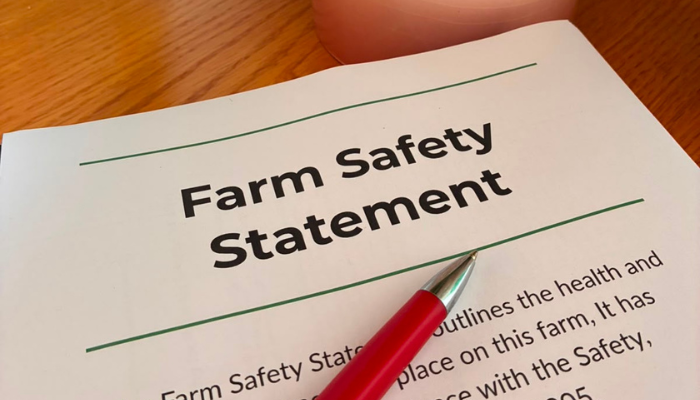
As Farm Safety Week approaches, Emer McCrum, Teagasc Pig Specialist, outlines why keeping your farm safety statement up to date is essential for legal compliance, good farm management and workplace safety.
Farm Safety Week takes place July 20 – 24, and is an ideal opportunity for producers and managers to review and update their farm safety statement, ensuring it reflects current practices and continues to support a safe working environment.
A well-prepared and regularly updated safety statement is a practical tool that identifies workplace hazards, evaluates the risk rating for each hazard and outlines the associated control measures required to reduce those risks, helping to safeguard employees, contractors and visitors.
Under the Safety, Health and Welfare at Work Act 2005 every employer in Ireland is legally required to prepare and maintain a written safety statement outlining how your organisation manages health and safety. An up-to-date safety statement is also an important business document. Insurance companies may request evidence that workplace risks are actively managed particularly following an incident or when assessing liability. Similarly, compliance with quality assurance schemes require evidence that suitable health and safety procedures and risk assessments are in place. Beyond legal and legislative requirements however, a current safety statement demonstrates good farm management and a commitment to providing a safe place of work.
A valid safety statement must be based on hazard identification and risk assessment, specifically including the following:
- Hazards and risks: Identification of the hazards and evaluation of the associated risks.
- Control measures: Description of the safety protocols, protective equipment and resources allocated to manage and prevent risks.
- Emergency plans: Procedures to follow in the event of serious danger or an emergency.
- Responsibilities: The specific duties of the employer, your employees, contractors and visitors regarding health and safety.
- Safety personnel: The names and job titles of people assigned with safety tasks.
The safety statement should be tailored to the individual farm and reflect day to day activities. Commercial pig farms present a range of hazards and while the risks will vary between farms, a safety statement should typically consider the following:
- Pig handling and animal behaviour.
- Machinery and equipment including tractors, PTO shafts, augers and feed systems.
- Vehicle movements involving tractors, loaders, telehandlers and delivery vehicles.
- Slurry storage and agitation.
- Confined spaces such as slurry tanks and enclosed pits.
- Electrical installations and equipment.
- Fire risks associated with buildings, heating systems and electrical faults.
- Manual handling of feed bags and equipment.
- Chemical hazards including detergents, disinfectants and fuels.
- Veterinary medicines and vaccines in addition to the safe handling and disposal of needles (sharps).
- Building structures including maintenance and upkeep.
- Working at heights during maintenance and inspection of buildings, roofs and feed bins.
- Respiratory hazards including potential exposure to dust and gases.
- Noise associated with feed delivery, power washing and working with machinery.
- The risk of slips, trips and falls caused by slippery floors, uneven surfaces, worn slats and untidy work areas.
- Lone working and out-of-hours duties.
- General house keeping in staff facilities and work areas.
- Biological hazards including zoonotic diseases.
- Safe access and egress for employees, contractors, service personnel and visitors.
Each potential hazard on the farm should be identified, the level of risk assessed and appropriate control measures put in place to eliminate or reduce the risk as far as reasonably practicable. These measures may include changes to work practices, the use of personal protective equipment (PPE), staff training or clear operating procedures. Every unit differs in layout, building design, equipment, work practices and staffing so the hazard analysis must be specific to your farm.
The safety statement should contain up-to-date emergency contact numbers including the emergency services, local doctor, hospital, utility providers where appropriate and key personnel within the business. Having this information readily available can save valuable time during an emergency.
Emergency procedures should also form part of the safety statement. This section should outline the procedures to be followed in the event of an emergency such as serious injury, fire, power failure or flooding to ensure all staff understand their roles and can respond quickly and safely when an incident occurs.
A health and safety statement should be treated as a live document and reviewed whenever significant changes occur on the farm. Updates may be required in case of the following:
- Construction of new buildings or alterations to existing facilities
- Installation of new feeding, ventilation or slurry systems
- Purchase of new machinery or equipment
- Introduction of new chemicals or work processes
- Changes to livestock numbers or production systems
- Recruitment of additional employees
- Following an accident, dangerous occurrence or near miss
- Changes in legislation or health and safety guidance
Even where no significant changes have occurred, carrying out a formal review at least once each year is considered good practice.