Is your herd’s parity profile where it should be?
Following Teagasc Pig and Poultry Department’s recent workshop on gilt management, Melissa Cupido takes a closer look at one of the key topics discussed, the herd's parity distribution.
When we think about the production efficiency of our breeding herd, the obvious things that come to mind are the piglets born alive, the birth weights, weaning weights and weaning numbers. But when last have you reviewed your sow herd’s parity distribution? Maintaining a good parity distribution can contribute to improved overall herd productivity, better use of investment in replacement gilts, reduced replacement costs, improved profitability, and a more balanced and manageable breeding herd.
The graph below gives us an example of an ideal parity distribution.
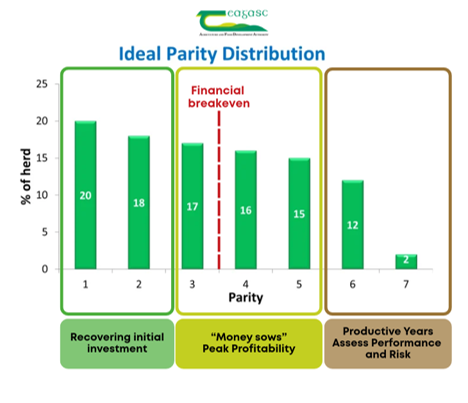
One of the key things to understand is the financial breakeven point. This is the point at which the income generated by a sow has covered the costs of rearing and maintaining that sow. Generally, a sow reaches her financial breakeven point around her third or fourth parity, depending on the farm’s costs and the sow’s performance. In other words, the first few litters are recovering the initial investment while the third or fourth parity and onwards are when the sow begins to generate a return for the farm.
With this in mind, keeping sows for as long as they are productive might seem like the obvious route to greater profitability. However, older sows can come with their own challenges. They are often associated with increased risk of lameness, poorer fertility, reduced milk production, and health issues, along with a declining born alive after parity five. These can all have a negative impact on the sow and the piglet performance and ultimately the farm profitability.
The aim is not to simply keep the sows for as many parities as possible, but to keep them for as long as their health, performance and welfare justify it.
This is why parities three to five are often considered the most productive stage of a sow’s life. At this stage, the sow has passed the financial breakeven point and is generally in her prime in terms of reproductive performance. These sows are also often easier to manage as at this point they are well accustomed to the farm’s systems and handlers, and are generally not yet experiencing the health challenges and production decline associated with older parities.
Watch the video below, which looks at the importance of maintaining a good parity distribution and why it deserves a place on your regular herd performance checklist.
If you missed our recent gilt management workshop, or attended and are keen to build on what you learned, keep an eye out for our next workshop on Sow Management, coming early next year.
More from Teagasc Daily: Replacement & Culling Rate
View the full Teagasc Pig Development Department Skills Video Series