
Key actions to protect water quality this October
As autumn approaches, careful planning is important to protect water quality, make the best use of nutrients and remain prepared for the winter period. Here, the Teagasc Better Farming for Water Campaign share actions to help reduce nutrient and sediment losses from the farm.
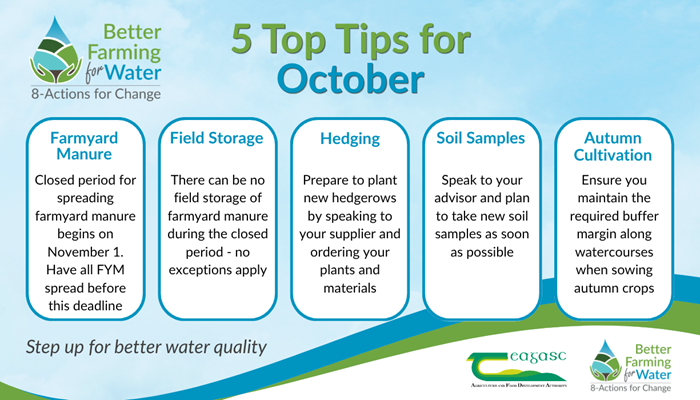
Farmyard manure
The closed period for spreading farmyard manure (FYM) begins on November 1. Plan ahead and ensure all FYM is spread before the closed period begins, when ground conditions are suitable and spreading is permitted.
Apply FYM in line with your Nutrient Management Plan and target fields where phosphorus (P) and potassium (K) are most needed. Do not spread on saturated or waterlogged soils, or when heavy rainfall is forecast. Maintain the required buffer zones beside drains, watercourses, wells and other sensitive areas.
- Standard surface waters: Maintain a 5m buffer from rivers, streams and open drains.
- Extended buffer periods: Increase the buffer to 10m during the first two weeks and the last two weeks of the permitted spreading season.
- Sloped land: Use a 10m buffer on land with an average incline greater than 10% that slopes towards water.
- Lakes and special features: Maintain a 20m buffer near lakes and larger water bodies.
- Wells and water supplies: Maintain a buffer of at least 50m to 250m from water abstraction points or wells used for human consumption, depending on the scale of the supply.
No field storage of FYM during the closed period is permitted – no exceptions apply. If farmyard manure is stored in a farmyard, all effluent generated from the manure must be directed to the effluent tank.
Planning a new hedgerow
Autumn is a good time to prepare for planting new hedgerows. Speak with your plant supplier early to source plants that are native species and grown in Ireland from Irish seed.
If planting a new hedgerow under a scheme, refer to the scheme guidance documents now to ensure you order the right type of plants and quantity needed.
The general guideline for planting a new hedge is 5 to 6 bare root plants per metre in a double staggered row, spaced about 30cm apart. Choosing species such as whitethorn/hawthorn, blackthorn, or holly will help create a dense hedge once established.
Well planned hedgerows can contribute to biodiversity, provide field boundaries and are valuable landscape features. When planning where to plant a new hedge, consider the position which will help intercept overland flow and protect vulnerable areas of the farm.
Soil samples
Speak to your advisor and plan to take new soil samples as soon as practical. Up-to-date soil analysis helps identify soil fertility requirements and supports the preparation of an accurate Nutrient Management Plan.
Applying nutrients according to soil sample results helps avoid unnecessary applications, improves nutrient use efficiency and reduces the risk of nitrogen and phosphorus losses to water.
If, in derogation, soil samples are required every four years, and a sample should represent no more than five hectares. Sampling areas of less than four hectares is recommended where practical, so as to divide fields based on soil type, cropping history and previous performance.
Autumn cultivation
When sowing autumn crops, ensure the required uncultivated buffer margin is maintained along watercourses and drains. These buffer zones help prevent sediment, nutrients and pesticides from entering watercourses.
A 3m uncultivated buffer zone is mandatory next to watercourses for all non-grass crops. While a 3m uncultivated buffer zone is mandatory next to all watercourses for non-grass crops, the buffer increases to 6m for late-harvested crops. A late-harvested crop includes vegetable crops harvested after September 15th, as well as fodder beet, sugar beet, main crop potatoes and maize, excluding cereal crops and beans. The minimum 6m uncultivated buffer applies to the ‘intersecting’ proportion of the watercourse, i.e. where the natural slope of the field directs water runoff into the river.
For more on the Teagasc Better Farming for Water Campaign, visit here.