
25 April 2024
Key advice for winter barley, winter wheat and fertiliser for spring cereals
Shay Phelan, Teagasc Crops Specialist, looks at the field work required for winter barley and wheat crops in the coming days and weeks and provides some key tips on a fertiliser strategy for late-sown spring cereals.
Winter barley
Most barley has received its final nitrogen at this stage and has already received its first fungicide, so all that is left now is to apply a growth regulator and a final fungicide. As many of the crops out there this year have limited yield potential for various different reasons, there will be no benefit in applying any extra fungicide when a growth regulator is being applied – probably next week.
Some farmers and agronomists are allergic to only putting one chemical into a tank to do a single job, and this is often the case when something like Terpal is being applied on winter barley. There seems to be a need to put something else in the tank to justify travelling through the crop, but – in this case, especially in 2024 – it is rarely warranted.
Be aware that KWS Joyau is very forward and probably needs a PGR as soon as possible, as awns will probably be visible by the end of next week.
The final fungicide should be applied at the awns peeping stage. Repeated trials have shown that by delaying for two weeks allows ramularia to infect the crop and will reduce yield by anything up to 0.4 t/ha. This will more than cover the cost of the fungicide, and remember include folpet at full rate but only 50% rate of an azole/SDHI/Strob mix will be fine e.g. Macfare Expro, Siltra, Decoy/Comet.
Winter wheat
Leaf 3 will be emerged on many of the early-sown wheat crops next week. From the Teagasc monitor crops we have seen, there is septoria reported on lower leaves which will spread up the plant. Graham does have some yellow rust, so be on the watch out for that. The table below gives options for growers at the leaf 3 application.
Table 1: Winter wheat disease control strategy Leaf 3
| Timing | Target diseases | Product options (rate/ha) |
|---|---|---|
|
Leaf 3 (third leaf fully emerged) |
Septoria, Yellow Rust and Eyespot |
Arizona/ Mirror/ Stavento 1.5L For Yellow Rust eradicant control – Elatus Era/Velogy Era/Tacanza Era 1.0L/ha, Comet/Modem 1.0 L/ha, Tebuconazole 1.0L/ha |
|
Date Late April |
+/- Mildew? | + Mildewcide e.g. clayton Midas ½ rate |
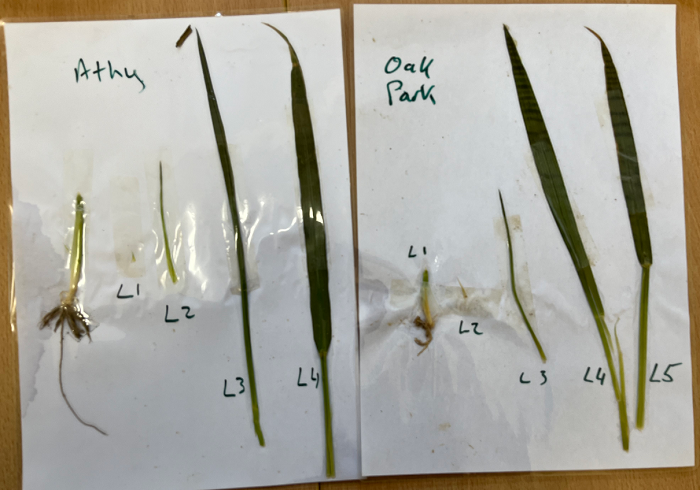
If you are unsure if leaf 3 is fully emerged, dissect the plants and count the leaves starting with the flag leaf (leaf 1). The picture below shows the different leaves from two different crops in Athy and Oak Park.
Figure 1: Various leaves from crops dissected from Athy and Oak Park
Spring cereal drilling
Many growers are continuing to drill spring cereal crops at the moment and one of the common questions we are being asked is how much nitrogen (N) should be incorporated into the seedbed. Some are suggesting that between 50-100% should go into the seedbed. Here are a few points to consider:
- Crops take up N by growth stage, so the majority of nitrogen uptake will still take place after GS30.
- Putting a higher proportion in the seedbed will help if a dry period follows sowing, but there is a risk of nitrogen losses if heavy rain follows. Applying nitrogen when the tramlines are visible is a compromise.
- Total nitrogen for feed crops should be based on yield potential. Use sowing date and establishment percentage as a guide. A 6.5t/ha crop has a requirement of 135kg/ha on index 1 soils. Add an additional 20kg/ha for every tonne expected over 6.5t.
- Reduce nitrogen rates for brewing barley equivalent to expected yield reduction when compared to a normal sowing date.
- Distilling is likely to be a real challenge with late-sown crops. A 20kg N/ha reduction from malting rates is generally recommended, i.e. if the recommendation was 120kg N/ha reduce to 100kg N/ha.
- High levels of unprotected urea will cause ammonia scorch and should be avoided.
Along with the contributions to Teagasc Daily, the Teagasc Crops Specialist team provide regular updates through the Teagasc Tillage Edge podcast. For more information on the Teagasc Tillage Edge podcast, click here.