
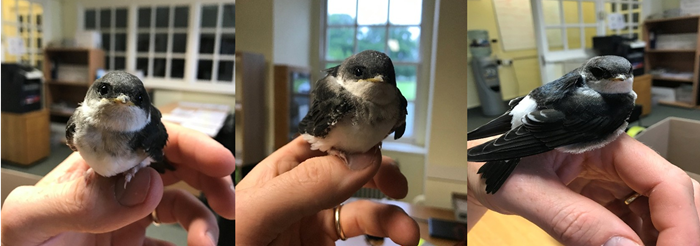
The summer evenings in Kildalton College in south Kilkenny are a flurry of activity given the recent return of guests from the warmer climes of the Sahara – the House Martin, College Lecturer at Kildalton, Brian Clancy tells us more.
These birds faithfully come all the way from Sub-Saharan Africa and the Iberian Peninsula to nest below the fascia boards on the college farm buildings each year.
Over the summer months, Ireland welcomes many migratory species that visit and breed on our shores. One such species is the House Martin (Irish name: Gabhlán Binne), which is a well-known summer visitor from mid-March to late September.
Each year, these amazing birds – which weigh no more than 20 grams (size of an AA battery) – make the 7,000km journey to a specific 6m2 or 8m2 of prime house front.
Their nests, built from mud, can take up to three weeks to construct and are located in the eaves of houses or buildings. They sleep in their nests at night. After their long journey, they don’t like having to build a new nest so regularly return to the same one each year.
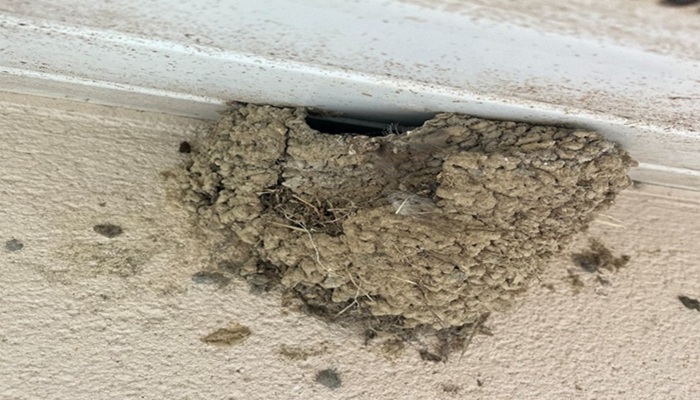
At this time, we believe the House Martins are busy feeding on insects, which they catch in flight, as they build up their energy after their long journey to Ireland in recent weeks.
Identification tips
House Martins are similar in size to swallows, but they can be distinguished from swallows as House Martins have a shallow forked tail compared to the swallow which has a long, forked tailed. The House Martin’s feathers are blue/black on the upper parts and white on the under parts. Although similar to Sand Martin, Swallow and Swift, the House Martin is the only one with a white rump.
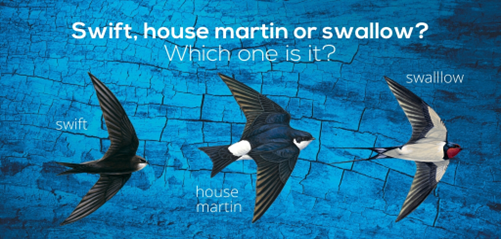
Image source: Royal Society for the Protection of Birds (RSPB)
These birds can have between two and three broods of chicks each year. Amazingly, some years, House Martins can still be rearing a brood of chicks well into late August, despite the fact that they usually begin their long return journey to Africa in September.
Conservation status
Red Lists are an internationally recognised methodology for assessing conservation status. An Irish Birds of Conservation Concern (IBoCC) List was published for 2020 to 2026. It found that the House Martin was Amber listed, meaning they are of medium conservation concern.
Management tips
- Food for House Martin:
- They spend most of their time on the wing collecting insects.
- Farmland habitat like mature native hedgerows, wet areas and ponds will help to supply their food, as will reducing the use of pesticides.
- Nesting sites for House Martin:
- The bird’s mud nest is usually sited below the eaves of buildings.
- A muddy pool or puddle where they can collect nesting material is helpful, especially during a dry spring.
- They cannot build their nests on plastic or metal surfaces, so lining eaves with suitable material such as wooden planks, will provide a nestbuilding opportunity.
- Various artificial House Martin nests are available. Several prefabricated nests can be placed alongside each other to encourage House Martins.
Studies at Teagasc Kildalton College
House Martins were first ringed in Kildalton College in 2016 by a local Ecologist/Ornithologist. Normally, three visits are carried out each year. Birds are caught by putting up mist nets which catch birds entering and leaving the nest site. Once a bird is caught, it is extracted from the net, fitted with a tiny aluminium ring which has a unique number so – if it is recaptured – its movements can be tracked. The birds are aged and sexed and have other biometric data taken such as wing length, weight, stage of moult, fat score and muscle score. The bird is then promptly released. In Ireland, bird ringing is linked with the British Trust for Ornithology and the National Parks and Wildlife Service.
The reasons for catching birds in general, which applies to House Martins, is to increase our understanding. The data collected can be used to monitor survival rates, breeding productivity and their general movements during migration if they happen to be re-trapped.
No birds were ringed in 2021 at Kildalton College due to the COVID-19 pandemic. In 2024, there was only one visit because numbers were down. Since starting in 2016, over 400 birds have been ringed, with some birds re-trapped in subsequent years. One adult male House Martin was caught in 2017 and re-trapped again the next two years. He had been over and back to Africa at least four times and managed to find his way back to the same spot to breed each year.
Re-trapping rate is currently running at around 30% which is comparable to other sites which ring House Martins in the UK. For example, if 100 birds were caught this year, next year re-trapping would be around 30 of those 100.
Where on the farm?
House Martins are mostly associated with people, found around towns and villages. House Martins can be seen feeding on aerial insects and so are most frequently seen in areas of mixed agriculture, near water and in the vicinity of woodland. They can be found nesting under eaves of suitable buildings, between 5 and 10m above ground.
Value
Aerial feeders over farmland, like House Martins indicate a good supply of flying insects are available. They feed on flying aphids, so act as a natural pest control. The area around farm buildings can makes an important contribution to farm wildlife.
Affected by a change in climate?
As these birds rely on wet weather to build their nests, and warm weather to gather food, dramatic changes in the weather (such as extreme dry or cold periods) can have a negative effect on their numbers.
Key facts about the House Martin:
- They traditionally built their mud nests on cliff faces.
- In the last 200 years, they started to make use of buildings, allowing them to expand their range.
- They now favour the close association with people, which has allowed the birds to even use urban areas.
- They are colonial nesters, with an average group size of four to five nests, although larger colonies have been recorded.
- Their intricate mud nests are built up with layers of bill-sized pellets. They take days to build and are often returned to and used in following years.
- Both males and females help to build the nest.
- The female lays up to five white eggs, which hatch after about a fortnight. The chicks are usually ready to fledge after around 22–23 days. A second brood is usually raised each year.
Find out more about Kildalton College here.
More from Teagasc Daily: Fabrication at Kildaton: Bringing designs to life
More from Teagasc Daily: Host farm placements proving valuable to Kildalton College students
More from Teagasc Daily: Strengthening equine futures at Kildalton College
More from Teagasc Daily: Udderly realistic: How calving simulators are ‘moo-ving education forward at Kildalton College