
Learning more about organic farming in Ireland
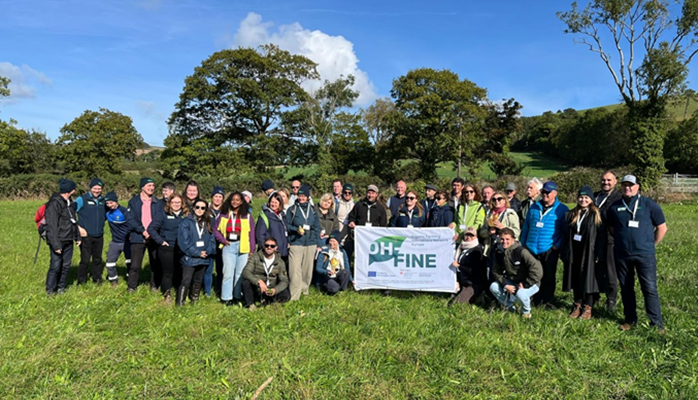
Farmers, advisors and researchers from seven countries visited Ireland in late September as part of a Teagasc hosted OH-Fine Project cross-visit to learn more about organic farming in Ireland.
OH-FINE is a 48-month Horizon Europe project focused on improving how knowledge about organic farming is created, exchanged and put into practice. The project includes established organic farmers, farmers undergoing conversion and farmers considering organic production with more than 100 case-study farms participating across five countries.
The first day began with a visit to Tommy Delahunt’s farm in County Wicklow. Tommy is an OH-FINE case study farmer and two OH-FINE field trials are taking place on his farm. Participants were shown the preliminary findings of the OH-FINE pea/bean intercropping ratios trial and the organic fodder maize trial. The group also learned about the Organic Tillage and Vegetable (OTV) EIP project and saw some of the weeding machinery used in the OTV project.
Following this, participants visited the Teagasc organic beef demonstration farm in Kildavin, Teagasc Johnstown Castle. The Teagasc team presented research results on the production costs and performance of suckler-breed organic weanlings and alternative organic finishing diets for beef cattle. Participants particularly valued the opportunity to see multi-species swards in practice and learn more about organic finishing diets.
On the second day, the group toured Airfield Estate, a working, organic farm situated within Dublin city limits. With a strong focus on tourism and education, Airfield provided participants with insight into how organic farming can be promoted through wider public engagement. The cross-visit ended at the McNally family farm in Dublin, which produces organic horticulture using both a polytunnel system and outdoor planting. The farm showcased innovative production techniques and marketing strategies for organic horticulture.
The cross-visit was very positively received by the participants. International visitors commented on the positive and collaborative nature of Ireland’s organic farming sector. They also noted the uniqueness of the strong links between advisory services, education and research within Teagasc in comparison with their own countries’ experiences. The key role played by the organic specialists and advisors in supporting farmers in the transition to organics was also highlighted.
The above first appear in the Teagasc Organic newsletter.
For more information and to sign up to subsequent editions, visit here.