
Lessons on rearing pigs with intact tails
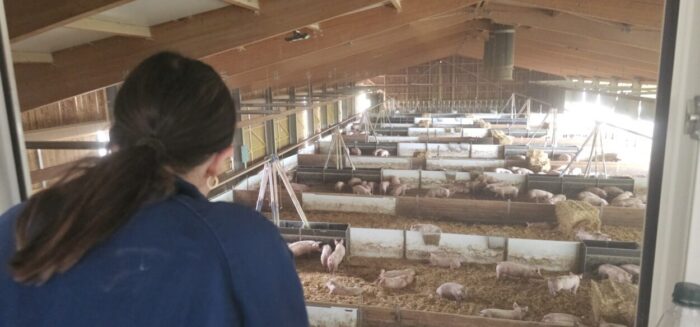
During a recent trip to Germany for the European Association for Animal Production meeting in Hamburg, Laura Boyle, Teagasc Pig Research Officer, visited Jan-Hendrik Hohls pig farm with Mirjam Lechner, a German consultant specialising in behavioural and metabolic disorders in pigs.
The farm is in Becklingen, Lower Saxony about 90km outside Hamburg, it is a well-known demonstration operation and has received national recognition and numerous awards for its commitment to animal welfare.
The enterprise is a multi-generational family farm operated by Jan who has a background in agricultural engineering and business economics with his wife Claudia and their 3 children, with support from the older generation, two permanent employees, an apprentice and seasonal labour. The farm integrates approximately 255 ha of arable land with pig production (breeding and finishing) and a biogas plant. Jan has a clear commitment to the concept of circularity. Most of the pigs feed is produced on the farm in a computer-controlled mill with high traceability. The diets are based predominantly on Jan’s home-grown cereals (barley, rye, wheat, maize), are GMO-free, and are formulated on fibre content. This is central to Jan (and Mirjam’s!) belief that gut health is a central element of both animal health and behaviour. Interestingly the farm also incorporates former foodstuffs in their pig diets.
Manure and slurry, together with grassland residues, feed the on-farm biogas plant. This partly ‘fuels’ the farms electricity and heating requirements with excesses sold to the grid and digestate returned to the fields as fertiliser. Photovoltaic installations on the roofs further support energy self-sufficiency. Slurry storage capacity is nine months.
Jan has approximately 320 sows (managed in groups of around 45) and around 2,000–2,500 finishing places within an annual production of 8,000–9,000 finished pigs. In keeping with the circular philosophy all animals are born and raised on the farm under a fully closed system. The core of the operation is the branded “Becklinger Strohschwein” (‘Becklinger Straw Pigs’), produced under a premium standard. The finisher pigs have permanent outdoor access and are on deep straw bedding indoors with a space allowance of 1.5 m² per finishing pig. One of the finishing buildings is an advanced “Pigport 5” design, one of only a few of this type in Germany. The weaner pigs are not kept on straw but are kept at a lower stocking density than required by legislation in conventional pens with slatted flooring and a balcony that is brought into use once the pigs are 1 week old. Earlier than that there is a risk of pigs remaining up on the balcony (and therefore not eating or drinking) either because they are too scared to scale the downward slope and become ‘trapped’ up there or because they choose to stay up on the balcony to avoid potential stressful social interactions occurring after mixing down below.
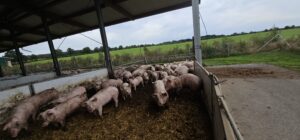
All pigs are produced with intact curly tails for which there is a premium (Ringelschwanz). Jan has not practised routine tail docking for more than four years, he emphasised that the position and condition of the tail serve as a practical daily welfare indicator for him and his staff. Indeed, the weaner pigs looked in excellent condition, with no visible evidence of ear necrosis. This contrasted with recent Irish research in which ear necrosis was observed in weaner pigs on many of the farms visited.
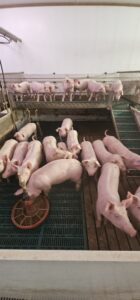
Jan provides the weaners with feeder trays of soya husks/hulls on a permanent basis. Mirjam prefers not to use the term ‘enrichment’ for such rooting and foraging materials and instead prefers to talk about ‘fibre food’ because of the role they play in balancing gut disturbances. Despite having ad lib access to a high fibre (and presumably more attractive) ration, the trays of soya husks were in good use. There were also sacks of compost and clay outside the weaner rooms which the farm mixes into the trays of soya hulls if pigs show signs of tail biting. There was one pen containing some bitten pigs. Mirjam dumped a scoop of clay into the pen and it was amazing to see the pigs vigorously compete for access to this bland and tasteless ‘foodstuff’. Mirjam said this shows that those pigs were experiencing gut disturbances which would have increased their propensity to tail bite reinforcing the well-known link between poor health and damaging behaviours. Mirjam talked about geophagy which is the deliberate consumption of soil/clay by wild and domestic animals. Animals appear to use it for mineral supplementation, detoxification, and relief of gastrointestinal issues such as diarrhoea, parasites/pathogens, or acidosis (in ruminants).
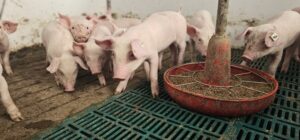
Jan tests his water quality frequently and water was generously provided in the weaner pens and generally throughout the farm, always in bowls rather than via nipple drinkers. Mirjam explained that in workshops she often challenges farmers to see how long it takes them to drink via a nipple on a bottle of water likening it to the difficulty a newly weaned 8kg pig faces in trying to consume their daily water allowance (approximately 1 litre) via a nipple drinker. Other strategies in evidence on the farm included robot-distributed fresh straw, brushes and opportunities for cooling. Jan stressed the importance of continuous animal observation as being essential to maintaining high levels of intact tails and low levels of aggression.
Jan’s pigs are marketed regionally under the “Becklinger Strohschwein” brand. The main partner is Fleischerei Zimmermann in Celle (approximately 35 km away). Products are sold through all 10 branches of Fleischerei Zimmermann, 6 Edeka Ehlers markets and 58 Wurst-Basar outlets in the greater Hannover area. The brand is positioned as a premium product. Jan explained that the viability of his business depends on achieving roughly 40 % above conventional market prices. Additional support comes from the Lower Saxony Ringelschwanzprämie and federal animal-welfare funding used during the conversion phase. The farm’s awards (Innovationspreis Tierwohl 2021 and first place in the MSD Preis der Tiergesundheit 2022) are actively used in communication with customers.
The focus of the tour of the farm was not on detailed technical performance figures, but gave an excellent overview of how the farm works. The visit confirmed a commercially sized operation that has successfully integrated higher welfare standards (intact tails, straw and outdoor access) into a closed, regionally oriented production system. The importance of space, observation, feed and water quality/quantity, fibre provision, circularity and short supply chains was a consistent feature of our discussions. The visit provides a useful reference for discussions on the feasibility of elevated welfare standards in conventional pig production here in Ireland.
In a future Teagasc Daily article Laura Boyle will share how she believes Jan achieves his impressively low sow replacement rate!