
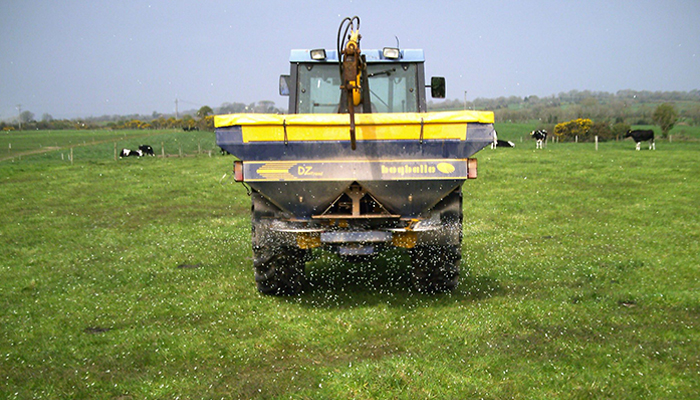
Grass-based dairy farms in Ireland have reached a critical point regarding the use of chemical nitrogen (N) fertilisers. There has been a significant lowering of chemical N use over recent years, with further cuts potentially leading to a risk of generating fodder shortages and increased reliance on feed import requirements.
This is one of the key findings from the recently published Teagasc report: ‘An environmental and economic assessment on the impact of possible reductions in the maximum chemical nitrogen allowances for all grassland stocking rates’, prepared at the behest of Minister for Agriculture, Food and the Marine, Martin Heydon T.D as part of the preparatory work for Ireland’s next Nitrates Action Programme and importantly securing a continuance of Ireland’s Nitrates Derogation.
Modelled simulations and national farm data contained within the report show that Irish farms are facing forage supply deficits as a result of further reductions in chemical nitrogen fertiliser use, resulting in dairy systems becoming less self-sufficient in feed supply. Already, dairy farmers have adjusted to lowered chemical N allowances but reducing chemical N allowances further risks deepening these deficits, leading to increased reliance on imported feeds, which may unintentionally raise N and phosphorus (P) inputs on farms, while increasing embedded GHG emissions while counteracting environmental progress from reduced N fertilisers.
Strategies – such as improving soil fertility, enhancing the efficiency of organic manure use, and incorporating white clover into perennial ryegrass swards – do exist and are effective at reducing the dependence on chemical N fertiliser.
However, as discussed within the report, the successful adoption of these technologies at farm level requires more time before further reductions in chemical nitrogen allowances can be realistically achieved.
Impact on arable crops
Similar to the above, Teagasc has also prepared a report assessing the potential impact of a reduction in chemical nitrogen use on arable crops.
The report on ‘An environmental and economic assessment on the impact of possible reductions in the maximum chemical nitrogen allowances for main arable crops’ outlined that the current fertiliser levels used are based on an economic optimum, above which further yield increases do not cover the cost of the additional fertilizer, they are therefore, below the rate to achieve maximum yield.
Research also shows that the residual nitrate-N at harvest of a crop remains relatively stable until applications exceed N optimum and then increase steadily as additional fertilizer N is applied.
Reducing recommended N rates for arable crops is therefore unlikely to provide any environmental benefit but risks reduced yield and profitability in a farming system. Arable systems are at risk of N leaching in the autumn and winter due to the mineralization of organic N residues when there is no crop to take up the N. Establishment and maintenance of over winter green cover is therefore the key action in arable systems to reduce the risk of over winter N leaching.