
Lots of rain and lambs in Galway
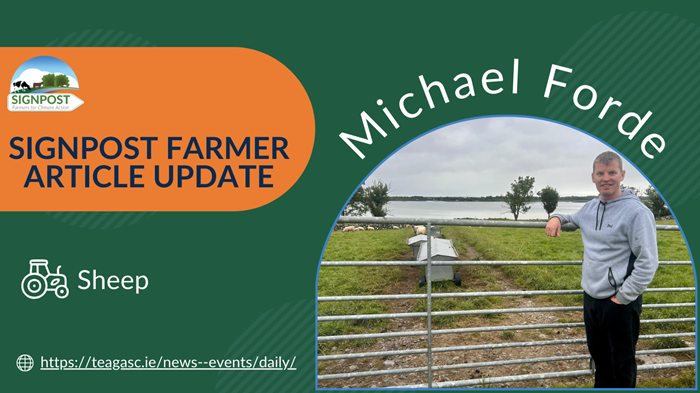
Participant in the Teagasc BETTER Sheep Farm and Signpost programmes, Michael Forde takes a look back at a challenging but successful lambing season, and outlines his plans for fertiliser, soil fertility improvements and silage for the year ahead.
Since writing my first article a month ago, a lot has changed on farm. This spring is a completely different spring than that of 2025, that’s for sure.
Lambing has gone quite well here on the home farm. We had a total of 180 to lamb this Spring.
We encountered a few issues with the hoggets. One or two hoggets had no milk and one or two lambs failed to thrive, but in general they went well. In-lamb ewes are group penned in the sheep shed and then moved to individual pens as they lamb.
We try and leave the ewes with their lambs for a week or so to ensure there is a good bond between ewe and lamb. Then we put out batches of ewes and lambs to grass. We have an out-farm in Corrandulla and we currently have 40 ewes with their 74 lambs there.
Challenges
The rain has been extremely challenging and even forced us to rehouse ewes and lambs again as we felt the weather was too harsh for these young lambs. It is amazing how the few days extra inside benefited these lambs, when compared to some others outdoors. We like to give the lamb every chance to develop and build their strength and immunity as this reduces any health issues and helps develop a hardier type sheep.
Nutrient management
In terms of fertiliser and slurry, we spread our first round of fertiliser on the 20th of March on lands that we could travel. We had several paddocks in which we could not travel due to conditions being too wet and soft. We went with a half a bag of protected urea (38% nitrogen & 7% sulphur). No slurry has been spread yet and we will hold off and spread this slurry on the silage ground post harvesting.
Silage budgeting
Thankfully, silage stocks from 2025 were high and we had a surplus. I will ensure that sufficient silage is made this year and that we have a buffer of feed.
This year, I plan on making some changes to the fields I harvest for silage. We always tried to make as much silage as possible on the home farm. One of the main reasons for this being the ease of bringing in bales as they were near the yard. However, this year we are going to try and give some of these fields a rest in terms of silage harvesting and instead we will harvest on other fields on two of the out-farms. While this may add cost and time in drawing in bales, I feel it will benefit the soil in the long term.
Soil fertility
Looking at our soil samples taken in 2025, out of 11 samples taken there is only a requirement to spread lime on 3 of these which we plan on doing this year. Six of the 11 samples taken were either Index 1 or 2 for phosphorous and we plan on spreading more 18-6-12 on these and targeting slurry on those fields also. The remaining 5 samples were either index 3 or 4 for Phosphorus which I was reasonably happy with.
We had taken a break spreading phosphorus due to the results of the previous soil samples but since then some have slipped a little. This also shows the importance of regularly testing the land and targeting slurry on the lower index soils. Our potassium status is quite good with no sample being Index 1 and just 3 soils being Index two with the remaining 8 samples being Index 3. It was also interesting to note that 2 of the 3 lowest potassium soils were also the two lowest fields for phosphorous.
The above first appeared in the Farming Examiner as part of a Signpost Programme update.