
26 November 2024
Lowering emissions without hampering profitability
Farmers enrolled in the Future Beef Programme – Teagasc’s flagship suckler demonstration farm programme – have achieved significant reductions in greenhouse gas emissions without impacting on farm profitability.
As part of the Teagasc National Beef Conference, held on November 18, Manager of the Future Beef Programme, Martina Harrington detailed how this is being achieved, and discussed the key technologies being implemented on the 22 suckler demonstration farms enrolled in the beef industry supported programme.
The title of Martina Harrington’s presentation was: ‘Driving Sustainability: Innovations on Future Beef Farms’, to which she prefaced: “We are looking to create more profitable and more sustainable farms.
“The word sustainability is used a lot, but if our farmers are not profitable, they are not viable and they are not going to stay in business. Profitability is key.”
Along with profitability, central targets of the Future Beef Programme are reducing greenhouse gas and ammonia emissions, improving water quality and biodiversity, and to provide a platform for knowledge sharing and dissemination of key technologies to farms in close proximity to the demonstration farm locations.
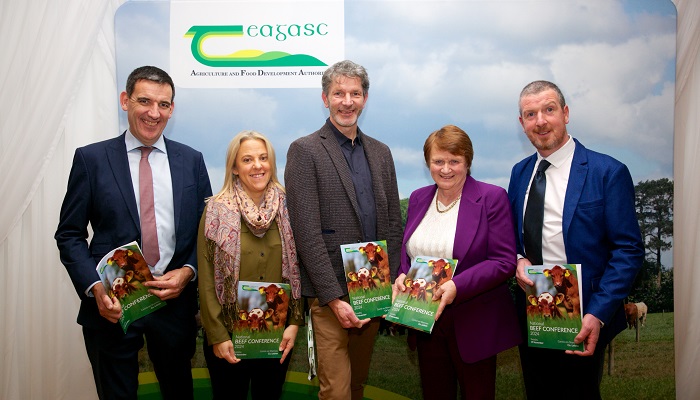
Pictured at the Teagasc National Beef Conference on November are from left to right: Pearse Kelly, Head of Drystock Knowledge Transfer at Teagasc; Martina Harrington, Manager of the Teagasc Future Beef Programme; Shane Pearson, Design Your Life Coaching; Alice Doyle, Deputy President of the Irish Farmers’ Association and Teagasc Authority member; and James Keane, Teagasc Regional Advisory Manager for Leitrim, Sligo and Donegal.
Progress to date
Since the programme was launched in 2021, the Future Beef farmers have made significant progress – both in terms of profitability and emissions reductions. When 2021 and 2023 are compared, Martina Harrington explained, gross margin improved by €160/ha on average across the farms, while the carbon footprint (GHG/kg of beef) declined from 10.63 to 9.75 – an 8.64% reduction.
Table 1: Key progress made on the Future Beef farms
| KPI Progress | 2021 | 2023 | Change |
|---|---|---|---|
| Gross margin (€/ha) | €629 | €789 | +€160 |
| Carbon footprint (GHG/kg beef) | 10.63 | 9.75 | -8.64% |
| Calves per cow per year | 0.92 | 0.96 | +0.04 |
| Heifers calved at 22-26 months | 69% | 82% | +13% |
| Age at finish – heifers (months) | 24.4 | 22.6 | -1.8 |
| Age at finish – bulls (months) | 16.3 | 15.4 | -1.0 |
| Age at finish – steers (months) | 21.8 | 21.1 | -0.7 |
| Output per livestock unit (kg) | 360 | 367 | +7.0kg |
| Optimal soil fertility | 17% | 20% | +3.0% |
| Silage DMD % (2022, 2023) | 69% | 73.4% | +4.4% |
| Chemical nitrogen (kg/ha) | 96 | 80 | -16.6% |
On how this was achieved, Martina Harrington explained: “Our focus is on increasing the output on these farms – increasing the kilograms of beef that are being sold – while reducing the inputs on the farm. It just so happens that this improves profitability and reduces the carbon footprint as well.”
Genetics and fertility
To ensure additional beef output is delivered – a key element in generating a margin from beef production systems – the Future Beef farmers are paying particular attention to the genetics of their cows. On this, Martina Harrington explained: “It is really a marriage between carcass, milk and fertility of the suckler cows to ensure we are producing a good-quality weanling that has a high value and is increasing the output on our farms.”
Some of the measures being taken on the Future Beef farms include: matching the sire – either the stock bull or through AI – with the cow to improve a herd’s weakness is specific traits; the introduction of good handling facilities and, in some cases, synchronisation programmes to facilitate the use of AI; and, on a small number of farms, the use of sexed semen.
Another key element of output discussed was the importance of producing a calf per cow per year, with Martina Harrington explaining: “The holy grail on any suckler beef farm is to have that calf per cow per year. We want every cow going out to grass with a calf with her and that includes your heifers, and we want those calving at 24 months.”
The critical actions being taken at farm level to achieve this are: ensuring the bull is fertile; cows are maintained in an appropriate body condition score pre- and post-calving; the correct nutrition is provided; and health and hygiene is in check to ensure calves remain healthy after birth.
Highlighting the improvements the Future Beef Farmers have made in this regard, Martina Harrington added: “They have reduced their calving interval, reduced mortality and have increased their calves per cow per year.
“74% of heifers are now calving at two years of age, showing it can be done at farm level when the right management is followed and heifers are minded.”
Weight gain and soil fertility improvements
The importance of having the correct genetics in play, along with being focused on feed management, were also discussed as having a critical role in delivering weight gain on the Future Beef Programme farms.
Martina Harrington detailed the practices the farmers are following to ensure weight gain at grass is maximised. Such practices include: budgeting and measuring grass through PastureBase Ireland; the implementation of spring and autumn rotation planners; making improvements to grazing infrastructure at farm level; and grazing grass covers at the correct pre-grazing height (9-10cm).
Winter feed management was also discussed, with Martina Harrington highlighting the importance of making distinctions between the qualities of silage available on farm. Higher quality silages (74+ DMD) are targeted at growing and finishing animals, freshly-calved cows require a silage of 70+ DMD to support milk production in early lactation; whereas dry suckler cows, where body condition preservation is a priority, require only moderate levels (66 DMD) of silage quality.
The farmers enrolled in the programme, Martina Harrington explained, have also made considerable progress in improving silage quality. First-cut silage quality moved from an average of 69.8 DMD in 2022 to 74.6 DMD in 2023 – allowing farmers to make a considerable saving on the meal required to support performance over the winter months.
Other measures being implemented by the Future Beef farmers were also discussed. These include: the correction of soil fertility through liming and the appropriate use of organic and compound manures; the application of appropriate weanling procedures to limit stress and to prevent a weight gain check; and the introduction of white clover and red clover swards, with 10 farmers in the programme now having the latter included in their rotation to provide a high-quality silage supply.
Additionally, in terms of making improvements to water quality and biodiversity, Martina Harrington told the delegates in attendance that the farmers have all received visits from ASSAP advisors and are implementing measures on their farms to protect water quality. Such measures include the fencing off of water courses and the implementation of buffer strips. Additionally, the Future Beef farmers are also participating in the National Biodiversity Data Centre’s monitoring programme to identify and improve areas on their farms.
If you were unable to attend the National Beef Conference, a recording of Martina Harrington’s presentation is available to view below:
Find out more about the Future Beef Programme here.