
19 June 2023
Machinery the largest investment on farms
After a number of years of substantial growth, gross new investment on Irish farms declined by 11% in 2022, the 2022 National Farm Survey has revealed. This decline is evident across all systems, except for dairy where investment was up marginally (2%) compared to 2021.
The survey, which is representative of almost 85,806 farms in Ireland, shows, on aggregate, across farm systems on-farm investment totalled over €1.35 billion. Investment on dairy farms remained highest, at an average spend of €46,005 per farm in 2022. Investment on dairy farms accounted for over half of total investment in 2022.
Investment across drystock farms declined further in 2022, having been quite static in recent years. On the average cattle ‘rearing’ farm – typically a suckler farm – in 2022, investment expenditure totalled €5,085. The equivalent figures on cattle ‘other’ – typically beef finishers – and sheep farms were €6,904 and €8,543, respectively. Investment on tillage farms also declined in 2022, down 24% year-on-year to an average of €21,997 per farm.
Investments
Figure 1 illustrates the broad composition of investment across farm systems. Machinery related investment was proportionately the largest investment category across farm systems in 2022. It accounted for just over half of total investment on the average dairy farm, at just over €24,000, and three-quarters on the average tillage farm, at just over €16,500. On drystock farms, machinery related investment of between approximately €3,500 and €6,000 on average, represented between 60% and 70% of total investment on those farms in 2022.
Figure 1: Average composition of farm investment by farm system 2022
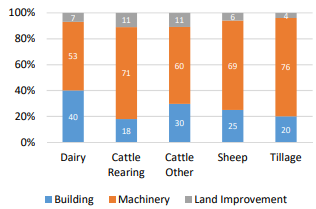
Building investment averaged €18,500 on dairy farms in 2022, with lower amounts of under €1,000 to €4,500 across the other farm systems. Expenditure relating to land improvement remained relatively low in 2022, at close to €3,000 on the average dairy farm and between €500 and €1,000 across the other systems.
Farm related debt
Farm related debt remained relatively stable year-on-year, up 1% on average across farm systems. On dairy farms, average debt declined by 7%. The decline was larger on cattle ‘rearing’ farms on average, down 26% (reflective of reduced investment). Outstanding debt on the average tillage farm remained relatively stable in 2022 (down 1%), but there were increases in debt on cattle ‘other’ and sheep farms.
Across all farm systems, 61% of farms have no farm business related debt (Table 1). However, this figure varies considerably by farm type. Two-thirds of dairy farms had related borrowings in 2021, compared to just over one-quarter of cattle ‘rearing’ and one-third of cattle ‘other’ farms. Similarly, 3 out of 10 sheep farms had outstanding farm debt in 2022, while the figure was 4 out of 10 for tillage farms, on average.
Table 1: Average farm debt by system 2022
| Farms with borrowings |
Average debt (farms with debt) |
|
|---|---|---|
| % | € | |
| Dairy | 66 | 127,477 |
| Cattle ‘rearing’ | 27 | 27,435 |
| Cattle ‘other’ | 35 | 50,015 |
| Sheep | 32 | 34,634 |
| Tillage | 40 | 78,375 |
| All | 39 | 72,809 |
When farms without debt are excluded, the average dairy farm debt in 2022 declined by 8% year-on-year to €127,477. The average debt on cattle ‘rearing’ farms with loans declined by 9% to €27,435, with the equivalent figure on cattle ‘other’ farms up 7% to €50,015 and debt on sheep farms also rose to €34,634. The data indicate that the average debt on tillage farms with loans also increased substantially in 2022 to €78,375, on average.
Debt type
The majority of farm related debt was classified as medium to long-term in 2022 (75%), with a further 18% relating to hired purchase or leasing and the remaining 7% considered to be short-term debt e.g. overdrafts. On average, 77% of dairy farm debt was classified as medium to long-term, with the comparative figure on cattle ‘rearing’ and cattle ‘other’ farms 80% and 70% respectively. The figure was lower on sheep farms at 61%. On the other hand, only half of average tillage farm debt was classified as medium to long-term, with 49% related to leasing or hired purchase and the remaining 2% considered to be short-term.
Debt to income ratio
Figure 2 presents the debt to income ratio for all farms, by system. The calculation is shown for all farms (inclusive of those with and without debt) and separately for just those farms with outstanding debt in 2022. Dairy farms were more likely to have debt than other farm types, and were also more likely to have substantially higher absolute levels of debt. However, given their comparatively higher income levels, the average debt to income ratio on dairy farms improved year-on-year at 0.77. Reductions in the debt to Family Farm Income for dairy farms generally occur in years when there are elevated income levels. More recently, this has resulted in the increased funding of investment through the use of earnings rather than borrowings. The average debt to income ratio also improved on tillage farms in 2022, at 0.69.
Figure 2: Farm debt to income ratios for all farms and those with debt in 2022
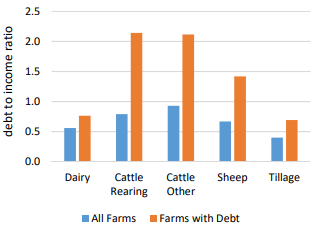
Conversely, although only 27% of cattle ‘other’ farms reported having debt in 2022, the debt to income ratio of those with borrowings was relatively high compared to other farm systems, at 2.14. A similar ratio (2.12) is reported on cattle ‘other’ farms (35% of whom had farm related debt in 2022). The debt to income ratio was also above 1 on sheep farms, at 1.42 in 2022.
This article was taken from the Teagasc National Farm Survey 2022, access the full publication here.
Also read: Increase in farm incomes largely confined to dairy and tillage farms in 2022
Also read: Milk price rise offsets steep production cost increases on dairy farms in 2022
Also read: 21% decline in sheep family farm income in 2022
Also read: Higher cattle prices boost beef finisher farm incomes in 2022
Also read: Rising gross output fails to lift cattle rearing income in 2022
Also read: Average tillage income rises 32% year-on-year