
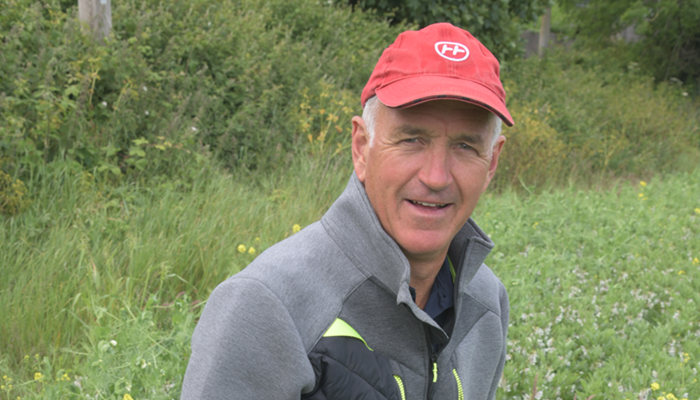
Teagasc Organic Tillage Specialist, Martin Bourke reports from Wicklow where Tommy Delahunt outlines his progression into organic tillage farming; his key message – rotation, rotation, rotation.
Tommy Delahunt, who farms just outside Wicklow Town, is a relative newcomer to organic tillage but is already making confident strides. In January 2023, he converted 18 hectares of his conventional tillage farm to organic. So pleased was he with the performance of his crops in that first year, he decided to convert another 14 hectares the following year, bringing his total organic area to 32 hectares (80 acres).
At the heart of Tommy’s organic philosophy is one key message: “Rotation, rotation, rotation!”
“Rotation is always important in tillage farming,” Tommy said, “but with organic crops, it’s absolutely critical. You’re managing fertility, weeds, and disease without chemicals, so you need to think ahead.”
His first two years under organic management featured spring oats, a pea/barley mix, a pea/bean intercrop, and a multi-species grass sward for fertility building. This year, he has introduced winter oats and winter barley, and is experimenting with organic maize, testing the limits of what can be achieved in an organic system.
Multispecies grass: fertility, feed and field performance
A key component of Tommy’s rotation is the use of multispecies grass swards, which serve multiple functions in an organic tillage system. These swards are typically a mix of grass, clovers, plantain and chicory.
The swards yield multiple benefits:
- Nitrogen fixation from legumes like white and red clover.
- Deep-rooting species like chicory help break up compacted soils and improve soil structure.
- Improved drought resistance and grazing resilience from diverse root systems.
- Enhanced soil biology and organic matter from a variety of root exudates.
- Natural weed suppression through dense ground cover.
Tommy sowed his multispecies sward in 2023 and grazed it with hoggets.
“I was blown away by both the performance of the sheep and the sward itself,” he said. “The lambs thrived on it, and the grass just kept coming back.”
After ploughing down the sward this spring, the benefits were immediately clear – the spring oats following the sward were some of the best-looking on the farm. Encouraged by this result, Tommy plans to continue incorporating multispecies grass into his tillage rotation in the years ahead.
From weed worries to weed wisdom
“Before making the switch, weed control and crop sales were my main concerns,” said Tommy. One persistent problem on the farm was wild oats, which had become resistant to all the herbicides available to Tommy.
“To be honest, that was part of what pushed me toward organic,” he explained. “I thought – what have I got to lose?”
The result? A very pleasant surprise. In his first two years of organic cropping, wild oats have been virtually absent and overall weed levels have stayed under control. While weeds are still present, Tommy has found that a quick-starting crop with strong vigour often outcompetes them.
“The crop just needs to get ahead early,” he said. “Species choice plays a big part.”
Oats: The organic tillage champion
It’s no accident that oats make up over 60% of all organic crops grown in Ireland. Not only is there strong market demand – especially from buyers like Flahavan’s, who contract Tommy’s oats – but oats also have a natural edge in the field.
Oats have a unique characteristic: they release natural compounds into the soil that suppress the germination and growth of nearby weeds. This built-in weed-fighting trait gives them an advantage in organic systems where synthetic herbicides are off the table.
That said, even with their benefits, oats need to be rotated carefully. Over-relying on them in the same field can lead to a build-up of Oat Mosaic Virus (OMV), a soil-borne virus that can linger for up to five years and affect future oat crops. One key risk is leaving spring oat volunteers growing in the autumn and early spring, which Intercrops are a key part of Tommy Delahunt’s rotation effectively acts like a continuous crop of winter oats – giving the virus a chance to take hold.
Getting a well-established catch crop or cover crop – without oats in the mix – can greatly help reduce the carryover of oat volunteers to the next crop and break this damaging cycle.
Every crop has a home
Another major part of Tommy’s success is how he plans for the market before planting. His oats are grown on contract for Flahavan’s and his intercrops are sold to organic livestock farmers for use as protein-rich, homegrown feed. This forward selling means he’s not taking chances at harvest – every crop has a home before the seed goes into the ground.
Driving innovation in organic protein crops
Tommy is also one of 13 participant farmers in the Department of Agriculture, Food and Marine-funded Teagasc Growing Organics Programme – a five-year monitor farm initiative aimed at supporting and showcasing best practices in organic farming.
A key feature of this programme on Tommy’s farm has been the on-farm trialling of protein crops for the organic animal feed market. In 2024, Tommy achieved a yield of 5.5 tonnes per hectare from his pea/bean intercrop, which was subsequently sold to an organic dairy farmer.
This year, he introduced a pea variety called ‘Ingrid’, known for better standability to reduce lodging in his barley/pea and bean/pea mixes. He’s also using a very early Finnish variety of bean called ‘Vire’ to ensure simultaneous ripening of the peas and beans – critical for a clean, efficient harvest. Beyond feed markets, Tommy’s farm also participates in trials for the VALPRO Path project, a Horizon Europe crops like peas into the human food market – think pastas, breads and other plant-based alternatives. The project balances profitability with environmental and social responsibility to future-proof the European protein supply chain.
Profit over yield: A fresh look at margins
“One of the most striking realisations for me since moving into organic tillage has been the difference in profitability,” Tommy said. “While many conventional tillage farmers focus on high yields and clean-looking crops, there are hidden costs behind that glossy image. The margins in conventional tillage are razor thin,” he said. “You’ve huge input costs, and then you’re hit with depressed grain prices. It’s a tough model to make work.”
For Tommy, going organic hasn’t just been an environmental or philosophical decision – it’s been a financial one. He’s found that the organic side of his farm is delivering a better return per acre, even if the yields aren’t as high.
“You have to be honest with yourself,” he said. “Is it really about yield? Or is it about profit? Because it’s the profit that keeps the farm going.”
The switch in mindset wasn’t easy. Like many conventional growers, Tommy had become accustomed to the pursuit of perfect-looking crops. But once he started measuring success in profit per acre instead of tonnes per acre, the picture became much clearer.
“The organic part of my farm is winning hands down. That’s why I’m now planning to expand more of the farm into organic,” he said. “It’s also a way of diversifying risk – with multiple buyers and lower input costs, the business is more resilient.”
For any farmer wrestling with the decision to convert, Tommy has a simple message: take a hard look at your books, not just your crops.
The above article first appeared in the July/August edition of Today’s Farm, find out more here.
Find out more about the Teagasc Growing Organics Farm Walk Programme here.