
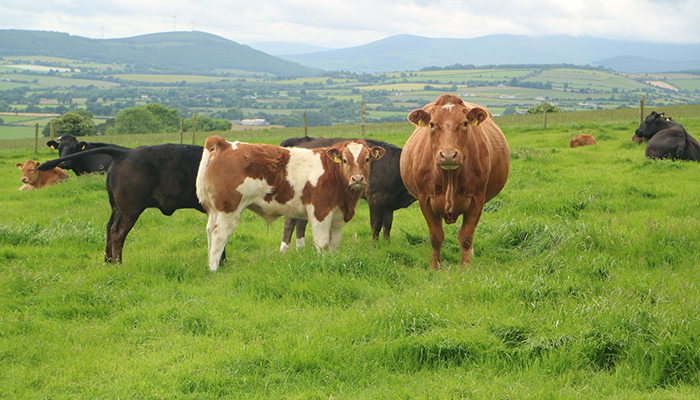
Anne O’Malley, Drystock Advisor in Teagasc Ballina, discusses key management practices for spring-calving suckler cows and their calves.
Body Condition Score (BCS) is a good guideline for the feeding of suckler cows from housing to calving and the target BCS at calving for spring calvers is 2.5. Management of cows to ensure they are at the target BCS at calving is critical to reduce the potential of calving difficulty.
A key measure of the nutritional value of silage is the dry matter digestibility (DMD, and this determines intake and energy value of silage and the level of supplementation needed. Moderate quality round bale silage of 65- 67% DMD can be fed to dry suckler cows in very good body condition as they can afford to lose some condition pre-calving but would not be suitable for thinner cows or growing stock, where supplementation and or good quality silage would be needed. Cows and heifers body condition should be assessed regularly from housing to calving and any issues with over or under-conditioned animals can be addressed early and nutritional adjustments should be well established prior to calving.
Pre-calving minerals and vitamins are essential for the health of both the cow and unborn calf and should be fed daily for four to six weeks pre-calving. Pre-calver mineral supplementation can be top-dressed on silage, through the drinking water, in boluses, in molassed mineral buckets and in a carrier ration. Allow adequate space at feeding barriers in late gestation and feed the right type and level of pre-calver mineral and ensure the feeding rate is correct as recommended.
Vaccination of cows pre-calving can boost the quality of the colostrum and improve the protection of the new-born calf if colostrum intake is adequate and timely. Vaccinating cows with scour vaccines, from three weeks to three months prior to calving to boost antibodies against E. coli, rotavirus, and coronavirus, will give passive immunity to calves through the colostrum. Consult with your vet and advisor well in advance of the calving season on diagnostic testing and pre-calving and calf vaccination protocols for calf scours and pneumonia. Vaccines are effective in combination with good nutrition and hygiene to combat infection on farm.
The new-born calf depends on the successful passive transfer of maternal antibodies from colostrum in order to defend itself against bacteria and viruses until its own active immunity begins to work, at about 3 to 4 weeks of age. Time is critical and factors that impinge on the duration between birth and the first suckling will negatively impact on calf passive immunity, and a key factor is difficult or abnormal calving. The earlier a calf suckles or is fed, the greater the level of immunoglobulin absorption. If the calf is unable or unwilling to suckle, the cow should be milked by hand and the calf fed colostrum with a bottle or stomach tube. This may be necessary for weak calves, difficult births or where you have a poor cow calf bond. It is vital that sufficient colostrum is consumed as soon as possible after birth because the ability of the calf to absorb antibodies starts to decline rapidly after 2 to 6 hours and ceases around 24 hours.
Infectious agents are present on every farm, such as bacteria, viruses, and parasites but with good management practice at calving and with calves up to 4 weeks of age you can keep infection pressure low and reduce the risk of diseases. Septicemia or infections via the navel can be reduced by dressing the navel cord as appropriate, keeping the calf lying area clean with adequate dry bedding and turnout of the cow and calf as soon as possible after calving.
Good preparation of calving facilities and equipment is needed pre-calving. Ensure all equipment is working properly and ready for use and ensure good monitoring of cows pre and post calving. It is easier to seek additional help when there is good preparation and organization and this provides a safer working environment for everyone during the busy calving season.