
29 February 2024
Management of thin winter cereal crops
With the price of grain having plummeted in recent weeks this will have an impact of the treatment of winter cereal crops especially those where yield potential has been reduced due to the winter weather conditions, writes Shay Phelan, Teagasc Crops and Potato specialist.
At current grain prices it will take 9.0 t/ha (3.6t/ac) for winter wheat and winter barley crops to break even so each crop will have to be assessed to establish their potential. Where the yield potential is likely to be lower than 9.0 t/ha then an altered management plan should be put in place by reducing fertiliser and disease control inputs.
10 points to consider when managing thin crops
- Reduce spend on inputs to try to reflect the potential yield in the crop.
- Apply P & K requirements to reflect off take i.e. 3.8 kg/t of P and 10 Kg/t of K. For example a 7.5 t/ha crop needs 28.5 kg/ha of P and 75 kg/ha of K = 350 kg/ha (2.8 bags per acre) of 10-8-20.
- Reduce overall nitrogen but apply more early to try to encourage tillers.
- Apply PGR’s early to try to encourage tillering. CCC, Moddus, K2, Meddax Max are all potential options but check the earliest timings of the product before applying.
- Treat known trace element deficiencies early.
- Thinner crops should be less susceptible to diseases so look at cheaper generic products or lower rates of the standard products e.g. 75-80% rate of Revystar, Questar etc.
- It is unlikely to be economic to use a T0 (leaf 4) on thin winter wheat crops this year.
- Question the benefits of all inputs, in the video attached Pete Berry discusses the Role and efficacy of Bio-stimulants
- Avoid complicated mixes that may place crops under stress this spring.
- Rolling may be an option but only if the ground is dry enough.
Oilseed rape
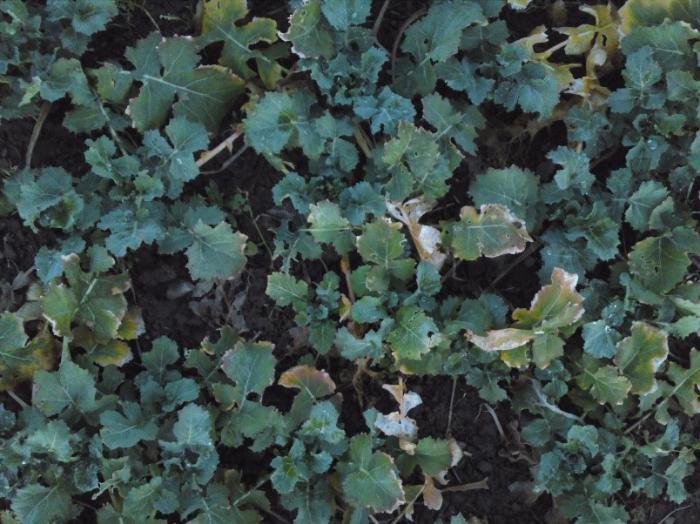
Oilseed rape crops look good at the moment with many achieving GAI’s of over 1, this means in many cases that fertilisers can be delayed until early March. Apply N, P & K compound fertilisers in the first split based on soil test results.
GAI of 1.5
Disease control
Most crops received no fungicides in the autumn so apply a fungicide which will give good light leaf spot and or phoma control, prothioconazole based fungicides (Proline or generics) at 0.5L/ha should give adequate control.
Weed control
From March 1st Korvetto can be applied to control cleavers, fat hen, poppy, fumitory and groundsel. Where grass weeds are an issue then use a graminicide e.g. Falcon etc. but beware of the latest timings of the different products.
Tillage edge podcast
Listen to the latest Tillage Edge Podcast here