
28 July 2023
Managing Organic Nutrient Sources Efficiently
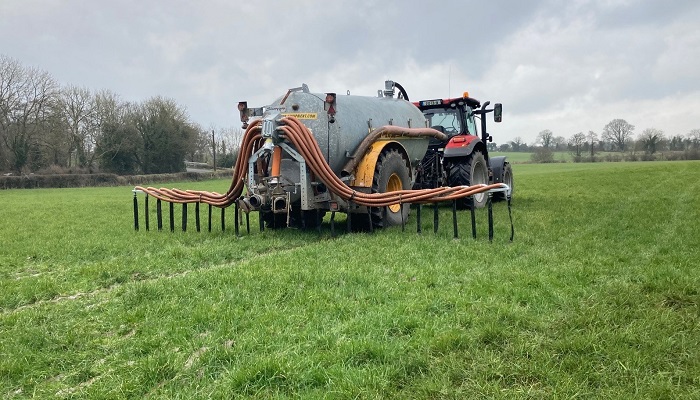
Mark Plunkett, Teagasc Johnstown Castle, tells us; a key component of building and maintaining soil fertility in organic
farming is an available supply of organic nutrient sources.
For example, farm manures will supply valuable major and minor nutrients to supply annual crop requirements and help replenish soil reserves. Aim to apply organic manures on a rotational basis depending on soil test results and crop nutrient requirements. Organic manure nutrient content can vary widely depending on the source of nutrients and it is advisable to have the nutrient content of manures checked through laboratory analysis.
Cattle Slurry P & K
Cattle slurry is an excellent source of P and K fertiliser and apply to parts of the farm that have either low soil P or K levels, or to crops with high P and K demands such as grass silage. Targeting these areas will supply crop requirements and build soil P and K reserves. Slurry is also a very well balanced nutrient source as its P to K ratio is 1:6 which is ideal for grass silage crops. While for grazing ground the correct required P: K balance is 1:2 for example a more dilutes slurry is good (2 to 4% DM).
The P and K in cattle slurry is 100% plant available at soil P index 3 and 4. However, if a soil is P Index 1 or 2 the availability of the P will be only 50%. While potassium is 90% available on K Index 1 & 2 soils.
Slurry Nitrogen (N)
The form of N in cattle slurry is ammonium-N and approximately 40% is available at time of application. This readily available form of N is easily lost during application depending on weather conditions. Apply slurry in springtime on cool, overcast or misty days to reduce N losses and maximise N recovery. LESS technology (trailing shoe / band spreader) will further improve N recovery by 50% for example LESS will recover an extra 3 units N/ 1,000gals compared to splash plate application techniques. Therefore, aim to apply cattle slurry in the springtime by LESS to maximise slurry N value. Spring applied slurry by LESS is worth approximately 6 units of N per 1,000 gallons extra compared with summer application by splashplate, due to better N recovery at that time of the year (Table 1).
Table 1: Typical available N, P & K values kg/m3 for cattle slurry depending on application method
| Time of Application | N kg/m3 (units/1,000gal) | P kg/m3 (units/1,000gal) | K kg/m3 (units/1,000gal) | €/m3* (€/1,000gal) |
| Spring (LESS) | 1.0 (9) | 0.6 (5) | 3.5 (32) | €9.7 (44) |
| Summer (Splashplate) | 0.35 (3) | 0.6 (5) | 3.5 (32) | €8.3 (38) |
| Organic *Cattle slurry value based on fertiliser N, P & K values in 1st April, 2023 | ||||
Farmyard Manure (FYM)
Farmyard manure is a very good source of N, P & K and organic matter. The N in FYM is 30% available at time of application. The majority of N is organically bond and composting / breakdown prior to application will help increase the availability of all major nutrients. FYM contains a valuable source of organic matter / carbon to feed soil biology and help improve soil quality.
Read the full Growing Organics farm walk booklet