
19 February 2024
Managing pregnant ewe lambs
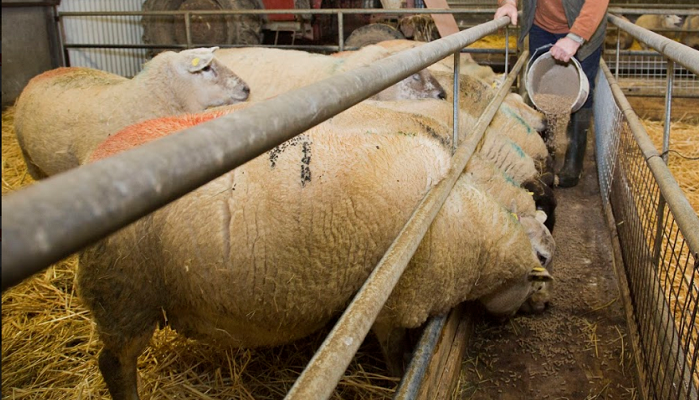
Many producers are lambing replacements at one year of age. These ewe lambs need to gain weight during pregnancy to enable them to progress in a timely manner towards mature body size.
As a result, relative to a mature ewe of similar weight, a ewe lamb requires an additional 2.5 Megajoules (MJ) of metabolisable energy (ME) (equivalent to 225 g of barley) daily during pregnancy to enable her to gain 50g daily in live weight.
Management during pregnancy
Unlike mature ewes, ewe lambs during mid and late-pregnancy require a plane of nutrition that sustains a gain in body weight (excluding weight of the conceptus) of approximately 80g/day in order to enable ewe lambs progress towards their normal mature body size. Energy is normally the first limiting component in the diet of pregnant ewe lambs.
When formulating a ration for ewe lambs, it is essential to make allowances for requirements for maintenance, live-weight gain, wool growth, stage of pregnancy and expected litter size (as determined by ultrasound scanning).
As a general rule, a pregnant ewe lamb requires an extra 2.5 MJ of ME relative to adult ewes of similar live weight at the same stage of pregnancy, and carrying the same litter size. Consequently, ewe lambs require high feed-value silage supplemented with concentrate after housing. The level of concentrate supplementation depends on silage feed value and expected litter size.
Management at Athenry
At Athenry, pregnant ewe lambs were housed in mid-December, penned according to expected lambing date, shorn post housing and offered high feed value grass silage (75 % DMD) as the sole diet. In mid-January, they received 250g of concentrate daily.
Following pregnancy scanning, the ewe lambs were penned according to expected litter size and lambing date. Ewe lambs carrying triplets had their concentrate allowance increased to 300g/day in mid-February. During the last 6 weeks of pregnancy (mean lambing date late March), ewes carrying singles, twins and triplets received a total of 18, 26 and 33kg concentrate per head, respectively. The feeding schedule required to deliver different concentrate feed levels is presented in Table 1.
Table 1: Daily concentrate allowance (kg) per ewe required for different total concentrate inputs per ewe during late pregnancy
| Weeks prior to lambing | Target total concentrate input per ewe prior to lambing (kg) | ||||||
|---|---|---|---|---|---|---|---|
| 5 | 10 | 15 | 20 | 25 | 35 | 45 | |
| 8 | 0.4 | ||||||
| 7 | 0.4 | 0.6 | |||||
| 6 | 0.2 | 0.3 | 0.4 | 0.5 | 0.6 | ||
| 5 | 0.2 | 0.3 | 0.4 | 0.6 | 0.8 | ||
| 4 | 0.1 | 0.2 | 0.2 | 0.4 | 0.6 | 0.7 | 0.9 |
| 3 | 0.1 | 0.2 | 0.3 | 0.5 | 0.6 | 0.8 | 1.0 |
| 2 | 0.2 | 0.4 | 0.5 | 0.6 | 0.7 | 1.0 | 1.0 |
| 1 | 0.3 | 0.6 | 0.75 | 0.8 | 0.9 | 1.0 | 1.1 |
If the quality of the silage available is poorer than that used at Athenry then increased concentrate supplementation would be required over the period from housing to lambing.
Management post lambing
Ewe lambs rearing twins should treated the same as mature ewes rearing triplets, i.e., managed in a separate flock and have access to 0.5kg concentrate daily for five weeks post lambing, whilst their lambs have access to up to 300g concentrate daily until weaning. Ewe lambs rearing singles, and their lambs, do not require concentrate supplementation. Concentrate supplementation ceased at weaning.
This article was adapted from Dr Tim Keady’s paper from the 2024 National Sheep Conference. To access the full paper, click here.
Also read: Pregnancy nutrition – the foundation of flock profitability