
Managing Soil Compaction on Tillage Land After a Wet Spring and Summer Drought
Investing in soil health will help tillage farmers reduce compaction, improve crop performance and build greater resilience against increasingly variable weather patterns, John Brophy, Tillage Advisor, Teagasc Naas, tells us more.
Irish tillage farmers have faced one of the most challenging growing seasons in recent years. Prolonged periods of heavy rainfall earlier in the year left many fields saturated, delaying field operations and increasing the risk of soil compaction.
This was followed by an extended dry spell, creating a difficult combination of compacted soils and moisture stress. While the drought improved field trafficability, it has also highlighted areas where crops struggled due to restricted root development caused by compaction.
The consequences are often seen throughout the season. Crops growing on compacted ground typically develop shallower root systems, making them less able to access moisture during dry periods. Water infiltration is reduced, increasing surface runoff during heavy rain, while poor drainage can leave fields waterlogged for longer. Nutrient uptake also suffers, resulting in uneven crop growth and lower yields.
The recent drought has made compacted areas easier to identify. Crops on these patches often wilt earlier, mature unevenly, and show signs of nutrient deficiency. These symptoms indicate that roots are unable to penetrate compacted layers to access deeper soil moisture.
Diagnose before you cultivate
One of the biggest mistakes after harvest is assuming every field requires deep cultivation. The first step in addressing compaction is to assess soils before deciding on a remedial action.
As ground is very hard now, remedial action may not be possible due to extra wear and tear of getting a machine into the ground or digging a pit. Some light rain may be needed to soften the upper layer of soil to allow penetration into the soil but not leave it too long to miss the benefits of subsoiling dry soil at the required depth to get required cracking rather than smearing.
Digging soil pits using the double spade method with a spade across different parts of the field allows farmers to examine soil structure, root growth and identify compacted layers.
The Double Spade Method
Carefully dig a soil pit roughly 5cm deep, 50cm long and 30cm wide. Dig out from 3 sides leaving one long wall untouched as this will be the assessment wall. While digging, do not stand or lean the spade on the side being assessed. Visually look at the wall for different layers, root penetration and worm activity. Use a pen knife to prod the wall from top to bottom to assess hardness of the wall to determine where compaction occurs as this may determine depth or type of machine to carry out remedial work. Also assess the soil at different levels for aggregate size, shape and strength.
More information is available on the Soil Structure A B C Guide found here
Fixing Compacted Soils
Self-Fixing
Dry conditions may have helped to repair soil through cracking. Where large cracks appear, there will also be smaller cracks and fissures which will help repair the damage. This will be seen more so in clay soils as clay particles can expand and contract. Sandy or Loamy soil may not show as much cracking and so there will be less repair due to drought.
Subsoiling
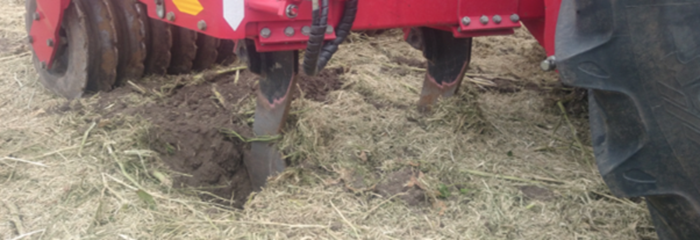
Subsoiling should only be carried out when soils are sufficiently dry to allow the soil to fracture rather than smear. Current dry conditions across many tillage areas provide a suitable opportunity, but timing remains critical. The subsoiler should operate just below the compacted layer rather than excessively deep, as unnecessary cultivation increases fuel costs and can create additional soil disturbance without improving soil structure.
Traffic control
Traffic control can also reduce future compaction by confining machinery to permanent wheeling’s and headlands, preventing light to medium compaction throughout the field.
Cover cropping
Cover crops offer an additional long-term solution. Species such as forage radish, oats and phacelia produce extensive root systems that naturally loosen soil, improve biological activity and increase organic matter.
Straw chopping
Straw chopping and incorporation also helps over time as it creates space between soil particles allowing soil to hold air and water as well as providing organic matter. As there will be no bales, there will be less risk of compaction from baling or loading especially if there is wet harvest.
Conclusion
The contrasting weather conditions experienced this year have demonstrated the importance of resilient soil structure. Fields with healthy, well-structured soils have drained more effectively during wet periods and retained moisture better during drought. Investing in soil health will help tillage farmers reduce compaction, improve crop performance and build greater resilience against increasingly variable weather patterns.
John Brophy is a Tillage Advisor working in the Laois/Kildare/Offaly Advisory Region.
Find out more about the Teagasc Laois/Kildare/Offaly Advisory Region here.