
Match fertiliser to grass growth in dry weather

Warm, dry weather is beginning to affect grass growth in parts of the country as soil moisture deficits continue to increase. Veronica Nyhan, Teagasc Soil and Plant Nutrition Specialist, tells us why it's important to match fertiliser applications to grass growth during this time.
While many regions remain within the normal range for this time of year, parts of the south and east are now experiencing soil moisture deficits (SMDs) exceeding 50 mm, meaning more than 50 mm of rainfall would be needed to replenish soil moisture. As grass growth slows, so too does the demand for nitrogen, making it increasingly important to match fertiliser applications to grass growth.
Continuing to apply nitrogen at normal rates during prolonged dry conditions can result in surplus nitrogen accumulating in the soil beyond the grass’s immediate requirements. When wetter conditions return, this surplus nitrogen is more vulnerable to leaching, reducing fertiliser efficiency and increasing the potential for nitrogen losses to groundwater and surface waters.
Based on current soil moisture conditions, the following approach is recommened:
- Continue planned nitrogen applications where grass growth remains above 50 kg DM/ha/day.
- Reduce nitrogen applications where SMDs exceed 50 mm and grass growth falls below 50 kg DM/ha/day.
- Delay further nitrogen applications where SMDs exceed 75 mm and severe drought conditions are restricting growth, until meaningful rainfall is forecast or has occurred.
- Where fertiliser is still required, consider compound NPK or NK products rather than straight N. Potassium plays an important role in regulating water within the plant, helping maintain growth under moisture stress while supporting efficient nitrogen uptake.
There is no single fertiliser strategy that will suit every farm during prolonged dry weather. Conditions can vary considerably between farms, and even between fields, so monitoring local soil moisture deficits, grass growth and the short-term weather forecast will help ensure nitrogen applications are matched to grass demand, maximising fertiliser efficiency while reducing the risk of nitrogen losses.
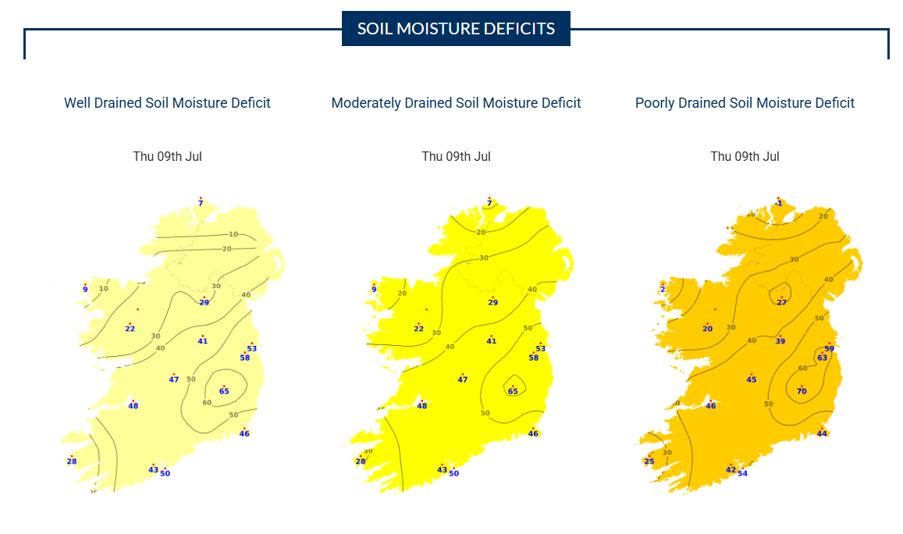
Figure 1: National Soil moisture deficits for different soil drainage classes on Thursday 9 July 2026. Source: Met Éireann.