
12 April 2024
Maximising the sow daily lactation feed intake
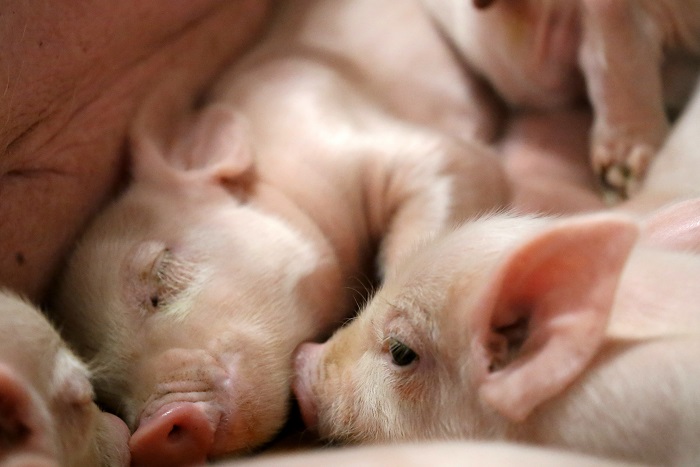
Michael McKeon writes about the continuous challenge for pig producers to maximise the sow daily lactation feed intake.
The feed intake in the farrowing room is the ‘engine’ for the unit. If intakes are high and the ‘engine is purring’ then milk yield, weaning weights and the subsequent conception rates / born alive will be excellent. However, if intakes are poor then the ‘engine will start to splutter’ with higher pre-weaning mortality, poor weaning weight, high sow body condition with a subsequent higher number of repeats, injuries and a low born alive.
Lactation feed intake target
The ‘target to hit’ will be largely based on the number of piglets weaned and the average weaning weight on your unit. Peadar Lawlor in a Teagasc Pig Conference paper estimated that a sow requires an extra 7 MJ DE/day for every extra pig weaned and 5.4 MJ DE /day for each extra kg increase in the average piglet weaning weight.
As a rule of thumb, a minimum required for gilts is 95 MJ DE / day and for sows 105MJ DE / day, on average over the lactation period. In dry feed terms this equates to 6.7 kgs /day (gilts) and 7.4 kgs /day (sows), based on a lactation feed with an energy density of 14.2 MJ DE / kg.
To achieve this intake will require a feed curve similar to the one included at the end of this article. In this feed curve, daily intakes rapidly increases over the first 10 days with the aim of achieving intakes of 99 MJ (gilts) and 110 MJ (sows) at day 10.
Achieving these intakes can be challenging, so what may help?
Gilt age at service
If a gilt is too young at service she will be still too small at farrowing to achieve large Gilts need to be 33/34 weeks of age at service but not more than 38 weeks old – any older can cause higher lameness due to their large body frames. Ensure damline gilts are tagged with their birth week number at birth/weaning.
Body condition
Fat sows or gilts at farrowing will have depressed appetites and therefore will not achieve large daily intakes. From my unit visits I observe this as one of the main causes of poor farrowing house intakes.
Water:feed ratio
A sow obviously requires a large volume of water for milk production. However, she also requires a high dry matter intake which will be difficult to achieve if the water:feed ratio is too high. On the sample feed curve at the end of the article a sow at day 20 will be consuming 45 kgs of feed per day, which is a large volume of feed and therefore liquid. At a water:feed ratio of 3.5 rather than 3.1, the sow will have to drink an extra 3.4 litres of water to achieve the same DM intake. In general, a lower feed: water ratio will help to encourage higher daily feed intake.
Dry Feed
Trying to get the sow to achieve the targeted daily feed intakes through the wet feed system may be a challenge. Some units find it easier to give supplementary dry feed (0.5-1kg), from day 10 onwards, as a dry ‘top- up’ in the middle of the day. This effectively is reducing the total volume of liquid the sow has to drink to satisfy her energy intake
House temperature
Running farrowing houses at too warm a temperature will reduce intakes. A ‘rule of thumb’ is that there is a feed intake reduction of 200g for each 1 °C increase in temperature. Aim to farrow at 24°C and three days post–farrowing reduce the temperature to 21°C. It’s important to ensure that heat pad temperature is correct before the temperature is reduced – often they are too hot!
Feed specification
A lactation feed with a higher energy density will help to achieve high energy intakes, however higher daily feed intake will have a greater overall effect than increasing the density of the diet. Increasing the density from 14.2 MJ to 15 MJ will only increase daily intake by 5.6 MJ whereas an extra 0.5 kgs feed/day will increase the daily intake by 7.1 MJ.
How can I calculate my intakes?
On a wet feed system the easiest way to calculate average intakes is to zero the feed valves either on entry into the house or preferably when they farrow. Then take a picture of the computer screen feed valves on the day of weaning and send to you adviser for analysis. If you can highlight the gilt valves this would add extra value as these are the low feed intake ‘high risk’ valves.
Hopefully if you implement some of these suggestions, then your farrowing house ‘engine will be purring’ all year!
Sample sow lactation feed curve
| Day | MJ DE | |
| Gilt | Sow | |
| 0 | 28 | 33 |
| 1 | 36 | 40 |
| 2 | 43 | 48 |
| 3 | 56 | 62 |
| 4 | 68 | 75 |
| 5 | 77 | 85 |
| 6 | 84 | 93 |
| 7 | 90 | 100 |
| 8 | 95 | 105 |
| 9 | 99 | 110 |
| 10 | 99 | 110 |
| 11 | 101 | 112 |
| 12 | 104 | 115 |
| 13 | 104 | 115 |
| 14 | 104 | 115 |
| 15 | 104 | 115 |
| 16 | 104 | 116 |
| 17 | 104 | 116 |
| 18 | 106 | 118 |
| 19 | 106 | 118 |
| 20 | 108 | 120 |
| 21 | 108 | 120 |
| 22 | 110 | 122 |
| 23 | 110 | 122 |
| 24 | 110 | 122 |
| 25 | 110 | 124 |
| 26 | 110 | 124 |
| 27 | 112 | 124 |
| 28 | 112 | 126 |
| 29 | 113 | 126 |
| 30 | 113 | 126 |
| Ave | 94.5 | 105.1 |
| @ 14.2 MJ | 6.7 | 7.4 |