
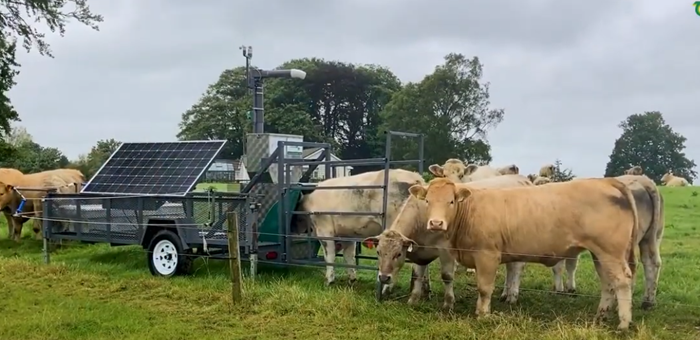
Accounting for 75% of Irish agricultural related greenhouse gas emissions, Dr. Paul Smith, a Research Officer based in Teagasc Grange, brings us up to date with Teagasc’s ongoing research in the area of methane and methane suppressing feed additives.
The microbial ecosystem residing in the rumen or forestomach of the ruminant animal facilitates the conversion of human inedible plant matter into high-quality sources of meat and dairy protein.
However, this digestive process results in the production of methane as a metabolic byproduct during the microbial fermentation of ingested feed.
Methane is the second most important greenhouse gas (GHG), after carbon dioxide, and accounts for 75% of Irish agricultural related GHG emissions, the vast majority of which is enterically produced in the rumen.
Both the quantity, and quality, of the feed consumed by ruminant livestock is the predominant contributor to the volume of methane emitted by an animal. Simply put, as an animal’s level of feed intake increases, more feed is fermented in the rumen, which increases the supply of energy and protein to the animal but also elevates the supply of substrates to methanogens (microbes that produce methane), leading to an increased synthesis of enteric methane.
A promising mitigation strategy
Based on work conducted by Teagasc Grange, across various diets, including intensive finishing rations and forage-based diets, and animal types, beef cattle have been shown to produce 22-27 g of methane for every kg of dry matter (DM) intake. Reducing the quantity of methane emitted by ruminant livestock will be pivotal to achieving a 25% reduction in Irish agricultural GHG emissions by 2030.
Methane suppressing feed additives – do they have role?
The addition of methane suppressing feed additives to the diet offered to ruminants has been identified as a promising GHG mitigation strategy for the sector, with the potential to reduce national GHG emissions by 0.79 Mt of carbon dioxide (CO2) equivalents (eq).
Over the last decade, Teagasc has extensively investigated a variety of different methane inhibitors, including seaweeds, microbial probiotics, oils and by-products from the grain industry as well as commercial or near market ready synthetic compounds.
At Teagasc Grange, a dedicated in-vitro lab has been established to provide an initial lab-based screening of potentially promising feed additives. Following this, the best performing additives are then evaluated in animal-based research trials.
Along with investigating their effect on methane emissions, the impact of all feed additives on animal performance (feed intake, growth, milk yield) as well as health and welfare is thoroughly investigated. Based on research to date, methane emissions reductions of up to 30%, in absence of any negatives to animal productivity, have been observed in some Teagasc studies conducted on housed cattle.
Indeed, while promising, the delivery of methane suppressing feed additives to pasture-based livestock is still a challenge. With this said, research is currently underway within Teagasc to develop cost-effective strategies for administering feed additives to grazing livestock.
In this short video, Dr. Paul Smith, Beef Research Officer at Teagasc Grange, gives an overview of some of research on methane supressing feed additives conducted at Teagasc:
Links to Teagasc lead peer-reviewed published research in this area can be found here.