
Mid-West Bio-District innovation wins international Parsons design award
An innovative proposal designed to strengthen regional seed systems and support organic growers has been named as the third placed winner of the international Good Interventions 2026 Design Competition, organised by Parsons School of Design at The New School in New York.
SeedLoop emerged from the partnership between the Mid-West Bio-District and the Digital Futures Lab at University of Limerick’s Kemmy Business School. Its international success was announced at the Mid-West Bio-District stand in the Organic Village at the National Ploughing Championships in Screggan, Tullamore, County Offaly.
SeedLoop was selected from more than 70 projects associated with over 25 organisations and universities across 10 countries. The competition recognises innovative work at the intersection of social science, art and design that responds to pressing social, economic and environmental challenges.
The winning projects will form part of the Good Interventions 2026 digital exhibition on the Design Strategies platform at Parsons. SeedLoop will also be showcased at the competition’s award ceremony at Parsons School of Design in New York on 23 October 2026.
Strengthening relationships amoung farmers, producers and consumers
SeedLoop was developed by a multidisciplinary student team participating in the Digital Futures Lab. Working with the Mid-West Bio-District and its stakeholders, students examined challenges facing the regional organic food system and designed interventions that could strengthen relationships among farmers, producers and consumers.
The project responds to difficulties experienced by smaller organic growers in accessing suitable seed, preserving locally adapted and heritage varieties, and retaining valuable knowledge about how different seeds perform under local growing conditions.
SeedLoop proposes a digitally enabled cooperative network through which growers could identify available seeds, document their provenance and characteristics, and share practical growing knowledge. Proposed digital seed passports and locally focused search functions would improve traceability and help create a trusted regional seed and knowledge network.
“This international award demonstrates the quality of innovation that can emerge when farmers, agricultural organisations, universities and communities work together,” Professor Frank O’Mara, Director of Teagasc, said when speaking at the announcement.
“SeedLoop offers an imaginative response to challenges surrounding seed access, biodiversity and resilience. I congratulate the student team and everyone involved in the Mid-West Bio-District and Digital Futures Lab partnership on this significant achievement,” Professor O’Mara said.
Joe Kelleher, Organic Specialist with Teagasc, said: “The Mid-West Bio-District brings farmers, producers, advisors, researchers and community organisations together to explore how the organic sector can develop at regional level.
“Our partnership with University of Limerick creates an important space in which challenges identified by the sector can be examined from different perspectives and translated into new possibilities. SeedLoop is an excellent example of what this collaborative approach can produce.”
Dr Annmarie Ryan, Associate Professor at Kemmy Business School and Lead of the Digital Futures Lab, said: “SeedLoop began with the experiences and challenges identified by people working within the Mid-West food system. Rather than asking students simply to analyse those challenges, the Digital Futures Lab asked them to work with our partners to imagine and design a different market arrangement. Winning this international competition is a tremendous endorsement of the student team’s work and of the ambition and insight contributed by our regional partners.”
Caitriona Scully, West Limerick Resources, said: “The Mid-West Bio-District is working to build a more connected, resilient and sustainable regional food system. This partnership combines the practical knowledge of farmers and producers with agricultural expertise, research, education and creative design. It’s a great example of the role that Biodistricts can play as innovation catalysts, connecting the broader interdisciplinary stakeholder landscape. SeedLoop demonstrates how a locally identified challenge can become the basis of an idea with international relevance.”
The next stage
The next stage will involve engagement with growers, agricultural advisors, seed organisations and regulatory stakeholders to test the proposed intervention and assess the legal, technical and organisational requirements for a regional pilot.
SeedLoop’s success provides international recognition not only for the individual project, but also for the wider partnership between Teagasc, the Mid-West Bio-District and University of Limerick. The collaboration enables students, farmers, producers and regional stakeholders to work together to imagine, design and test new approaches to building a sustainable organic food economy in the Mid-West.
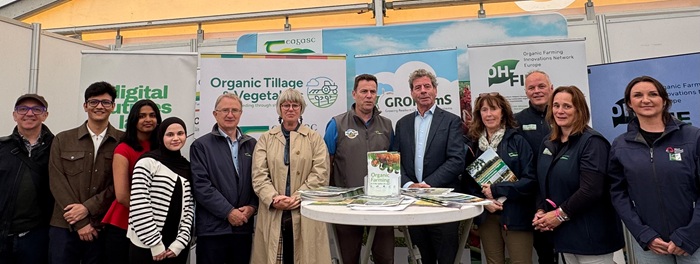
Photo caption: Steve Coakley, University of Limerick; Vaibhav Kapri, Mariam Malek, Gisa George, students; Professor Frank O’Mara, Teagasc Director; Dr Annmarie Ryan, Associate Professor at Kemmy Business School and Lead of the Digital Futures Lab; Martin Bourke, Teagasc Organics; Liam Herlihy, Teagasc Chair; Mary Ryan, Joseph Joe Kelleher, Elaine Leavy, Teagasc Organics; and Caitriona Scully, West Limerick Resources.