
11 November 2024
Milk recording, LESS and spring slurry spreading higher on top performing dairy farms
To measure uptake and to evaluate whether evolving science and knowledge is being translated to farming practices, Dairy Innovation Indicators were measured in the Teagasc National Farm Survey (NFS) Sustainability Report 2023.
The uptake of innovations such as discussion group membership, liming and reseeding, spring slurry spreading, protected urea fertiliser use, low emissions slurry spreading use, and milk recording were measured.
Milk recording
Milk recording and the practice of keeping detailed records of individual cow performance was identified as a key aspect of dairy farm management practice from which farms could build on and improve herd health performance, breeding and milk yield.
The NFS Sustainability Report 2023 indicates that farms with better economic performance were more likely to use milk recording. Over 66% of the dairy farmers in the top group were milk recording, compared to 48% in the bottom group.
Discussion group membership
Discussion group membership was selected as indicating the degree of interaction farmers have with farm extension services and their peers. Better economic performance was more prevalent among discussion group members. Membership rates were higher across the top economic performing group, at 73%, compared to 25% in the bottom cohort.
Spring slurry spreading
Spreading at least 50% of total slurry between January and April was identified as an important practice to minimise nutrient losses to the environment and maximise grass production. The application of the majority of slurry in early spring was slightly higher across the top performing cohort at 74%. The middle and bottom cohorts had slightly lower level of spring time slurry application at 59% and 53%, respectively.
Low emissions slurry spreading
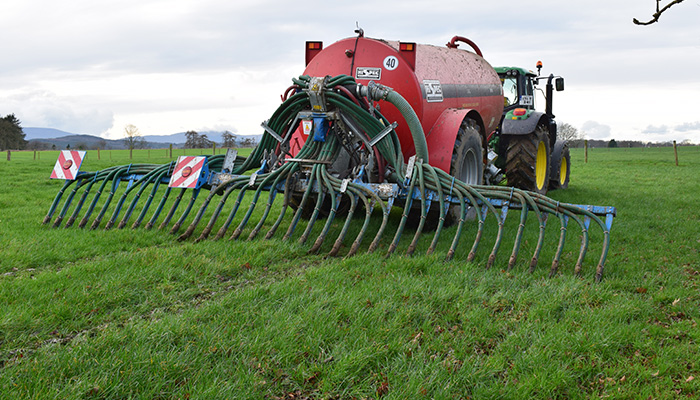
The transition towards the use of low emissions slurry spreading (LESS) equipment for slurry application continued in 2023. In total, 81% of slurry on the average dairy farm and 38% on the slurry on the average cattle farm was applied via LESS.
The use of LESS technologies, such as trailing shoe, trailing hose or injection methods, increases nitrogen retained in slurry and reduces the need for chemical fertiliser, as well as reducing nitrogen losses to the environment. The indicator reported is the proportion of farm slurry applied using LESS techniques.
On the average dairy farm, over 80% of all slurry applied by dairy farmers was via low emission slurry spreading methods. This ranged from 97% for the top performing cohort to 66% for the bottom performing cohort.
Protected urea
Protected urea fertiliser use is associated with lower greenhouse gas emissions compared to use of Calcium Ammonium Nitrate (CAN). Protected urea is also associated with lower ammonia emissions compared to conventional straight urea fertiliser formulations and allows for greater nitrogen recovery for agronomic purposes. The indicator reported is the proportion of chemical N applied in protected urea form.
The percentage of total chemical nitrogen applied in the form of protected urea averaged 27% across all dairy farms. This ranged from 40% for the top performing cohorts to 16% for the bottom group.
Liming and reseeding
Liming and reseeding were identified as important farming practices in grassland management. The NFS Sustainability Report 2023 shows that liming was slightly more prevalent among the middle and better economic performers (50-56%) in 2023, compared to 46% for the bottom group.
More information
The above was adapted for use on Teagasc Daily from the Teagasc National Farm Survey Sustainability Report 2023, which was authored by Cathal Buckley and Trevor Donnellan from the Teagasc Agricultural Economics and Farm Surveys Department.
Also read: Sustainability performance of Irish farms in 2023 revealed