
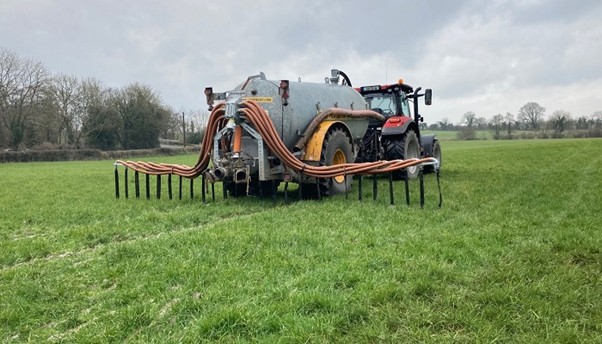
With the slurry spreading opening date fast approaching for farmers, ASSAP Advisor, Joseph Maher gives us key tips and advice on how best to use slurry, while making sure we protect our environment and our waters.
Slurry is a valuable source of nutrients on the farm and can benefit grass and crop growth when applied correctly. At current prices for nutrients, applying 1,000 gallons of slurry at 6% dry matter (DM) to grass is equivalent to a 50kg bag of 9-5-32 fertiliser when applied by LESS and is worth €29 per 1,000 gallons. Before slurry spreading, it is important that farmers look at their Nutrient Management Plan for their farm, be mindful of ground conditions, the weather forecast and then target slurry to the right field, at the right time and at the right rate. The rationale behind doing this is to ensure that the nutrients in our organic fertiliser are taken up by the growing crop and not lost to ground water by leaching or by overland flow in the case of saturated soils.
Maximise the use – minimise the loss
Now is a good time for farmers to have their slurry tested using a simple on-farm tool like a slurry hydrometer or by sending a representative sample to a laboratory for analysis. Understanding the Nitrogen and Phosphorus value of a 1,000 gallons of slurry is important as farmers can then match spreading rate with grass growth rates. There can be a large variation in the DM% of our slurry on farms depending on the animal’s diet during housing and the amount of water either mixed at the time of agitation or from rainfall.
After last week’s freezing temperatures, farmers need to be mindful of the effect that this can have on grass growth rates and therefore nutrient uptake. See Table 1 below for information regarding the nutrient values of cattle slurry. When slurry is applied at rates higher than crop requirements, nutrients are available to be leached to groundwater or washed away into the drainage system. It is advised to apply organic fertilisers at lower rates in early spring. Effective use of slurry can improve soil health and the environment while significantly lowering the cost of chemical fertilisers.
Table 1: The effect of slurry DM on the N, P & K values of cattle slurry
| DM % | N kg/m3 (units/1,000 gals) | P kg/m3 (units/1,000 gals) | K kg/m3 (units/1,000 gals) |
| 2 | 0.4 (4) | 0.21 (2) | 1.4 (13) |
| 4 | 0.7 (6) | 0.35 (3) | 2.3 (21) |
| 6 | 1.0 (9) | 0.5 (5) | 3.5 (32) |
| 7 | 1.1 (10) | 0.6 (6) | 4.0 (36) |
| Soiled water | 0.48 (4) | 0.08 (0.7) | 0.6 (5) |
Slurry spreading requirements
- It is mandatory for all farmers with a grassland stocking rate of 100 kgs organic N/ha or above to apply slurry using LESS technology. LESS equipment is also required when spreading pig slurry and cattle slurry on arable land unless incorporated into the soil within a 24-hour period.
- A 10-meter buffer margin needs to be adhered to when spreading slurry near waters for 2 weeks after the opening date for slurry spreading and 5 meters thereafter.
- Farmers are prohibited from spreading slurry when heavy rainfall is forecast within 48 hours.
- Farmers that have fields with a 10% gradient or greater must maintain a 10-meter buffer margin near all surface water bodies during the slurry spreading season.
It is advisable to hold off on slurry spreading until later in the spring if there is sufficient storage on the farm to carry it into February. However, for a lot of farms, slurry storage tanks will begin to come under pressure and farmers will start making phone calls to slurry contractors. Contractors should ensure there spreading rate of slurry matches grass growth rates and be mindful of buffer margins.
Location
Slurry should be applied to carefully selected fields. These should be fields with a good pH and a requirement for P and K. Additionally, they should be the farm’s drier fields, ideally away from rivers, streams and without a drainage system. Be mindful of critical source areas (CSAs) when spreading slurry as these tend to have a high connectivity to the drainage network and are at high risk of impacting a water body. These are often low-lying parts of the farm or corners of a field where runoff accumulates in high concentration. Avoid these areas when spreading slurry in early spring as runoff from these areas carry sediment and nutrients to rivers and streams.
Finally, farmers should be mindful of the topography of their surrounding landscape when spreading slurry. To best protect our waters into the future farmers should consider wider buffer margins on farms. These buffer margins are our greatest resource on farms when it comes to breaking the pathway for nutrients getting into our streams, river, lakes and drains.
Slurry must be managed and applied effectively in order to maximise its value, protect the environment and comply with regulations.