
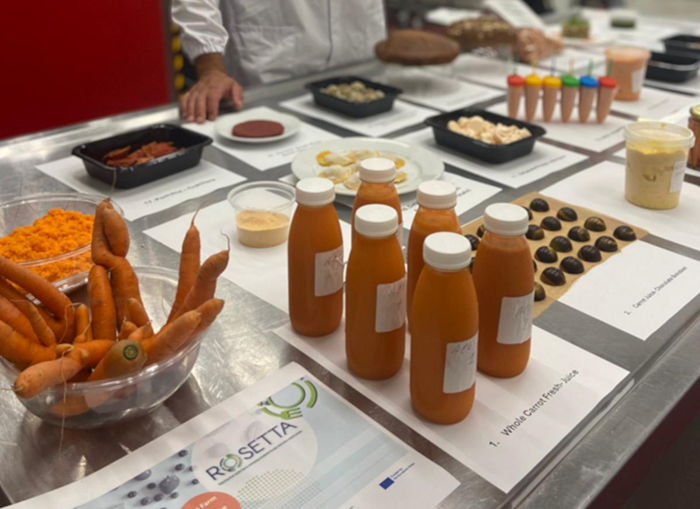
Did you know that marketing standards can lead to perfectly edible and nutritious food being discarded simply because it doesn’t fit the bill in terms of size or good looks? As part of our partnership in the ROSETTA project, Teagasc is striving for solutions that not only prevents this food waste but is aiming to find alternative uses for fruits and vegetables – even the wonkiest of carrots.
Involving 17 partner organisations from eight European countries, ROSETTA is a 3-year EU funded project that aims to assess the impact of marketing standards on food waste and bring forward sustainable solutions for the use of food that does not meet marketing standards but is still safe to be consumed.
“We have verified that food waste due to marketing standards in Ireland occurs at different stages of the supply chain and affects different products,” affirms Estela Hoffmann, Research Officer, Teagasc.
Pilot initiatives in five countries, including Ireland, will test and promote practical solutions to inform future strategies for food businesses, policymakers and regulators. The project focuses on four key food commodity groups: fruits and vegetables, meat, dairy, and cereals.
The pilot in Ireland focuses on fruits and vegetables that are commonly discarded due to appearance or consumer preferences. To address this, one of the key actions involves developing new food products using produce that would otherwise go to waste and testing consumer acceptance of these products.
To illustrate the potential of this solution, an extensive range of products have been developed from wonky carrots at the National Prepared Consumer Foods Centre (NPCFC) at Teagasc Ashtown.
“At the NPCFC, we’re excited to be part of the Rosetta project and to contribute our expertise in developing new products from surplus and by-products that would otherwise be lost”, highlighted Shay Hannon, Prepared Consumer Food Centre Manager.
Highlighting the value of the product range, Angelo Galatolo, Food Technologist at Teagasc, explained: “Developing this range of 24 products has been a great opportunity to show how surplus ingredients can be transformed into both expected and truly innovative products.”
These range from more familiar examples, such as carrot juice and carrot cake, to more novel creations like chocolate incorporating a carrot ganache.
In light of the above, Professor Maeve Henchion, Teagasc, added: “We will work with representatives from across the Irish fruit and vegetable supply chain to develop further solutions for other products and to implement these initiatives.”
The first demonstration of this range took place during the National Ploughing Championships from the 16th to 18th of September in Tullamore. The next public engagement will be at the farmers’ market at Airfield Estate in Dublin on the 10th, 11th and 17th, 18th October.
More from Teagasc Daily: Milk kefir – a role in supporting gut health?