
17 December 2024
New EU project to bring healthier, minimally processed plant-based foods to Europe
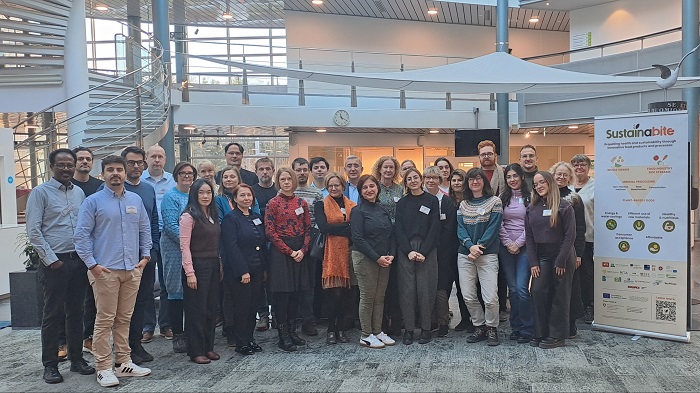
Teagasc has partnered with experts from across Europe to deliver the EU-funded Sustain-a-bite project, a new project aiming to bring healthier, minimally processed plant-based foods to Europe.
Sustain-a-bite, an EU Horizon supported initiative involving 19 partners from 13 different countries, aims to develop minimally processed food alternatives using whole grains – barley, faba bean, and chickpea – and upcycled side-streams from the food industry, such as apple, carrot, and tomato pomaces.
Coordinated by VTT Technical Research Centre of Finland, this collaborative effort seeks to create foods that satisfy both taste and health needs while lowering environmental impacts over the next three and half years. To achieve the associated health benefits, Sustain-a-bite aims to develop foods rich in protein, dietary fibre, vitamins and essential nutrients, with low levels of anti-nutritional factors, saturated fats, and added sugars.
Through the use of developed co-(bio)processing concepts, the Sustain-a-bite consortium aims to produce clean-label, nutritious, versatile ingredients that reduce the reliance on additives. Additionally, minimal processes are targeted to allow for ease of use and adaption by local, small enterprises, as well as larger companies, facilitating widespread adoption and implementation.

Commenting on the project’s aims, Nesli Sözer, Sustain-a-bite coordinator and research professor at VTT, said: “Our mission is to deliver technology solutions that enable healthier, more accessible and appealing plant-based food options, respecting European food traditions while promoting sustainability.”
“Since the Industrial Revolution, we’ve focused on stripping nutrients (e.g. dietary fibre, vitamins, and other health promoting compounds) from grains to improve taste and texture. Now, Sustain-a-bite is flipping the script – bringing them back with natural, innovative processes for healthier, tastier plant-based foods, without relying on artificial ingredients or preservatives,” Professor Sözer added.
Dr. Linda Giblin, a Principal Research Officer and lead on the project in Teagasc, added: “As one of the partners of Sustain-a-bite, Teagasc will assess the nutritive and health benefits of these foods using our lab based gut models.”
More about Sustain-a-bite
The Sustain-a-bite project has gathered partners from across Europe with multidisciplinary expertise, including universities and technological centres, large food companies, along with experts in consumer behaviour, D&C and exploitation.
Project partners are: VTT, Finland; University College Cork; Wageningen Food & Biobased Research, the Netherlands; IBA BUCURESTI, Romania; University of Milan, Italy; Innovarum, Spain; University of Vaasa, Finland; Teagasc; Technical University of Denmark; IZTECH, Turkey; University of Oxford; University of Porto, Portugal; MOA Foodtech; Spain; EIT Food CLC North-East, Poland; Roquette, France; Viking Malt, Finland; Tymbark, Poland; MASPEX, affiliated entity; BezMięsny, Poland; and Bern University of Applied Sciences, Switzerland.
More information on the project is available at the Sustain-a-bite website.