
02 December 2024
Next generation considerations a catalyst for climate action on Signpost farms
The climate knowledge, mind-set, attitudes and beliefs of Signpost Farmers toward climate action technologies and climate change were recently assessed. The results of this survey generated some interesting results.
As part of the Signpost Conference and General Assembly held on November 21, Head of Signpost Programme at Teagasc, Dr. Tom O’Dwyer shared the results of the survey, to which 75 farmer participants or 62% of those enrolled responded.
The participating farmers were asked to rank their level of agreement with a number of statements; both before they became Signpost Farmers and after they joined the programme, which aims to improve sustainability and lower greenhouse gas emissions (GHG) from their farming enterprises.
Reporting the survey’s results, Dr. O’Dwyer explained that there is an increased awareness amongst the Signpost Farmers of their farm’s GHG emissions, and of how their farming activities contribute to their annual GHG emissions.
More of the Signpost Farmers reported having a plan in place to reduce their farm’s GHG emissions since joining the demonstration farm programme, Dr O’Dwyer explained, and they also report that they increasingly consider the impact of weather on their future plans.
“Practically all the respondents are ‘somewhat’ or ‘very concerned’ about the impact of weather on both their current and future farming practices, and 44% were ‘very concerned’ about the impact of weather on their future farming practices.”
An additional finding from the survey points to what farmers can do to limit climate change, with Dr. O’Dwyer commenting: “Interestingly, the Signpost Farmers indicate they now realise that they could do more to reduce their GHG emissions, while continuing to place a high importance on maximising farm profit.
“The desire to maximise profit from farming activities is still there. It is important for us in the Signpost Programme to recognise that,” Dr. O’Dwyer said.
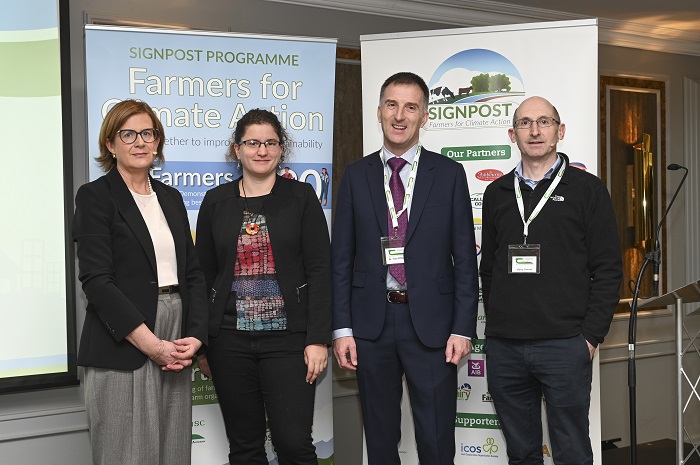
Pictured at the Signpost Conference and General Assembly from left to right are: Dr. Siobhán Kavanagh, Signpost Programme Communications and Engagement Specialist; Dr. Elodie Ruelle, Senior Research Officer in Teagasc Moorepark; Dr. Tom O’Dwyer, Head of Signpost Programme at Teagasc; and Barry Coonan, Met Éireann.
Climate actions
The Signpost Farmers’ understanding of climate mitigation technologies was also unearthed, with respondents indicating that they had either a ‘reasonable’ or a ‘very good’ understanding of the actions they can take to reduce their farm’s emissions.
When questioned on the impact of taking climate action, and the potential impact it could have on their farm’s profitability, Dr. O’Dwyer explained that the respondents were equally split between reducing, improving or maintaining profit on current levels.
Additionally, 44% of respondents viewed taking climate action on their farms as a way of improving their quality of life, while an overwhelming majority (80%) viewed is it as being important for leaving the farm in a better positon for the next generation.
The Signpost Farmers were also asked to rank the ease of use of mitigation measures, with the majority reporting using NPBT-Urea (protected urea) and maintaining optimum soil pH as being ‘easy’ or ‘very easy’ technologies to adopt and incorporate into their farming systems.
“Farmers tended to rank maintaining optimum soil P and K levels, using organic manures, increasing clover content in grassland or planting legume crops in tillage, and planting trees/forestry as more difficult technologies to adopt,” Dr. O’Dwyer added.
“The Signpost Farmers are telling us that these technologies are more challenging to work into their farming systems.”
The Signpost Farmers’ attitudes on the usefulness of these measures were also assessed, with the vast majority reporting these technologies – with the exception of planting trees/forestry – as being ‘useful’ or ‘very useful’.
“It was perhaps a little surprising that 41% of respondents did not recognise the usefulness of planting trees or forestry as a climate mitigation measure,” Dr O’Dwyer commented, and this will be an area where refocusing or advisory efforts and messaging will be required to clarify the benefits.
The above is just a brief summary from Dr. Tom O’Dwyer’s presentation to the Signpost Conference and General Assembly. For further insights and to view the full Signpost Farmer Survey results and the improvements Signpost Farmers have made, access Dr Tom O’Dwyer’s full paper from the Signpost Conference and General Assembly here.
Also read: Adapting to climate change: More grass and more management
Also read: Beef cattle finishing age reductions have stalled
Also read: Signpost Programme playing an instrumental role in agriculture’s emissions reductions