
Nitrogen fertiliser: Will it give a return on sheep farms?
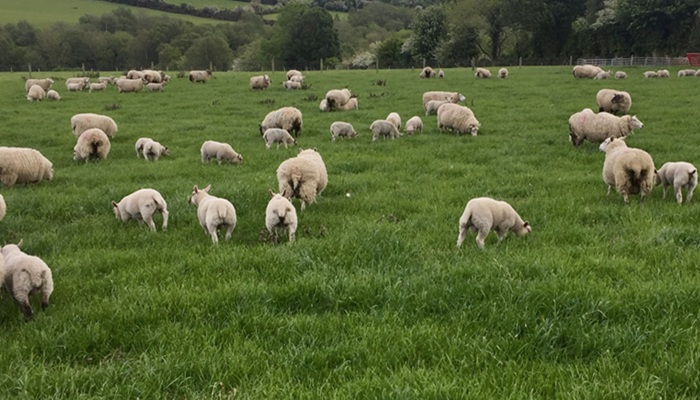
Elevated fertiliser prices and lower application rates over recent years has many sheep farmers questioning the value of chemical nitrogen applications to grow grass this spring.
To shed light on the economics, Dr. Philip Creighton, Sheep Enterprise Leader at Teagasc joined Ciaran Lynch on a recent Let’s Talk Sheep Webinar.
With peak grass demand on sheep farms occurring five to seven weeks post-lambing, Dr. Creighton explained that a priority for the coming weeks is making sure there is enough grass available in front of ewes and lambs to meet demand.
“Current management tasks are about dealing with the issues in front of us. Some we can control and some we cannot. Fertiliser price is one of the big issues. Costs have increased significantly, and many farmers are questioning whether they will get a return from spreading fertiliser,” Dr. Creighton commented.
“We need to make sure we can keep grass in front of sheep by growing enough of it on the farm. At this point in the year, farmers should be assessing how much fertiliser has gone out and what the plan is to get grass supply back to where it should be,” Dr. Creighton added.
Two scenarios were presented to farmers attending the webinar; one where fertiliser was purchased before the price spike this spring (protected urea at €520/t and CAN at €410/t), the second after prices rose (protected urea at €800/t and CAN at €540/t). For the latter, Dr. Creighton reminded farmers that protected urea remains better value at €1.74/kg of N compared with €2.00/kg of N for CAN.
Despite heightened fertiliser prices, Dr. Creighton reminded farmers that the key comparison is between growing grass with fertiliser and buying in concentrate feed. Typically, he explained, the response rate to nitrogen is somewhere in the region of 10 to 20kg of grass grown for every 1kg of nitrogen applied. To grow a kilogram of grass costs around 10c/kg of DM, while feeding a kilogram of concentrate is around 3.5 to four times the cost of grass.
He continued: “When we compare the cost per kilogram of concentrates with the cost per kilogram of grass produced from applying nitrogen, it is still much more economical to feed sheep by growing grass. Even though fertiliser is more expensive than we would like, it is still more economical to grow grass than to replace lost pasture production with additional concentrates.”
Anecdotally, he added, there have been significant increases in the amount of concentrates being fed and significant reductions in the amount of grass being grown and utilised on sheep farms.
“Many farmers are now running into shortfalls, with less grass and winter feed available. While fertiliser is expensive and remains higher than it was in previous years, it is still an economic way to grow grass to feed sheep on the farm when the figures are examined,” Dr. Creighton added.
Through his appearance on the webinar, Dr. Creighton also discussed Teagasc National Farm Survey trends in concentrate and chemical nitrogen usage on sheep farms, noting: “In 2024, there was an average of 109kg of concentrates being fed per ewe on Irish lowland sheep farms, while 53kg of chemical nitrogen was being spread per hectare. A number of years ago, before previous fertiliser price shocks, that nitrogen figure would have been around 70-75kg per hectare. In 2022, it dropped to less than 30kg of chemical nitrogen per hectare.”
Delving into the research work from Teagasc Athenry, Dr. Creighton added: “Previous work has shown that there should be approximately 10kg of nitrogen going in per ewe. Therefore, if a farm is stocked at seven ewes per hectare, the requirement to grow enough feed to support that stocking rate is about 70kg of nitrogen per hectare.”
For full insights and an update on the research working ongoing at the Teagasc Athenry Sheep Research Centre, a recording of the Let’s Talk Sheep Webinar is available to view below: