
18 January 2025
Nitrogen rate effect – research update
Edward O’Riordan, MJ Kelly, Sarah Burke and Mark McGee, Teagasc Grange, report on the effect of nitrogen fertiliser application rates on herbage yield and sward white clover content.
Grass-white clover swards comprised of perennial ryegrass (Aberchoice, 25kg/ha) and white clover (Aberherald, 5kg/ha) were established in autumn 2018 at Teagasc Grange. For the next four years they received an annual chemical fertiliser nitrogen (N) application rate of either zero, 100, 200 or 300kg N/ha in the form of calcium ammonium nitrate (CAN), with P and K fertiliser applied as necessary. The annual N distributions for the N fertiliser treatments were 25%, 25%, 25%, 15% and 10% in April, May, June, July and August, respectively. Pastures were harvested at monthly intervals. The mean relative annual herbage production is summarised in Figure 1.
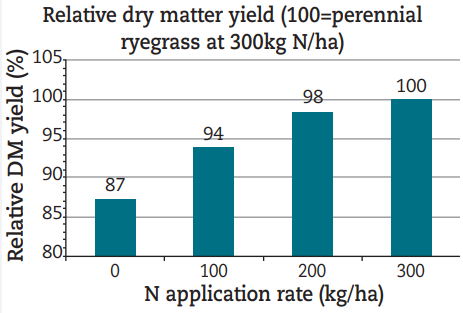
Figure 1: Relative herbage dry matter yield (perennial ryegrass-white clover receiving 300kg N/ha = 100).
Taking the grass-clover sward receiving 300kg N/ha as the reference point, grass-clover receiving zero N, 100kg N/ha or 200kg N/ha had relative yields of 87%, 94% and 98%, respectively. The contribution of clover to herbage dry matter yield was very seasonal, Figure 2. Swards receiving zero N had, on average, 40% clover over the year. Each additional 100kg N/ha approximately halved the sward clover content (i.e., to 22%, 11% and 7%, for the 100, 200 and 300kg N/ha treatments, respectively).
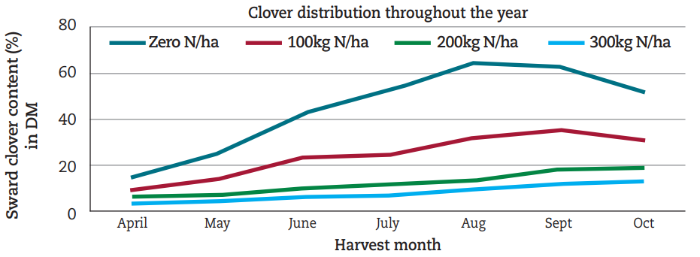
Figure 2: Average sward clover content (%) over the year.
Read more from the latest Teagasc Beef Newsletter