
04 June 2025
No more tail paint
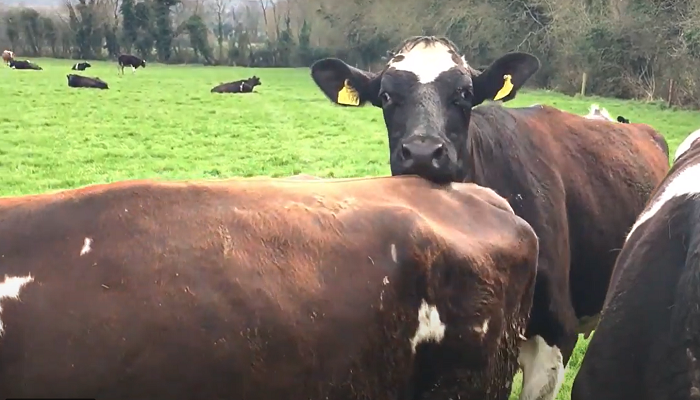
In the midst of the breeding season, Teagasc Signpost Programme and Lakeland Dairies Monitor farmer, Kieran McDermott tells us how a recently installed heat detection system is proving its worth on his farm in Co. Monaghan.
I have just installed heat detection collars on the farm. It is a job less for me to worry about. I don’t have to tail paint cows anymore and try and catch them in heat in the parlour. The heat detection app on my phone tells me every morning what cows are in heat. It is going smoothly so far.
The first couple of weeks is always the easiest of the breeding season to find cows in heat. I am hoping that as I get further into the breeding season that the collars will pick up harder seen cows on their second heat. These are cows I would have missed out on in previous years. This will be when I will see the full benefit of the heat detection system.
Silage quality
I had some of my first-cut silage baled on the 16th of May. The quality of the silage will be far superior when its cut early. If I waited another few weeks, I would have gotten a better yielding crop but a poor-quality crop, with lower digestibility.
In 2009, we started making bales because we converted the silage pit into cubicles, so we have had to make bales since. There is great flexibility in bales because, if paddocks grow too strong to graze, I can have the field baled and back into the grazing rotation quicker than leaving the field closed up to put into a pit.
I was saying back in March I had to graze some of my silage ground so I will not be baling that for another few weeks. The bales give me the flexibility to graze the silage ground if I need to.
Reseeding
I have 6ac reseeded and I hope to do another 11ac after first cut. I used minimum tillage as a method of reseeding as it reduces cultivation levels of the soil compared to ploughing. The ground was all soil sampled last year, and it came back Index 1 for phosphorus and very low in pH. When reseeding, I applied 3 tonnes of lime per acre and 3 bags of 10-10-20 per acre. I hope to graze this at 1,000kg DM/ha cover for the first three grazings with heifers.
The above article was adapted for use on Teagasc Daily from an article first published in the Farming Independent.
Find out more about the Teagasc Signpost Programme and the farmers enrolled here.