
26 February 2023
‘Once you look after the heifer, calving at two years of age will work’
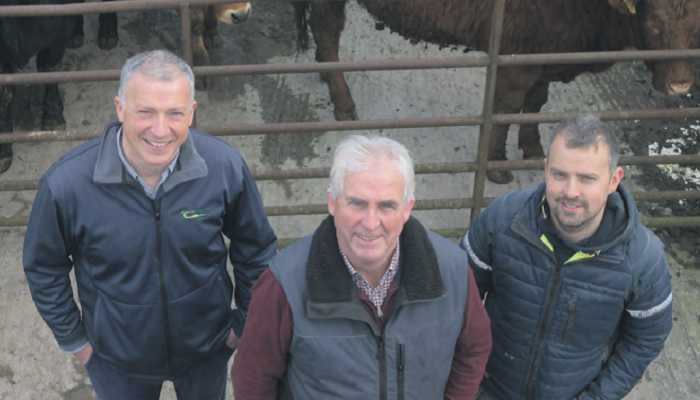
Michael Biggins and his son Niall farm near Glencorrib in south Mayo. Michael works full-time on the farm, combining the farming work with his busy role as IFA Rural Development Chair. Niall works off-farm as a carpenter, but is also heavily involved in the farm.
The 45ha farm is in three blocks. The land is described as dry limestone, but there is also an area of a heavier peaty soil. There are 65 spring-calving suckler cows.
The Biggins family participates in the Teagasc Future Beef Programme. Michael and Niall are continually improving their suckler herd. The herd is made up of Limousin x Saler suckler cows, who are fertile and have a lot of milk.
“We sell our bulls as weanlings and the heifers as yearlings,” Michael explained in the January/February edition of Today’s Farm. “We cull hard – any cow with only an average quality calf or who calves late will not get a second chance,” added Michael.
Breeding policy
Two Charolais stock bulls are used on the mature herd and an easy-calving Saler runs with the heifers. Approximately 20 cows with their calves plus the bull will be put into a separate group on each of the three blocks. To keep the calving interval tight, the bulls are removed after eight weeks.
“We want to start calving on February 1st, so the bulls are let out in the last few days of April,” said Michael.
Replacement policy
Replacement heifers largely come from within the herd, but Michael will occasionally purchase suitable in-calf heifers, directly from farmers where possible. They have one main rule: “Heifers must calve at two years of age or very close to it. It costs too much to have a heifer running around for an extra year without producing a calf,” Michael explained.
Do heifers need assistance at calving? “We’ve had heifers calving at three years of age and they are the ones I had the most trouble with. All heifers calving need extra observation and assistance, no matter what age they are,” he answered.
All of the Biggins’ suckler herd have now calved at two years of age with the exception of some purchased replacements.
“There are cows on their fourth and fifth calving with a mature weight of over 650kg, who calved for the first time at two years old,” Niall commented.
Key weight targets
There are specific target weights that the heifer must meet at different stages of her development. On the Biggins’ farm, the young heifer calves are forward grazed during the first summer. This ensures that they get to graze leafy covers of grass and, combined with their mother’s milk, will be gaining 1.2kg liveweight per day. Prior to weaning, meal is introduced at 1kg/head/day. They are also vaccinated against IBR and RSP and dosed for worms.
“The heifers are weaned in a stress free, gradual way by removing three to four cows at a time from the main group,” Michael explained. “There is no housing of cows and calves during this process. The heifers will be weaned at 280kg and over. After weaning, the heifers remain on grass with 1kg of meal until housing. Then they are weighed and this year, the group averaged 300kg.
“They are penned and offered high-quality 73% DMD silage. The target is a weight gain of 0.6kg/day while indoors for the first winter. We take dung samples and animals are dosed based on the results. The heifers have plenty of room and feed space to ensure maximum performance.”
Table 1: Key weight targets
| Mature cow weight | Weaning weight | Bulling weight | Calving weight |
|---|---|---|---|
| Target percentage of mature weight | 60% | 80% | |
| 600kg | 260-280kg | 360kg | 480kg |
| 700kg | 300-320kg | 420kg | 560kg |
Year two
Weather permitting, the heifers are let out to grass as early as possible in late February. “The target is to have them at 60% of their mature cow body weight, i.e 400kg + at bulling on May 1st,” added Michael.
“Prior to bulling, we will draft 12-15 of the best heifers. These heifers will be from the best mothers that meet the following criteria:
- Consistently produced a top-quality calf;
- Plenty of milk;
- Good docility;
- Calved early in the season;
- Good udder and feet;
- High Replacement Index on ICBF (€100 plus).”
Table 2: Key performance indicators from the 2022 ICBF reports
| Biggins’ herd average | National average | Top 10% | |
|---|---|---|---|
| Replacement Index (cows) | €105 | €87 | €112 |
| Replacement Index (first calvers) | €133 | €91 | €128 |
| Herd calving interval | 366 days | 393 days | 358 days |
| Calves per cow per year | 0.99 | 0.87 | 1.02 |
| Heifers calved at 22-26 months | 74% | 24% | 75% |
| Six week calving rate (spring) | 85% | 55% | 100% |
Breeding time
An easy calving bull is selected. The bull will run with the heifers for eight weeks only. “If the heifer does not go in calf in this time she will be sold off-grass to the local mart,” Michael noted.
This means that the most fertile heifers are kept and will calf compactly the following year. Michael likes to calve the heifers along with the main herd, adding: “Calving in mid-February means that the heifer won’t be far off going to grass”.
Management pre and post-calving
After breeding, the heifers are scanned and the in-calf heifers are kept as a group on their own. The farm is well paddocked and the heifers get three-day grass allocations. The target is to get a liveweight gain of 1kg/day. During the second winter, the heifers are penned as a group. They are not mixed with other stock such as older cows. They are offered moderate quality silage (68% DMD+) ad-lib and a close eye is kept on body condition. Heifers are vaccinated prior to calving against rotavirus, coronavirus and leptospirosis.
“At calving, we make sure one of us is near home and we can both watch the calving pens from our phones,” Niall explained.
“After calving, the heifer is allowed to bond with her calf in a pen of her own for three days. She will be given top-quality silage (73%DMD+) until turnout.
“It is vital that the heifer is well looked after post-calving to ensure that she will go back in-calf. We will continue to keep the heifers that calved as a group of their own for another year. We have an easy-calving Charolais bull for them for the second season.”
Michael sums up their attitude to 24 month calving: “We wouldn’t have it any other way. Once you look after the heifer, calving at two years will work.
“It is a lot more profitable and I read that it reduces GHG by 12% – we all have to be very conscious of the environment side as well as profit from now on. Calving at two years is a win-win all round.”
Read more: Fact vs fiction: the ‘myths’ of calving at 24 months
Read more: Calving heifers at 24 months of age – a farme’s experience