
Opportunities to diversify are never too far from James O’Keeffe’s mind
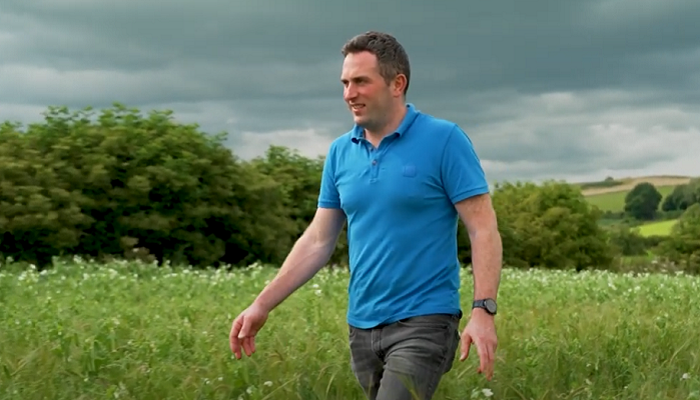
Creating multiple income streams to develop a resilient farm business, James and Zita O’Keeffe, from Crossakiel, Co. Meath, are organic tillage farmers with a diversified farm holding. Dr Siobhán Kavanagh and John Mahon, Signpost Programme tells us more.
James and Zita O’Keeffe, from Crossakiel, Co. Meath, are organic tillage farmers with a diversified farm holding. James, a chartered civil engineer, took over the running of the farm in 2013 after the sudden and tragic loss of his father Michael in a farm accident.
Farming was initially on a part-time basis. With tillage income pressures over the following years, James recognised that change was needed for financial sustainability and considered many opportunities to diversify the farming system and ultimately profitability.
The starting point
Six years ago, a set of ideas were drafted and put into action in the following years to change and diversify the farm and farm income.
In 2020 part of the farm was entered into the Organic Farming Scheme. James wouldn’t say he was initially particularly environmentally focussed, but he couldn’t get enthusiastic to learn about applying agrochemicals and chemical fertilisers to his crops.
Instead, he found he preferred to learn about farming with nature and would admit that he got sucked into organics, focusing on soil health and farming with a more biological focus.
Zita, being a strong advocate for organic food and farming, also encouraged a focus in that direction.
Organic farming started to make financial sense for the O’Keeffes – three years later all of the farm had been converted to organics and further land leased to expand the area farmed.
Crop diversity
There is a big focus on a diverse targeted rotation across the farm to help deal with weeds but also to open up market opportunities. Spring oats are sold for the organic porridge market. Milling wheat has been grown for organic flour, albeit unsuccessfully to date, and rye is being trialled for the food market. The opportunity to grow a crop for the distilling market is also being explored as another potential niche outlet.
The O’Keeffe’s grow several intercrop mixes, such as winter wheat/barley/beans and a trial of spring barley/wheat/pea/bean/lupin, offering high energy/protein ration to organic farms. These mixes and the remainder of grain grown are sold direct to organic farmers under “O’Keeffe Organics”.
James utilises the existing grain handling and storage facilities his father had built over the years prior to his passing, providing the foundational infrastructure for this business, but has also continued to invest more in processing equipment.
James is producing red clover silage on a two-to-three-year cycle. He takes in slurry from a local dairy farmer and sells four cuts of high protein, high digestibility silage to that farmer annually. It’s a win-win for both farmers. James is getting valuable nutrients for his farm and it’s an excellent weed break. And the dairy farmer gets high quality-silage and it helps him stay within nitrates regulations.
Carbon footprint
James and Zita are fully engaged with the AgNav platform and measuring the carbon footprint of the grain he is producing. Emissions from this tillage farm are already low with gross 2025 figures ranging from 159 to 227 kg CO₂e / tonne before straw chopping, which reduced these to -61 to 81 kg CO₂ e / tonne net. Low carbon footprint grain combined with miscanthus sequestering carbon, farmed organically, an extensive network of high-quality hedgerows, straw incorporation, and clay soils means this farm will very likely be close to being carbon neutral or even carbon negative every year. Carbon farming is just around the corner and James will be in a position to capitalise on opportunities that may arise within that framework.
Find out more about the O’Keeffes’ farming system in the below video:
Miscanthus
The O’Keeffes are just one of the farmers that invested in miscanthus back in 2006, when there was encouragement to grow bioenergy crops to replace peat for energy production. However, changes in policy led to a lack of markets for the crop and many were left with stores full of unsaleable produce.
By chance, a local equestrian centre asked to try some of the chopped miscanthus for bedding, which worked well. James persisted and slowly learned the best harvest timing and technique to achieve the lowest moisture, correct chop length, and to produce a consistent quality product.
Since then, they have developed a niche animal bedding business called Dri-Bed Animal Bedding, selling to local livestock farmers and the equine and poultry sectors. Grown organically, and receiving only organic manure, this is a very environmentally friendly crop with a negative carbon footprint. The market has continued to grow with James doubling his area planted to miscanthus in 2021. Alternative uses are currently being explored such as the horticultural sector.
Solar
They installed a 50 kW solar panel array on a shed in December 2023 to produce electricity for the farm but primarily to sell electricity back to the grid. The unit produced 38,000 kwh in 2025, and since its installation has saved 75t CO2e which is the equivalent of 30 tonnes of coal saved. James was not eligible for the TAMS grant but got the SEAI grant of 25% for non–domestic use. He is awaiting the ESB 3 phase smart meter since 2024, needed to meter the actual quantity of exported electricity for payment, currently only being paid a deemed rate, roughly equating to 35% of maximum export, a significant loss financially (> €6000 per annum, which ESBN are getting for free).
The latest update (December 2025) was that this timeline has again slipped and won’t be starting until late 2028 at best. This is very frustrating for James. Solar energy is a potential income stream but also an important tool in reducing emissions from fossil fuels. James feels that if we want farmers to engage in diversification options like solar, the structures need to be in place to allow this to happen.
Advice to other farmers
James’ advice to other farmers is to look inward first and have a good look at the resources you have on your farm and getting the most from these – the crops you grow, the crops you could grow, the infrastructure on the farm etc., and look around you for opportunities and to utilise the numerous grants available.
Much of James’ business is transacting with other farmers whether that be selling animal feed, selling animal bedding or growing forage crops. There is significant potential for many farmers to work collaboratively with local farmers. This means being open to talk to everyone and anyone and a willingness to work with others and build trusting relationships. James sees climate change as an opportunity – an opportunity to produce low carbon grain for premium markets, producing sustainable energy whether that be solar or biomethane. James is open to considering energy farming but is very clear that government backing is needed in terms of policy, structures and incentives.
James and Zita are opportunity spotters. People like James constantly have their radar on for ‘what else could this farm do?’ He doesn’t just see land as ‘oats and wheat’. He sees possibilities where others might see tradition. James clearly wants a system where the farm is less exposed and more self-reliant. The advantage of many of his actions is that they are good for the environment as well as his profit. James would say he is motivated by independence: “If I can create multiple income streams, I create resilience in the farm business.”
The above was first published in the Farming Independent.