
29 September 2022
Organic Beef Open Day – Red clover silage
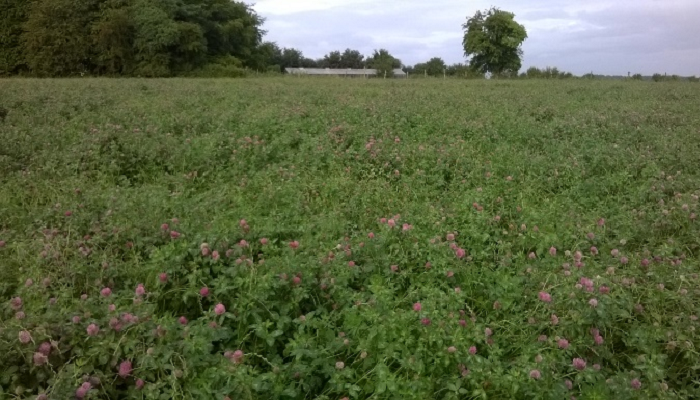
Red clover silage swards can produce high yields without the need for chemical N inputs due to its ability to fix in excess of 200 kg N/ha. Nicky Byrne and Donall Fahy write about some of the benefits of red clover.
Introduction
Red clover (RC) can contribute substantially to organic, low-input and conventional animal production systems due to its ability to fix atmospheric N and support of higher animal performance. These benefits contribute to beef systems of improved farm gate nitrogen (N) balance, through a lessened need for fertiliser and feed, while maintaining high animal performance. Swards with a high content of red clover (75% on a dry matter basis) are capable of fixing 24-36 kg N/t dry matter (DM) produced, meaning swards of high clover proportion and DM production are potentially fixing in excess of 200 kg N/ha annually. The inclusion of red clover in conserved grass silage swards can increase average daily live weight gain (ADG) compared to grass silage diets. Despite the many benefits of RC inclusion, it has had limited uptake across Irish production systems, likely due to its more complex management requirements, unsuitability to frequent grazing, reduced DM yield stability and persistence giving a short term lifespan of approximately 3-4 years.
Orla Kinane, Digital Communications, Teagasc caught up with Nicky Byrne, Research Officer, Teagasc to get an insight into the benefits of red clover silage at the #OrganicBeef22 Open Day which took place on Wednesday, 28 October on the farm of John Purcell, Cashel, Co. Tipperary. Red clover (RC) can contribute substantially to organic, low-input and conventional animal production systems due to its ability to fix atmospheric N and support of higher animal performance.
Agronomy
Unlike for perennial ryegrass (PRG) and white clover varieties, no Recommended List currently exists for RC varieties in Ireland, with Irish producers relying on information from the UK Recommended/National List to identify suitable varieties. Red clover should be grown in rotation, allowing for a four year break to control diseases such as stem eelworm and Sclerotinia fungus (clover rot). Typically 7.5 to 10 kg/ha of RC in addition to 20 to 22 kg/ha of PRG should be sown on well drained soils with a soil pH of 6.5 to 7. Depending on soil moisture and temperature, seedbed preparation and sowing, establishment may be slow but not necessarily a failure. Spring reseeds offer the greatest window of opportunity to optimise pre and post-sowing management.
Red clover has a deep taproot, an erect growth habit, with a low density of large shoots. Stems are formed from the growing points located on the crown on top of the taproot. Reserves of carbohydrates and N are stored in the crown and taproot, where they are remobilised to fuel regrowth after defoliation. The crown/growing point of RC is solitary and exposed, making it vulnerable to physical damage by machinery and animals. This means that RC is best suited to infrequent silage cuts rather than regular grazing.
Cutting intervals of 6 to 8 weeks allow sufficient time for the canopy to intercept sunlight to replenish energy reserves. Increasing the defoliation frequency beyond three cuts can reduce yield due to insufficient replenishment of plant reserves and thus persistence. ‘Late’ silage harvests (beyond mid-September) can be difficult to ensile (insufficient wilting) and are of relatively low yield making it difficult to justify economically. To protect the crown of RC cutting height should be 7–8 cm. Red clover has a low water soluble carbohydrate concertation and high buffering capacity, reducing its ensilability. The inclusion of perennial ryegrass as a companion species will improve the overall ensilability of RC silages as well as wilting (24 to 48 hours) to increase DM concentration, while ensuring that the leaf is not damaged (shattered) as a result of over wilting and excessive machinery passes.
Red clover swards have the ability to fix high levels of atmospheric N, making it available to plants in the soil, supplying in excess of 200 kg N/ha annually. Mixed RC and PRG swards receiving no chemical N were found to have similar annual DM production to PRG swards receiving up to 412 kg N/ha per year (15.8 and 15.7 t DM/ha, respectively).
Feeding value
Cattle consuming silages containing RC have increase dry matter intake (DMI) compared to grass silage. From this additional DMI and increased levels of rumen undegraded protein cattle consuming RC silage can achieve increased levels of live weight gain (ADG). Beef cattle offered a mixture of RC and grass silage were found to have an ADG of 1.04 kg, compared to grass silage which supported an ADG of 0.59 kg. The feeding vale of RC silage appears lower than that of grass, with lower levels of digestibility because of high fibre levels. The elevated fibre levels are likely due to the higher levels of stem required to support the plants erect growth habit. Despite overall lower digestibility increased DMI and animal performance can be achieved due to the faster rate of digestion of plant fibres and increased particle break down contributing to increased passage rate and rumen fill.
Conclusion
The inclusion of RC into silage swards has great potential across Irish pasture-based production systems of all intensities. These swards have an enhanced ability over grass only swards to maintain high levels of herbage production and animal performance in the absence of chemical N fertiliser.
A forum took place at the OrganicBeef22 Open Day on the farm of John Purcell, Co. Tipperary on Wednesday, 28 September and was addressed by Minister Charlie McConalogue. The forum chaired by Damien O’Reilly included panel speakers Joe Bourke, Bord Bia; Catherine Roche, Irish Country Meats; Jack Nolan, Department of Agriculture, Food and the Marine; Pat Dillon, Teagasc and host farmer John Purcell
More information about the National Organic Beef Open Day