
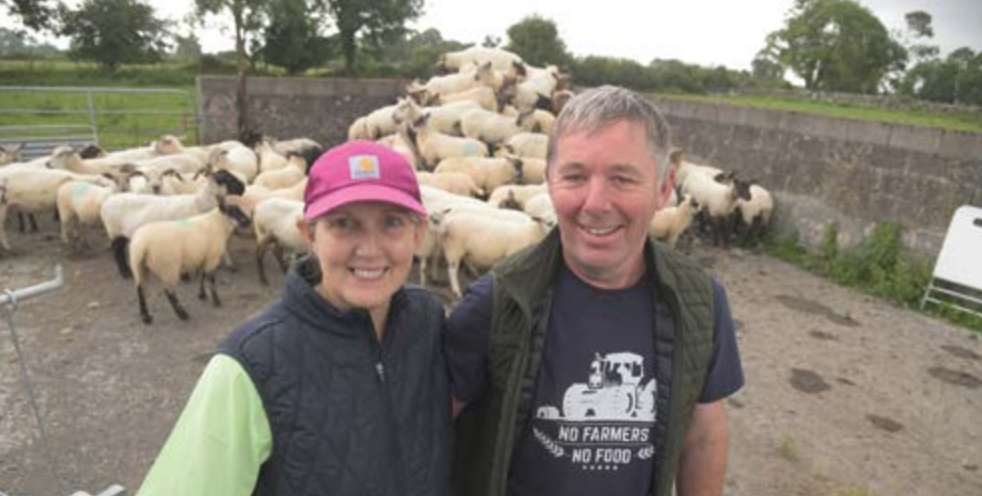
John Noonan highlights the sustainable practices of Enda and Noreen Monaghan, organic sheep farmers in Galway, and Joe Kelly, organic horticulture and suckler farmer in Mayo. These two farms are very different, illustrating the range of possibilities within organic farming.
Enda and Noreen Monaghan, Caherlistrane, Co. Galway
Organic sheep farmers, farming a lowland mid-season flock of 140 ewes. “We joined the Organic Farming Scheme back in 2003 as part of our REPS plan, with a flock of 140 mid-season lambing lowland ewes,” says Enda.
The closed flock comprises mainly Suffolk x Texel ewes plus Belclare ewes and Leicester Cross rams. They have been bred back to Suffolk and Milford cross rams in recent years to improve the maternal traits and avail of hybrid vigour. Ewes are mated in October and are managed outdoors and housed for a few weeks pre-lambing.
“After lambing, all male lambs are castrated, and ewes and lambs are moved to sheltered paddocks that are saved over winter to provide spring grass,” says Enda. “I sell some ewe lambs for breeding when I have my own picked out. They are fed round bale silage and hay, with organic oats and some concentrates introduced six weeks pre-lambing.”
The land in the area is excellent quality, which helps reduce the pressure on feed both in winter and summer. There is no fertiliser applied, apart from some farmyard manure that has built up under the ewes during housing. The fields are grazed mostly by the flock and there is adequate recycling of nutrients occurring through the sheep’s dung and urine.
“All health treatments are part of a health plan in the organic system,” says Enda. Lambs are dosed based on faecal egg counts, and Vitamin B12 is given whenever lambs or ewes are in the penning area. Flystrike is controlled with Click while ewes and lambs are foot bathed with zinc sulphate when lameness is an issue.
Lambs are weaned in late July, with the best 20–30 lambs sent to the organic market if weighing 42 kg and with the necessary fat cover. Enda and Noreen manage the remaining lambs by keeping them growing and generally targeting the January to March organic market, when lambs are scarcer and the price is stronger.
“In recent years we have finished lambs on red clover swards and have found that they thrive much better than feeding organic concentrates,” adds Enda. “If any late lambs are left, they finish quickly on some spring grass in April and May.”
Enda has strong views on marketing organic lamb and thinks that supports should be put in place for local butchers to sell organic lamb in their shops around the country. “This would be a new outlet for farmers and help give Irish consumers more access to organic lamb,” he says.
The Monaghans also grow eight hectares of organic oats annually that is contracted to be sold to Flahavan’s. The market for organic oats is very strong. With many new organic sheep farmers keen to buy them, organic oats can make €500/tonne.
There is a plan in place to sow four hectares of red clover and four hectares of multi-species sward after harvest in late July. That will provide excellent crops for growing and finishing lambs along with providing good quality winter feed high in energy and protein.
“We purchased a new sheep handling unit in the spring under the TAMS,” says Enda. “That will help reduce the workload, get jobs done more efficiently and reduce the risk of injury.” It will tie in nicely with a system that reduces the stress of farming while at the same time improving farm income and the sustainability of the farm.
Joe Kelly, Kiltimagh, Co. Mayo
Joe Kelly, or “Joe Leaves” as he is locally known, is an organic horticultural and suckler farmer near Kiltimagh. He is also a walking encyclopaedia of horticultural knowledge about dozens of edible plant species.
He frequently takes calls from chefs who want to know what plants are reaching their peak of taste and quality. Joe grew up on the farm working closely with his father, who also was a tillage and vegetable grower. The townland was well known as having a tradition in growing raspberries and other berries.
This gave Joe his introduction to horticulture. He became a lightning-fast picker of raspberries. “My father paid me by the weight picked,” says Joe. This entrepreneurial experience seems to have sparked an enthusiasm to delight his customers with ultra-high-quality produce.
“Chefs and customers are always looking for something new, whether it’s taste or colour. Everything needs to be perfectly fresh and at its best when it reaches the table.”
Joe has a number of greenhouses where he grows a huge array of fruit and vegetables from tomatoes, cucumbers, runner beans and basil of various varieties. The garden carries an equally huge array of salad leaves of rocket, mustards and different varieties of lettuces.
According to Joe: “I’m paid on weight of leaves. The shape, colour, texture and taste are all factors that local chefs are demanding constantly, to reduce preparation time and give discerning consumers quality organic produce that tastes great.”
Organic tomatoes, both vine and bush types, are grown and the taste is vastly different from conventionally grown tomatoes. They receive no chemical sprays or artificial fertilisers and get all their nutrients from composted farmyard manure from Joe’s cattle.
Grow local, buy local
The range and quality of Joe’s production shows that it’s not necessary to import a huge quantity of food, organic or conventional, from abroad with attendant air miles and carbon footprint. Joe produces vegetables and edible leaves both outdoors and in polytunnels. He is a strong advocate of people buying local and producing their own vegetables.
“People can start with simple crops such as lettuce or onions,” says Joe. “They’ll soon notice the difference in flavour. And of course, organic production means no chemicals and no artificial fertilisers, which delivers benefits in terms of biodiversity and water quality.”
The farm is extremely busy in summer as crops of leaves and other seasonal produce are picked, packaged and dispatched to restaurants and hotels in the nearby towns of Kiltimagh, Castlebar and Westport. The work is constant with watering, resowing and ground prepared for the next round of crops.
Careful attention is given to rotations, with families of crops such as celeriac, spinach, chard, cabbage and leeks followed by potatoes and then carrots.
Joe is not just a grower but also an enthusiast for edible crops: “Leeks are amazing plants. Sow them now; they will be harvested next spring. Onions are equally great. They grow madly until June 21st and then they begin to put all their energy into developing a root – it’s as if they know the days are getting short.”
The organic suckler enterprise complements the horticultural side of the business. A stabiliser bull is crossed on the cows to get easy-calving, fast-growing, saleable weanlings that are sold to organic finishing farms in the region. Farmyard manure produced by the Angus cross sucklers is allowed to compost and is then added to the soil to provide nutrients for the growing edible crops.
Although the horticultural enterprise is very labour and management intensive, Joe is producing excellent quality food that is in high demand locally, providing huge health and nutritional benefits to consumers.
“I think that the growing of vegetables and leaves should be part of the school curriculum,” says Joe. “It would give young people a life skill that has the potential to feed a family and show how important healthy food is for our mental and physical well-being.”
Read more from the September/October edition of Today’s Farm