
12 December 2022
Organics – good for soil and the bottom line
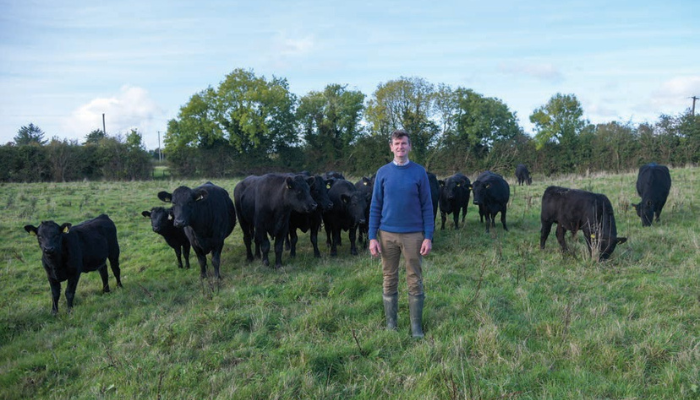
Donal and Frederique Keane run an organic suckler-to-beef and cereal farm with their daughters Pauline, Marie and son John at Camelton Stud, Summerhill, Co Meath.
“There have always been cat- tle and tillage enterprises on our farm,” says Donal.
“In the early 2000s, we were turning over a lot of money but very little seemed to remain with us,” he says.
In 2010, having looked at the costs of their conventional farming systems compared to the returns, the Keane family decided to see if there were other possibilities.
Background
“I had always been uncomfortable with the use of chemical fertilisers and sprays on grassland and crops, but believed that they were neces- sary,” says Donal.
“With the increasing cost of inputs and falling price of produce, we knew we had to make a change. I started re- searching other farming systems and spoke to several organic farmers.
“I met a local organic farmer who gave me an overview of his farming system. After that, I began seriously looking at organic farming as an opportunity to improve the financial position of the farm.”
Donal says the Keane family also recognised the environmental ben- efits of organic farming.
After careful consideration and Donal having completed the Teagasc FETAC Organic Farming course, the farm entered organic conversion in 2011.
Changes that have been made to the farming system
Initially, the livestock system on the farm was a suckler-to-beef system, with some weanlings also being purchased from other organic produc- ers. All finished animals were sold directly to an organic processor.
The suckler herd on the farm is predominantly Aberdeen Angus. In previous years, these animals were crossed with an Aberdeen Angus bull.
However, last year the suckler herd were crossed with Wagyu, producing their first calves this spring. Going forward, the plan is to finish these calvesand sell off the farm. The Keanes also plan to source organic breeding heifers off-farm.
“We increased our tillage area sig- nificantly and began to grow oats on contract for Flahavans. We also grow winter wheat for the organic livestock feed market,” Donal says.
“We grew varieties of heritage wheat on a field scale as part of a project to produce flour high enough in protein (12.5%) to make sourdough bread.
“Unfortunately, the yield penalty from growing heritage varieties wasn’t adequately offset by the price premium.”
Crop rotation
Crop rotation is a planned sequence of different crop types. It is a key component of conventional crop production and is even more impor- tant in organic systems. The role of rotation is to;
- Replenish soil nitrogen.
- Manage weed, pest and disease levels.
- Maintain soil organic matter and structure.
There are no blueprints for rota- tions, as circumstances are different on every farm. An organic advisor will advise on key aspects of organic rotations.
With cereals already being grown, Donal is gradually implementing a more complex cropping rotation on the farm. The plan is to introduce more mixed crops (including leg- umes, peas and beans, together with wheat or barley). Where spring crops are planned, they will be preceded by forage crops or cover crops.
Multi-species sward
“In late August this year, we sowed 14ha of a multi-species sward made up of a mixture of white clover, red clover, three different grass types, chicory, plantain and mustard. The 14ha had previously been in either oats or wheat,” Donal says.
“This sward will be used for grazing by cattle. The herbal mixture does not need high fertiliser inputs and
is therefore ideally suited to organic farming. With the different species in the sward having varying root depths, they will unlock resources from deeper in the soil profile and naturally improve soil structure with their roots.”
Hens
The most recent diversification on the farm is the introduction of a flock of 400 laying hens. This gives the Keanes, as Donal says, “a direct con- nection with customers.”
They market their eggs directly under Keanes Organics (@keanes_or- ganic on Instagram) through shops in nearby Summerhill and Trim, shops in Dublin and a vending machine in Summerhill.
Future plans
The Keanes want to figure out how to market some of their produce directly to the consumer. They are realistic that this not going to be possible for all their produce.
“We would like to sell some of our beef and eggs and grow more protein crops such as peas or beans for hu- man consumption,” says Donal.
All about the soil
This summer, Donal completed a week long course in Kilmallock on Korean Natural Farming, delivered by an expert based in Hawaii.
“It focused on the role of microbes in the soil, manures and compost,” says Donal.
“I learnt that there is a symbiotic relationship between the microbes and plants. Some are found on the surface of the roots, which feed off the carbon, or sugar that the plant produces during photosynthesis.
“They get their energy source from the root of the plant, and in turn, they digest the microscopic particles in the soil. Through a complex food chain, the nutrients that they digest from the soil particles are made avail- able to the plant.”
This, to Donal, was only a starter course on his way to understanding the complexities of soils, in particu- lar the microbial life of the soil.
“We want to get the soil brimming with microbial health to produce high nutrition value food to serve a market demanding high nutritious food,” he says.
From time to time, people ask Donal has he any regrets about going into organic farming.
“I reply that my only regret is that I didn’t get into organics 20 years earlier,” he says.
This article was first published in Today’s Farm – Read the full publication here.