
18 February 2025
Overcoming pigeon damage in oilseed rape crops
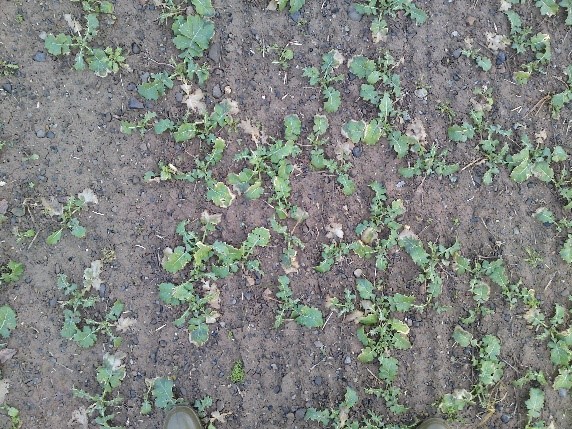
Tillage Specialist at Teagasc, Shay Phelan shares advice on how to boost oilseed rape performance after many crops have suffered pigeon damage over the winter months.
Oilseed rape crops seem to have been heavily grazed by pigeons this year, more so than in the last couple of years. This has resulted in some crops, which had relatively good canopies before Christmas, looking quite poor now.
As grazed crops will soon need their first application of fertiliser, all efforts to stop pigeons grazing in the coming weeks need to be deployed to stop further damage. Remember that nitrogen (N) is stored in the leaves of oilseed rape and when pigeons graze it, they are taking away that N, which will need to be replaced by chemical N, adding to the overall cost of growing the crop.
Measuring canopy size
The size of the canopy can be measured by using the green area index (GAI) app on your iPhone. For Android smartphones you can use the BASF GAI website. Where crops have a GAI of 1.0, you have approximately the equivalent of 50kg/ha of N already in the crop that is worth approximately €54/ha at the current N price of approximately €1.04 per kg. Over the coming weeks, assess your canopy size before deciding on a fertiliser regime for the crop. Table 1 shows the N requirement and strategies at different GAIs.
Table 1: N requirement for crops with different GAIs
| Crop GAI | Total N (kg/ha) | Early split (late February or early March) | Main split (mid March) | Seed fill (late March/ early April) |
|---|---|---|---|---|
| 2.0 | 130 | 0 | 70kg/ha | 60kg/ha |
| 1.5 | 190 | 40kg/ha (March) | 90kg/ha | 60kg/ha |
| 1.0 | 210 | 50kg/ha (March) | 100kg/ha | 60kg/ha |
| <1.0 | 225 | 70kg/ha (February) | 120kg/ha | 35kg/ha |
Note: Add 30kg/ha for target yield of 5.0t/ha where farm fertiliser plans allow.
Sulphur and fungicides
Sulphur (S) is often forgotten where fertilising oilseed rape crops, even though the crop has a relatively high requirement of 30-35kg/ha. Use N fertilisers that have a relatively high level of S, e.g., ASN (if available). Apply S in the first two splits if possible.
Even though most crops received a fungicide in the autumn, depending on the varietal resistance to light leaf spot, some crops may need to be monitored to see if they require another fungicide application.
Take samples of leaves and put them in a plastic bag and then put the bag in a warm room (e.g., a hot press) for 24-48 hours and you should then see the tell-tale signs of the little white salt-like lesions on the leaves. Where you see light leaf spot lesions use a fungicide containing prothioconazole (e.g., Proline) or tebuconazole (Fezan) for control. Note that prothioconazole-based products will not have a growth regulator effect on the crop, whereas tebuconazole will have some level of effect.
More from Teagasc Daily: Sit down and examine your costs
More from Teagasc Daily: Winter barley fertiliser and establishing spring beans